
Vrat Katha — The Story of Sayana Ekadashi
Source: Bhavishya-uttara Purana — narrated by Lord Brahma to Sri Narada Muni, later retold by Lord Sri Krishna to Maharaja Yudhishthira
Sri Yudhishthira Maharaja once asked Lord Sri Krishna: "O Keshava, what is the name of the Ekadashi that occurs in the bright fortnight of Ashadha? Who is its worshipable Deity, and what is its proper observance?" Lord Krishna replied that He would gladly relate a most wonderful history — one that Lord Brahma himself had once narrated to his son, Sri Narada Muni, recorded in the Bhavishya-uttara Purana.
Narada Muni had similarly asked his father: "What is the Ekadashi of Ashadha Shukla, and how should one observe it to please Lord Sri Vishnu?" Lord Brahma, the original guru of the Vaishnava sampradaya, answered: "O purest of devotees, there is nothing in this or any other world equal to Ekadashi, the day of Sri Hari. Fasting on Ashadha-shukla Ekadashi — known as Padma Ekadashi and also as Sayana Ekadashi — purifies one of all sins and fulfils every desire. To illustrate its power, hear the story of Maharaja Mandhata."
In a previous age there ruled a most powerful and saintly emperor named Mandhata, a chakravarti monarch whose kingdom encompassed the entire earth. He was a tapasvi-raja — a king-saint — devoted to dharma, truthful, charitable and tireless in serving his subjects as his own children. Under his rule no living being suffered, no calamity was known, and even the rains came at the prescribed times.
But fate has its own designs even for the most pious. Suddenly, a terrible drought struck Mandhata's kingdom and continued unabated for three years. No rain fell. Crops withered, rivers ran dry, cattle died of thirst, and the citizens cried out to their king for relief. The Vedic sacrifices that depended on grain offerings could not be performed; even brahmanas had no food to offer to the demigods or to the forefathers. The king's heart broke at the sight of his suffering people. Although he had committed no sin he knew of, he understood that somewhere a subtle error must lie — for, as the Vedas declare, a kingdom mirrors the karma of its ruler.
Determined to find the cause and the remedy, Mandhata took a small army and entered the deep forest. After much wandering he came at last to the ashrama of the great sage Angira Muni, son of Lord Brahma. The king offered his obeisances at the sage's lotus feet, narrated the calamity of his kingdom, and beseeched the muni to reveal the cause of the drought and prescribe its remedy.
The all-knowing Angira Muni meditated for a moment and then spoke gravely: "O great king, in your kingdom one shudra is performing severe austerities although it is not his prescribed duty in this age. This act, being against varnashrama-dharma, is the unseen cause of the drought." The king grew distressed: "Sage, that shudra has done no wrong to me; he is performing austerity in his own way. How can I order his death simply for that? Please give me another remedy that will harm no one."
Pleased with the king's compassion, Angira Muni revealed a most merciful path: "O righteous king, return to your capital and there, in the bright fortnight of Ashadha, observe the great Padma Ekadashi together with all your subjects — your queen, your ministers and your citizens. Fast with full devotion to Lord Hrishikesha, the master of the senses, perform jagaran in the night with kirtan, and offer the merit of the vrata for the welfare of your kingdom. By the mercy of Sri Vishnu, rain will surely return."
Maharaja Mandhata returned to his capital and proclaimed the vow throughout the land. On the auspicious Padma Ekadashi, the entire kingdom — king, queen, ministers, brahmanas, vaishyas, shudras, women and children — observed the fast together with one mind and one purpose. The night was spent in chanting the holy names of Lord Hari. At the moment of Dvadashi-parana the next morning, dark clouds gathered, gentle thunder rolled across the sky, and rain poured down in torrents upon the parched earth. Rivers swelled, fields turned green, and the citizens danced in joy, glorifying their king and the matchless mercy of Sri Hari.
Lord Brahma concluded to Narada Muni — and Lord Krishna, in turn, to Yudhishthira: "From that day onward, Sayana Ekadashi has been famous as the bestower of every welfare, both material and spiritual. On this very day, Lord Sri Vishnu enters into yoga-nidra upon Sesha Naga in the ocean of milk, where He rests for four months until He rises again on Utthana Ekadashi. This four-month period is known as Chaturmasya. During these months a devotee should intensify austerity, study scripture and worship — for whatever sadhana is performed in Chaturmasya is multiplied many times over." Thus Sayana Ekadashi inaugurates the most spiritually potent season of the entire Vaishnava year.
Spiritual Significance
Sayana Ekadashi is the threshold of Chaturmasya — the four sacred months when Lord Vishnu reposes in mystic sleep. From this day until Utthana Ekadashi (Kartik Shukla Ekadashi), every Vaishnava is enjoined to undertake additional vows: the first month avoiding green leafy vegetables, the second month avoiding curd, the third month avoiding milk, and the fourth month avoiding pulses (urad-dal). Sadhana performed during Chaturmasya is multiplied immensely, and Sayana Ekadashi itself bestows both material welfare and ultimate liberation.
Benefits of Observing Sayana Ekadashi
- ✦Inaugurates Chaturmasya — multiplies the result of every devotional act for the next four months.
- ✦Removes the karmic causes of drought, scarcity and collective misfortune (as in the story of Maharaja Mandhata).
- ✦Pleases Lord Hrishikesha, the master of all senses — granting victory over the urges of the body and mind.
- ✦Fulfils all righteous desires of the devotee and grants entry to Vaikuntha.
- ✦Even hearing the katha grants the merit of bathing in all sacred tirthas.
How to Observe
- Take sankalpa at sunrise both for the Ekadashi fast itself and for the four-month Chaturmasya vrata.
- Abstain from grains and pulses for the full Ekadashi tithi.
- Offer special worship to Lord Vishnu as Hrishikesha; offer tulasi leaves at His lotus feet.
- Begin the first Chaturmasya restriction from this day — avoid green leafy vegetables for one month.
- Increase japa, scripture-reading and hari-katha for the entire Chaturmasya season.
- Stay awake the night in kirtan.
- Break the fast on Dvadashi morning within the Parana window.
What to Avoid
- Grains and pulses on Ekadashi.
- Green leafy vegetables from this day for one full month (first month of Chaturmasya).
- Initiating new material undertakings (marriages, house-warmings, etc.) — Lord Vishnu rests; auspicious sanskaras resume after Utthana Ekadashi.
- Sleeping during the day, sense gratification and offences to Vaishnavas.
Recommended Bhajans & Prayers
Frequently Asked Questions — Sayana Ekadashi
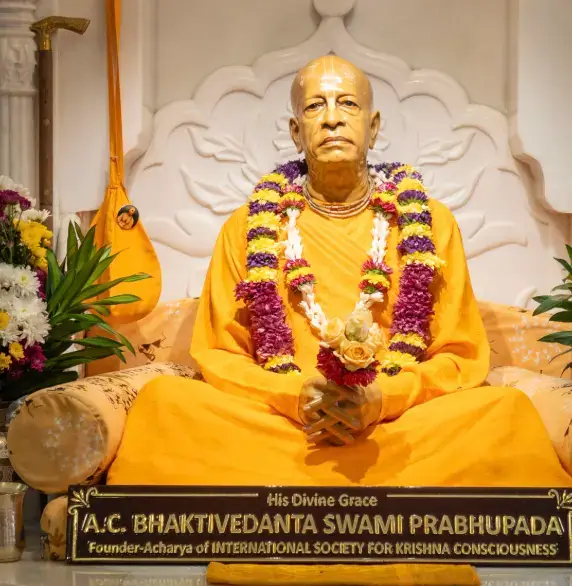
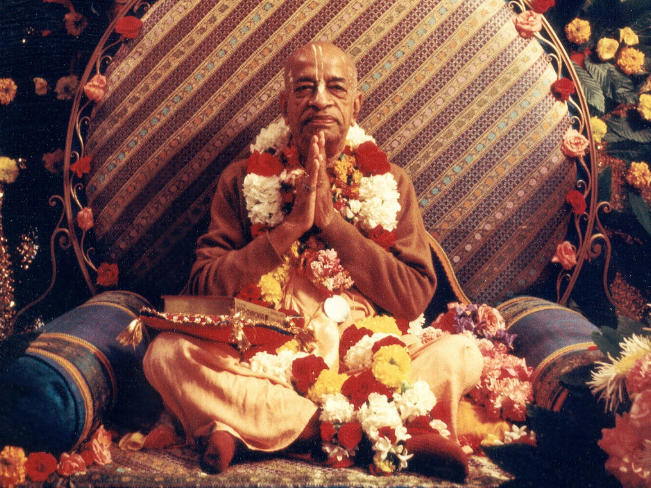
Gratitude to His Divine Grace A.C. Bhaktivedanta Swami Srila Prabhupada
We offer our humble obeisances at the lotus feet of our founder-acharya, His Divine Grace A.C. Bhaktivedanta Swami Srila Prabhupada, without whose causeless mercy the priceless prayers, bhajans and sacred literature of the Gaudiya Vaishnava tradition would have remained inaccessible to most of the world. By his herculean preaching efforts, his unparalleled translations and his founding of the International Society for Krishna Consciousness (ISKCON), the holy names, pastimes and instructions of Sri Sri Radha-Krishna and Sri Chaitanya Mahaprabhu are today chanted in every town and village.
nama om vishnu-padaya krishna-preshthaya bhu-tale
srimate bhaktivedanta-svamin iti namine
namas te sarasvate deve gaura-vani-pracharine
nirvishesha-shunyavadi-pashchatya-desha-tarine
All glories to Srila Prabhupada. All glories to the Vaishnava acharyas in the disciplic succession.