
Vrat Katha — The Story of Pavitropana Ekadashi
Source: Bhavishya-uttara Purana — narrated by Lord Sri Krishna to Maharaja Yudhishthira
Maharaja Yudhishthira once asked Lord Sri Krishna about the Ekadashi of the bright fortnight of Shravana. The Lord said: "O king, this day is famous as Pavitropana Ekadashi — also called Putrada — and its glories were first revealed by sage Lomasha to King Mahijita in ancient times. Let Me narrate that history."
In the kingdom of Mahishmati there ruled a noble and righteous king named Mahijita. He was just, charitable, devoted to dharma, and beloved of his subjects. Yet one great sorrow tormented him: although he ruled a vast kingdom and possessed every form of wealth, he had no son to continue his lineage. The thought that all his pious works would have no heir gave him no rest. He summoned the most learned brahmanas of his kingdom and pleaded with them to discover the cause of his childlessness.
The brahmanas reflected deeply but could find no answer in their own learning. They went together to the ashrama of the great sage Lomasha Rishi — a knower of past, present and future. They explained the king's grief and begged the sage to look into his previous birth. By his yogic vision Lomasha at once saw the cause. "In a previous life," he said, "this king was a poor vaishya who, in his thirst, drove away a thirsty cow with her calf from a public water-trough on a Dvadashi day. The cow was forced to suffer thirst, and that single act of cruelty has carried over into this life as the absence of a son."
The brahmanas returned and gently informed the king. Mahijita asked tearfully: "Is there any expiation by which I can be released?" Lomasha had already foreseen this and sent word: "Let the king and queen observe the Pavitropana Ekadashi, the bright Ekadashi of Shravana. Let them fast with full faith, worship Lord Vishnu with all opulence, and offer the merit of the vrata for the welfare of their lineage. They will most certainly be blessed with a noble son."
Mahijita gathered his queen, ministers, brahmanas and entire family. On the auspicious Pavitropana Ekadashi the whole kingdom observed the fast together with one heart. They worshipped Lord Vishnu, offered Him a sacred pavitra thread woven of pure white cotton, kept jagaran the night in kirtan, and on Dvadashi performed elaborate charity to brahmanas. The merit was offered for the king's lineage. Soon thereafter the queen conceived, and in due course gave birth to a magnificent son who grew into a virtuous and powerful prince, the joy of his parents and the protector of dharma in the kingdom.
Concluding, Lord Krishna told Yudhishthira: "This Ekadashi is named Pavitropana because the devotee offers a sacred pavitra thread at the lotus feet of Lord Vishnu and prays for purification of all the lapses in his devotional service throughout the year. It is also named Putrada because it grants noble sons to childless devotees. Beyond these specific results, Pavitropana Ekadashi nullifies sins of countless lifetimes, especially those committed against animals and the helpless, and prepares the devotee for the second month of Chaturmasya — when curd is to be given up."
Spiritual Significance
Pavitropana Ekadashi is unique in that the devotee weaves or obtains a pavitra — a sacred thread or garland — and ceremonially offers it at the lotus feet of Lord Vishnu, praying that any neglect, offence or omission in devotional service during the year be forgiven. It is also one of the two Putrada Ekadashis of the year (the other being Pausha Putrada) — both especially recommended for couples praying for noble progeny.
Benefits of Observing Pavitropana Ekadashi
- ✦Purifies the devotee of all lapses, omissions and offences in devotional service.
- ✦Bestows noble, dharma-following children upon childless couples.
- ✦Removes the karmic reactions of cruelty toward animals and the helpless (as in King Mahijita's story).
- ✦Pleases Lord Vishnu through the offering of the sacred pavitra.
- ✦Inaugurates the second month of Chaturmasya — the giving up of curd.
How to Observe
- Rise early, bathe, take sankalpa to fast for Lord Vishnu and for the welfare of one's family.
- Abstain from all grains and pulses for the full tithi.
- Weave or obtain a pavitra (a thread or garland of pure white cotton or silk) and ceremonially offer it at the lotus feet of Lord Vishnu.
- Pray for forgiveness of all lapses in one's devotional service throughout the year.
- Read the Srimad-Bhagavatam (especially canto 10 — the birth of Krishna).
- Stay awake the night in kirtan and jagaran.
- Break the fast on Dvadashi morning within the Parana window.
What to Avoid
- Grains and pulses.
- Cruelty or harshness toward any living being, especially animals and children.
- Onion, garlic, mushrooms and tamasic foods.
- From this day, give up curd for one month (second month of Chaturmasya).
- Sleeping during the day, gossip and offences to Vaishnavas.
Recommended Bhajans & Prayers
Frequently Asked Questions — Pavitropana Ekadashi
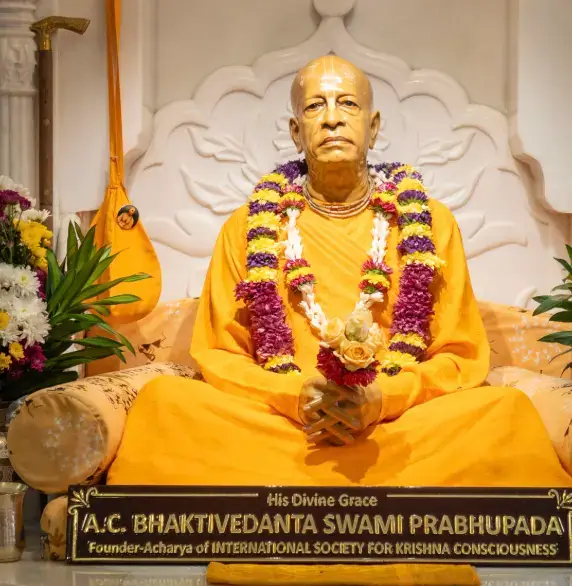
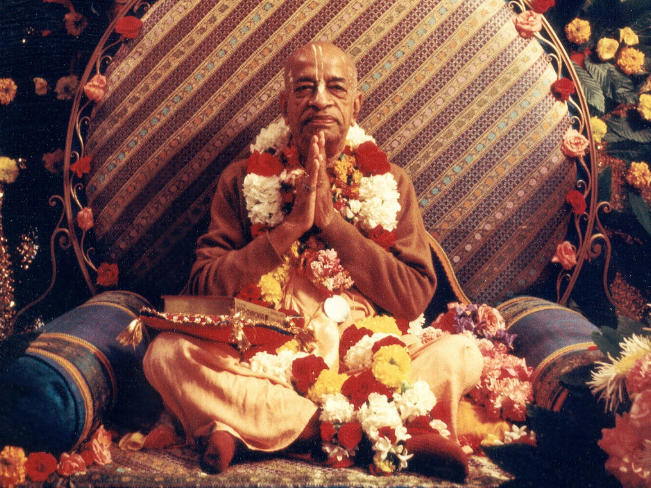
Gratitude to His Divine Grace A.C. Bhaktivedanta Swami Srila Prabhupada
We offer our humble obeisances at the lotus feet of our founder-acharya, His Divine Grace A.C. Bhaktivedanta Swami Srila Prabhupada, without whose causeless mercy the priceless prayers, bhajans and sacred literature of the Gaudiya Vaishnava tradition would have remained inaccessible to most of the world. By his herculean preaching efforts, his unparalleled translations and his founding of the International Society for Krishna Consciousness (ISKCON), the holy names, pastimes and instructions of Sri Sri Radha-Krishna and Sri Chaitanya Mahaprabhu are today chanted in every town and village.
nama om vishnu-padaya krishna-preshthaya bhu-tale
srimate bhaktivedanta-svamin iti namine
namas te sarasvate deve gaura-vani-pracharine
nirvishesha-shunyavadi-pashchatya-desha-tarine
All glories to Srila Prabhupada. All glories to the Vaishnava acharyas in the disciplic succession.