Also available in:
Sri Sri Gurvastakam
Morning prayer to the spiritual master (also known as Mangal Aarti) — Glories of the Spiritual Master by Srila Vishvanatha Chakravarti Thakura
Sanskrit Verses
Verse 1
saḿsāra-dāvānala-līḍha-loka- trāṇāya kāruṇya-ghanāghanatvam prāptasya kalyāṇa-guṇārṇavasya vande guroḥ śrī-caraṇāravindam
Verse 2
mahāprabhoḥ kīrtana-nṛtya-gīta- vāditra-mādyan-manaso rasena romāñca -kampāśru-tarańga-bhājo vande guroḥ śrī-caraṇāravindam
Verse 3
śrī-vigrahārādhana-nitya-nānā- śṛńgāra-tan-mandira-mārjanādau yuktasya bhaktāḿś ca niyuñjato 'pi vande guroḥ śrī-caraṇāravindam
Verse 4
catur-vidha-śrī-bhagavat-prasāda- svādv-anna-tṛptān hari-bhakta-sańghān kṛtvaiva tṛptiḿ bhajataḥ sadaiva vande guroḥ śrī-caraṇāravindam
Verse 5
śrī-rādhikā-mādhavayor apāra- mādhurya-līlā guṇa-rūpa-nāmnām prati-kṣaṇāsvādana-lolupasya vande guroḥ śrī-caraṇāravindam
Verse 6
nikuñja-yūno rati-keli-siddhyai yā yālibhir yuktir apekṣaṇīyā tatrāti-dākṣyād ati-vallabhasya vande guroḥ śrī-caraṇāravindam
Verse 7
sākṣād-dharitvena samasta-śāstrair uktas tathā bhāvyata eva sadbhiḥ kintu prabhor yaḥ priya eva tasya vande guroḥ śrī-caraṇāravindam
Verse 8
yasya prasādād bhagavat-prasādo yasyāprasādān na gatiḥ kuto 'pi dhyāyan stuvaḿs tasya yaśas tri-sandhyaḿ vande guroḥ śrī-caraṇāravindam
Translation
1) The spiritual master is receiving benediction from the ocean of mercy. Just as a cloud pours water on a forest fire to extinguish it, so the spiritual master delivers the materially afflicted world by extinguishing the blazing fire of material existence. I offer my respectful obeisances unto the lotus feet of such a spiritual master, who is an ocean of auspicious qualities.
2) Chanting the holy name, dancing in ecstasy, singing, and playing musical instruments, the spiritual master is always gladdened by the sańkīrtana movement of Lord Caitanya Mahāprabhu. Because he is relishing the mellows of pure devotion within his mind, sometimes his hair stands on end, he feels quivering in his body, and tears flow from his eyes like waves. I offer my respectful obeisances unto the lotus feet of such a spiritual master.
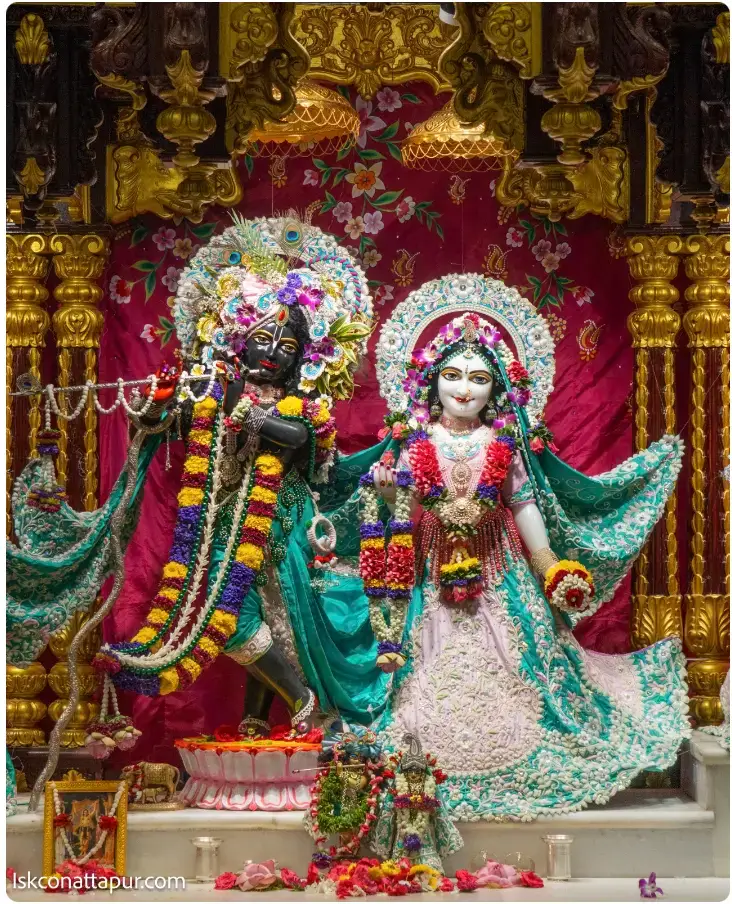
3) The spiritual master is always engaged in the temple worship of Srī Srī Rādhā and Kṛṣṇa. He also engages his disciples in such worship. They dress the Deities in beautiful clothes and ornaments, clean Their temple, and perform other similar worship of the Lord. I offer my respectful obeisances unto the lotus feet of such a spiritual master.
4) The spiritual master is always offering Kṛṣṇa four kinds of delicious food [analyzed as that which is licked, chewed, drunk, and sucked]. When the spiritual master sees that the devotees are satisfied by eating bhagavat-prasāda, he is satisfied. I offer my respectful obeisances unto the lotus feet of such a spiritual master.
5) The spiritual master is always eager to hear and chant about the unlimited conjugal pastimes of Rādhikā and Mādhava, and Their qualities, names, and forms. The spiritual master aspires to relish these at every moment. I offer my respectful obeisances unto the lotus feet of such a spiritual master.
6) The spiritual master is very dear, because he is expert in assisting the gopīs, who at different times make different tasteful arrangements for the perfection of Rādhā and Kṛṣṇa's conjugal loving affairs within the groves of Vṛndāvana. I offer my most humble obeisances unto the lotus feet of such a spiritual master.
7) The spiritual master is to be honored as much as the Supreme Lord, because he is the most confidential servitor of the Lord. This is acknowledged in all revealed scriptures and followed by all authorities. Therefore I offer my respectful obeisances unto the lotus feet of such a spiritual master, who is a bona fide representative of Srī Hari [Kṛṣṇa].
8) By the mercy of the spiritual master one receives the benediction of Kṛṣṇa. Without the grace of the spiritual master, one cannot make any advancement. Therefore, I should always remember and praise the spiritual master. At least three times a day I should offer my respectful obeisances unto the lotus feet of my spiritual master.
Spiritual Significance
Sri Sri Gurvastakam is the supreme expression of guru-bhakti (devotion to the spiritual master) in the Gaudiya Vaishnava tradition. Its eight verses paint a complete portrait of the ideal spiritual master: one who extinguishes the blazing fire of material existence for suffering souls, who dances in ecstasy at Lord Chaitanya's sankirtana movement, who worships the Deities of Radha and Krishna with care and beauty, and who is always meditating on the sweet conjugal pastimes of the divine couple in Vrindavan. The eighth and final verse crystallizes the entire philosophy: yasya prasadad bhagavat-prasado / yasyaprasadan na gatih kuto 'pi — "By the mercy of the spiritual master, one receives Krishna's mercy; without the spiritual master's grace, there is no path forward at all." This is not merely devotional poetry but a theological statement at the heart of ISKCON practice.
Scriptural Source & Tradition
The hymn draws on the Gaudiya Vaishnava understanding of the guru developed through the Six Goswamis of Vrindavan — particularly Srila Rupa Goswami's Bhakti-rasamrita-sindhu and Srila Krishnadasa Kaviraja Goswami's Chaitanya Charitamrita. The principle that the guru must be honored "as much as the Supreme Lord" (verse 7: sakshad-dharitvena samasta-shastrair uktas tatha bhavyata eva sadbhih) is confirmed throughout Vedic literature. Srila Prabhupada, who brought this tradition to the West through ISKCON, emphasized that Sri Sri Gurvastakam describes not a human being but the transcendental position of the pure devotee who has surrendered completely to Krishna.
Commentary from the Acharyas
Srila Prabhupada taught that the seventh verse of Sri Sri Gurvastakam contains the most precise scriptural statement on the guru's position: saksad-dharitvena — "as directly being Hari (Krishna)." He explained that this does not mean the guru IS God in an absolute sense, but that the guru is so dear to Krishna, so surrendered to His service, that approaching the guru is functionally equivalent to approaching Krishna Himself. This teaching is what makes the daily Mangal Aarti more than a ritual — it is a reorientation of the devotee's entire consciousness toward the guru-parampara (disciplic succession) through which Krishna's mercy flows.
The sixth verse — on the guru's expertise in assisting the gopis in Radha and Krishna's forest pastimes — is particularly elevated in Gaudiya theology. It reveals that the ideal guru is not merely a teacher of philosophy but a confidential associate of the divine couple, whose internal life is entirely absorbed in their service. In ISKCON, this verse is understood as describing the most advanced stage ofraganuga-bhakti (spontaneous devotion following in the mood of the Vraja associates).
When to Sing / Chant
- Every morning during Mangal Aarti — the pre-dawn prayer at 4:30 AM in all ISKCON temples
- On Vyasa Puja — the spiritual master's appearance day celebration
- During guru-disciple initiation ceremonies in ISKCON
- On Gaura Purnima (Lord Chaitanya's appearance day) and Vaishnava festivals
- In ISKCON IVCC kirtans and morning program assemblies
- As a personal sadhana bhajan for meditating on the guru-disciple relationship
Benefits for the Devotee
- Establishes the guru-disciple relationship as the foundation of one's devotional practice
- Daily singing at Mangal Aarti calibrates the mind toward surrender before the day begins
- Deepens understanding of why the spiritual master is essential in ISKCON bhakti-yoga
- The refrain vande guroh sri-charanaravindam becomes a natural prayer of gratitude
- Connects the practitioner to the entire Gaudiya Vaishnava disciplic succession (parampara)
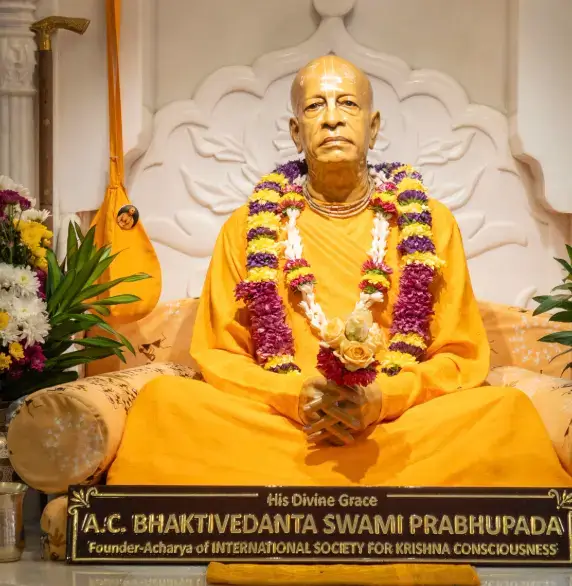
Gratitude to His Divine Grace A.C. Bhaktivedanta Swami Srila Prabhupada
We offer our humble obeisances at the lotus feet of our founder-acharya, His Divine Grace A.C. Bhaktivedanta Swami Srila Prabhupada, without whose causeless mercy the priceless prayers, bhajans and sacred literature of the Gaudiya Vaishnava tradition would have remained inaccessible to most of the world. By his herculean preaching efforts, his unparalleled translations and his founding of the International Society for Krishna Consciousness (ISKCON), the holy names, pastimes and instructions of Sri Sri Radha-Krishna and Sri Chaitanya Mahaprabhu are today chanted in every town and village.
nama om vishnu-padaya krishna-preshthaya bhu-tale
srimate bhaktivedanta-svamin iti namine
namas te sarasvate deve gaura-vani-pracharine
nirvishesha-shunyavadi-pashchatya-desha-tarine
All glories to Srila Prabhupada. All glories to the Vaishnava acharyas in the disciplic succession.
Spiritual Significance
Scriptural Source & Tradition
Commentary from the Acharyas
When to Sing / Chant
Benefits for the Devotee
Gratitude to His Divine Grace A.C. Bhaktivedanta Swami Srila Prabhupada
We offer our humble obeisances at the lotus feet of our founder-acharya, His Divine Grace A.C. Bhaktivedanta Swami Srila Prabhupada, without whose causeless mercy the priceless prayers, bhajans and sacred literature of the Gaudiya Vaishnava tradition would have remained inaccessible to most of the world. By his herculean preaching efforts, his unparalleled translations and his founding of the International Society for Krishna Consciousness (ISKCON), the holy names, pastimes and instructions of Sri Sri Radha-Krishna and Sri Chaitanya Mahaprabhu are today chanted in every town and village.
nama om vishnu-padaya krishna-preshthaya bhu-tale
srimate bhaktivedanta-svamin iti namine
namas te sarasvate deve gaura-vani-pracharine
nirvishesha-shunyavadi-pashchatya-desha-tarine
All glories to Srila Prabhupada. All glories to the Vaishnava acharyas in the disciplic succession.