Damodarastakam
Damodarastakam by Vyasadeva from Padma Purana - Eight prayers glorifying Lord Damodara
Sanskrit Verses
Verse 1
namāmīśvaraṁ sac-cid-ānanda-rūpaṁ lasat-kuṇḍalaṁ gokule bhrājamanam yaśodā-bhiyolūkhalād dhāvamānaṁ parāmṛṣṭam atyantato drutya gopyā
Verse 2
rudantaṁ muhur netra-yugmaṁ mṛjantam karāmbhoja-yugmena sātaṅka-netram muhuḥ śvāsa-kampa-trirekhāṅka-kaṇṭha- sthita-graivaṁ dāmodaraṁ bhakti-baddham
Verse 3
itīdṛk sva-līlābhir ānanda-kuṇḍe sva-ghoṣaṁ nimajjantam ākhyāpayantam tadīyeṣita-jñeṣu bhaktair jitatvaṁ punaḥ prematas taṁ śatāvṛtti vande
Verse 4
varaṁ deva mokṣaṁ na mokṣāvadhiṁ vā na canyaṁ vṛṇe 'haṁ vareṣād apīha idaṁ te vapur nātha gopāla-bālaṁ sadā me manasy āvirāstāṁ kim anyaiḥ
Verse 5
idaṁ te mukhāmbhojam atyanta-nīlair vṛtaṁ kuntalaiḥ snigdha-raktaiś ca gopyā muhuś cumbitaṁ bimba-raktādharaṁ me manasy āvirāstām alaṁ lakṣa-lābhaiḥ
Verse 6
namo deva dāmodarānanta viṣṇo prasīda prabho duḥkha-jālābdhi-magnam kṛpā-dṛṣṭi-vṛṣṭyāti-dīnaṁ batānu gṛhāṇeṣa mām ajñam edhy akṣi-dṛśyaḥ
Verse 7
kuverātmajau baddha-mūrtyaiva yadvat tvayā mocitau bhakti-bhājau kṛtau ca tathā prema-bhaktiṁ svakāṁ me prayaccha na mokṣe graho me 'sti dāmodareha
Verse 8
namas te 'stu dāmne sphurad-dīpti-dhāmne tvadīyodarāyātha viśvasya dhāmne namo rādhikāyai tvadīya-priyāyai namo 'nanta-līlāya devāya tubhyam
Translation
1) To the Supreme Lord, whose form is the embodiment of eternal existence, knowledge, and bliss, whose shark-shaped earrings are swinging to and fro, who is beautifully shining in the divine realm of Gokula, who I (due to the offense of breaking the pot of yogurt that His mother was churning into butter and then stealing the butter that was kept hanging from a swing) is quickly running from the wooden grinding mortar in fear of mother Yasoda, but who has been caught from behind by her who ran after Him with greater speed--to that Supreme Lord, Sri Damodara, I offer my humble obeisances.
2) (Seeing the whipping stick in His mother's hand) He is crying and rubbing His eyes again and again with His two lotus hands. His eyes are filled with fear, and the necklace of pearls around His neck, which is marked with three lines like a conch shell, is shaking because of His quick breathing due to crying. To this Supreme Lord, Sri Damodara, whose belly is bound not with ropes but with His mother's pure love, I offer my humble obeisances.
3) By such childhood pastimes as this He is drowning the inhabitants of Gokula in pools of ecstasy, and is revealing to those devotees who are absorbed in knowledge of His supreme majesty and opulence that He is only conquered by devotees whose pure love is imbues with intimacy and is free from all conceptions of awe and reverence. With great love I again offer my obeisances to Lord Damodara hundreds and hundreds of times.
4) O Lord, although You are able to give all kinds of benedictions, I do not pray to You for the boon of impersonal liberation, nor the highest liberation of eternal life in Vaikuntha, nor any other boon (which may be obtained by executing the nine processes of bhakti). O Lord, I simply wish that this form of Yours as Bala Gopala in Vrndavana may ever be manifest in my heart, for what is the use to me of any other boon besides this?
5) O Lord, Your lotus face, which is encircled by locks of soft black hair tinged with red, is kissed again and again by mother Yasoda, and Your lips are reddish like the bimba fruit. May this beautiful vision of Your lotus face be ever manifest in my heart. Thousands and thousands of other benedictions are of no use to me.
6) O Supreme Godhead, I offer my obeisances unto You. O Damodara! O Ananta! O Vishnu! O master! O my Lord, be pleased upon me. By showering Your glance of mercy upon me, deliver this poor ignorant fool who is immersed in an ocean of worldly sorrows, and become visible to my eyes.
7) O Lord Damodara, just as the two sons of Kuvera, Manigriva and Nalakuvara, were delivered from the curse of Narada and made into great devotees by You in Your form as a baby tied with rope to a wooden grinding mortar, in the same way, please give to me Your own prema-bhakti. I only long for this and have no desire for any kind of liberation.
8) O Lord Damodara, I first of all offer my obeisances to the brilliantly effulgent rope which binds Your belly. I then offer my obeisances to Your belly, which is the abode of the entire universe. I humbly bow down to Your most beloved Srimati Radharani, and I offer all obeisances to You, the Supreme Lord, who displays unlimited pastimes.
Spiritual Significance
Damodarastakam is the most beloved prayer of the entire month of Kartik (Damodar Maas). Composed by the sage Satyavrata Muni during a conversation with Narada Muni and Saunaka Rishi, it glorifies the pastime in which mother Yashoda bound little Krishna with a rope around His belly — a unique pastime that reveals how the Supreme Lord, who cannot be bound by the greatest yogis, allows Himself to be conquered by the simple love of His devotee.
Scriptural Source & Tradition
The eight verses appear in the Padma Purana, within the conversation between Satyavrata Muni and Narada Muni describing the supreme glories of the month of Kartik (Urja-vrata). Srila Sanatana Goswami quotes and elaborates the prayer in his Brihad-Bhagavatamrta, and Srila Prabhupada established the daily evening recitation of Damodarastakam in every ISKCON temple worldwide during Kartik.
Commentary from the Acharyas
Srila Prabhupada explains that this prayer captures the highest principle of bhakti: "Krishna is bound by love, not by ropes." Mother Yashoda's two-finger-short rope miraculously kept growing because the unlimited Lord cannot be measured — yet He chose to be bound the moment He saw her exhaustion, simply to reward her love.
In verse four, the devotee explicitly rejects all forms of liberation (sayujya, salokya, etc.) and prays only for the vision of Krishna's childhood Bala-Gopala form in the heart. Srila Sanatana Goswami calls this the very essence of pure devotion — desiring nothing for oneself, only the Lord's eternal association.
Srila Bhaktisiddhanta Sarasvati Thakura emphasised that singing Damodarastakam in Kartik with attention awards more spiritual benefit than thousands of years of austere practice in any other month.
When to Sing / Chant
- Every evening of the month of Kartik (October–November) while offering a ghee lamp to Lord Damodara
- During Damodar Maas / Urja-vrata observance, ideally after sunset
- Before Tulsi Devi while offering a wick lamp
- On Govardhana Puja and the appearance day of Srila Prabhupada (which falls in Kartik)
- Any time one wishes to invoke the intimate, parental mood of devotion (vatsalya-rasa)
Benefits for the Devotee
- Awakens the sweet parental love (vatsalya-bhava) for Sri Krishna
- Considered to grant the rare gift of pure devotional service (prema-bhakti)
- Frees the heart of subtle desires for liberation, opulence and material gain
- Brings the special mercy of Kartik vrata multiplied many times over
- Helps devotees develop deep attraction to Krishna's intimate childhood pastimes in Vrindavan
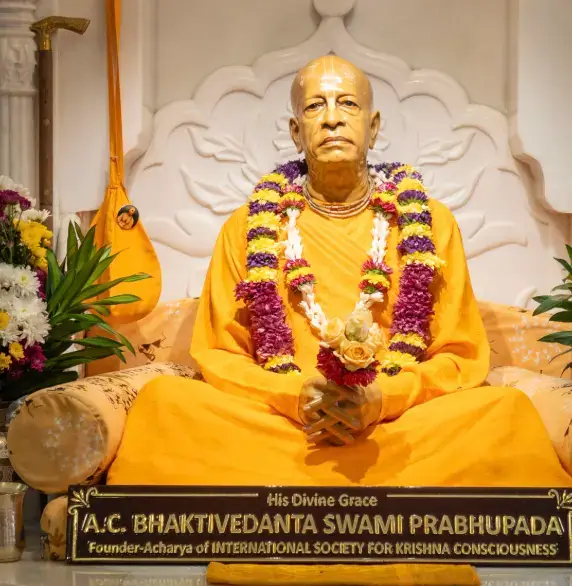
Gratitude to His Divine Grace A.C. Bhaktivedanta Swami Srila Prabhupada
We offer our humble obeisances at the lotus feet of our founder-acharya, His Divine Grace A.C. Bhaktivedanta Swami Srila Prabhupada, without whose causeless mercy the priceless prayers, bhajans and sacred literature of the Gaudiya Vaishnava tradition would have remained inaccessible to most of the world. By his herculean preaching efforts, his unparalleled translations and his founding of the International Society for Krishna Consciousness (ISKCON), the holy names, pastimes and instructions of Sri Sri Radha-Krishna and Sri Chaitanya Mahaprabhu are today chanted in every town and village.
nama om vishnu-padaya krishna-preshthaya bhu-tale
srimate bhaktivedanta-svamin iti namine
namas te sarasvate deve gaura-vani-pracharine
nirvishesha-shunyavadi-pashchatya-desha-tarine
All glories to Srila Prabhupada. All glories to the Vaishnava acharyas in the disciplic succession.