
Vrat Katha — The Story of Indira Ekadashi
Source: Brahma-vaivarta Purana — narrated by Lord Sri Krishna to Maharaja Yudhishthira
Maharaja Yudhishthira once asked Lord Sri Krishna: "O Madhusudana, what is the name of the Ekadashi that occurs in the dark fortnight of Ashwin, and what is its glory?" Lord Krishna replied: "This day is famous as Indira Ekadashi. It is most dear to Me, for by it a devotee can liberate his ancestors from hellish conditions. Hear the story of King Indrasena."
In the city of Mahishmati there ruled a most pious king named Indrasena. He was just, devoted to Lord Vishnu, learned in dharma and beloved of his subjects. One day the great sage Narada Muni descended into his court from the heavenly regions. Indrasena received the sage with full honour, washed his feet and inquired about his welfare. Narada Muni gently said: "O king, I have come from Pitr-loka, and there I met your father. He sends you a message: although in this life he was generally pious, he committed a single grave error at the end of life — he ate without first feeding a guest who had arrived on an Ekadashi — and for that reason he has fallen from Pitr-loka into a lower region. He is suffering greatly. He requests that you observe Indira Ekadashi in his name, for by its merit he will be lifted up to Vaikuntha."
The king was stricken with grief but at the same time deeply relieved that a remedy existed. He humbly asked the sage how Indira Ekadashi should be observed. Narada Muni instructed him: "On Dashami, eat only one simple meal, sleep upon the bare ground, and remain celibate. On Ekadashi morning, bathe and take sankalpa to fast for the deliverance of your father. Spend the day in chanting and worship of Lord Sri Hari. Feed brahmanas and Vaishnavas, give them charity, and offer the full merit of your fast at the feet of Lord Vishnu in the name of your father. Stay awake the night in kirtan. On Dvadashi, after feeding brahmanas, break your fast within the proper window. Your father will at once be delivered."
King Indrasena faithfully followed every instruction. As soon as the vrata was complete, dazzling celestial messengers descended from the sky and announced that his father had been lifted from his lower condition and was being carried in a divine vimana to the abode of Lord Vishnu. Showers of flowers fell upon Indrasena. The king continued to rule for many years in righteousness, and at the end of his own life he too returned to Vaikuntha, accompanied by his entire family.
Concluding the katha, Lord Krishna told Yudhishthira: "O king, Indira Ekadashi is unique. It falls during Pitri-paksha — the fortnight sacred to the forefathers — and its merit, when offered to one's departed family members, directly liberates them. Even those who have committed grave sins and fallen into lower regions can be lifted to Vaikuntha by a single sincere observance of Indira Ekadashi performed by a living descendant. Therefore every devotee should observe it not only for his own welfare but for the welfare of all his ancestors."
Spiritual Significance
Indira Ekadashi falls within Pitri-paksha — the dark fortnight of Ashwin sacred to the forefathers. Of the many rituals (sraddha, tarpana, pinda-dana) prescribed for ancestors during this fortnight, the most powerful by far is the offering of the merit of Indira Ekadashi. Together with Mokshada Ekadashi, it is one of the only two Ekadashis whose merit can be ritually transferred to a departed soul.
Benefits of Observing Indira Ekadashi
- ✦Directly lifts departed ancestors from lower regions to Vaikuntha.
- ✦Pleases one's forefathers — bringing their blessings upon the devotee and his descendants.
- ✦Removes the karmic reactions of one's own family of seven generations on both sides.
- ✦Hearing the katha alone bestows the merit of performing a complete Ekadashi vrata.
- ✦Especially recommended for those whose parents or grandparents have departed.
How to Observe
- On Dashami: eat one simple meal only, sleep upon the bare ground, observe celibacy.
- On Ekadashi: rise early, bathe, take sankalpa to fast in the name of one's departed ancestors.
- Abstain from all grains and pulses.
- Worship Lord Vishnu, feed brahmanas/Vaishnavas, give charity in the name of one's father and forefathers.
- Stay awake the night in kirtan.
- Break the fast on Dvadashi morning, after first feeding brahmanas, within the Parana window.
- Offer the full merit of the vrata at Lord Vishnu's lotus feet in the name of one's ancestors.
What to Avoid
- Grains and pulses.
- Quarrels, anger, gossip and any disrespect toward elders or departed family members.
- Onion, garlic, mushrooms and tamasic foods.
- Sleeping during the day.
- Breaking the fast outside the Parana window.
Recommended Bhajans & Prayers
Frequently Asked Questions — Indira Ekadashi
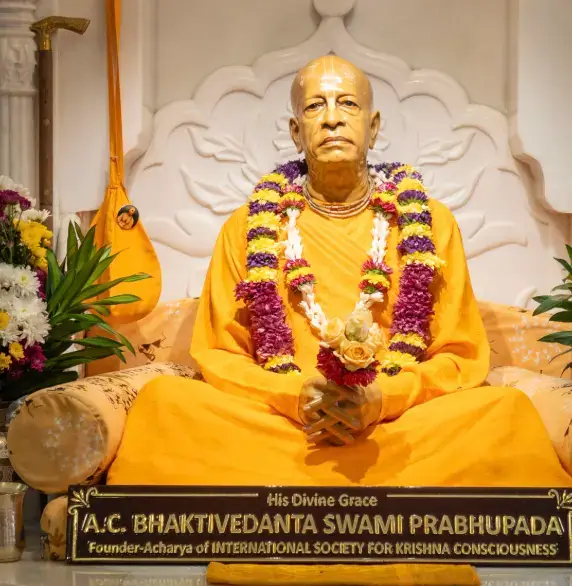
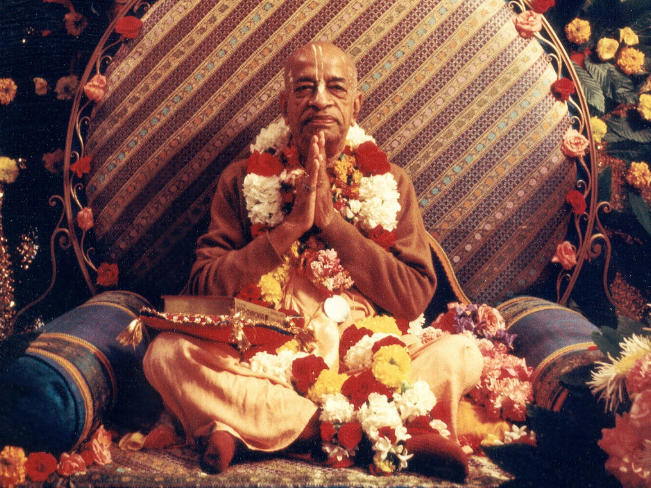
Gratitude to His Divine Grace A.C. Bhaktivedanta Swami Srila Prabhupada
We offer our humble obeisances at the lotus feet of our founder-acharya, His Divine Grace A.C. Bhaktivedanta Swami Srila Prabhupada, without whose causeless mercy the priceless prayers, bhajans and sacred literature of the Gaudiya Vaishnava tradition would have remained inaccessible to most of the world. By his herculean preaching efforts, his unparalleled translations and his founding of the International Society for Krishna Consciousness (ISKCON), the holy names, pastimes and instructions of Sri Sri Radha-Krishna and Sri Chaitanya Mahaprabhu are today chanted in every town and village.
nama om vishnu-padaya krishna-preshthaya bhu-tale
srimate bhaktivedanta-svamin iti namine
namas te sarasvate deve gaura-vani-pracharine
nirvishesha-shunyavadi-pashchatya-desha-tarine
All glories to Srila Prabhupada. All glories to the Vaishnava acharyas in the disciplic succession.