
What is Ekadashi fasting?
Ekadashi falls twice every lunar month, on the eleventh day of the waxing (Shukla) and waning (Krishna) phases of the moon. It is the most important fasting day in the Vaishnava tradition. Fasting on Ekadashi is described in the Padma Purana and other scriptures as the prescribed spiritual practice that purifies the heart and pleases Lord Vishnu.
The essential rule is simple to state: on Ekadashi one avoids all grains, beans and lentils. Beyond that, the food a devotee takes should be simple, sattvic and offered to Krishna first. Some devotees keep a strict nirjala (waterless) fast, some take only fruits and milk, and others cook a full plate of grain-free preparations. The right level depends on your health, your practice and the guidance of senior devotees — but the grain-free principle is common to all.
Foods you CAN eat on Ekadashi
All fruits
Fresh and dried fruits are pure and sattvic — the simplest Ekadashi food.
Milk, yogurt, paneer, ghee
Dairy is permitted and nourishing; ghee is used for cooking instead of grain-based oils.
Makhana (fox nuts)
Roasted in ghee as a snack or cooked into kheer — a favourite Ekadashi food.
Nuts and dry fruits
Peanuts, almonds, cashews and coconut give energy and protein during the fast.
Sabudana (tapioca pearls)
Not a grain — a starch that makes khichdi, kheer and vada for the vrat.
Kuttu (buckwheat) flour
A seed flour, not a cereal grain — used for puris and parathas on Ekadashi.
Rajgira (amaranth) flour
An amaranth seed flour permitted on the fast for rotis and sheera.
Singhara (water chestnut) flour
A non-grain flour used for puris and pakoras during vrat.
Sama rice (barnyard millet)
Botanically a seed/grass, accepted as a rice substitute for khichdi.
Potatoes, sweet potato and most vegetables
Root and gourd vegetables are allowed; only onion and garlic are excluded.
Sendha namak (rock salt)
Rock salt replaces ordinary iodised table salt on fasting days.
Foods you CANNOT eat on Ekadashi
All grains — rice, wheat, oats, corn, barley
According to the Padma Purana, sin takes shelter in grains on the Ekadashi tithi, so all cereals are avoided.
All dals, beans and lentils
Pulses are treated together with grains and are set aside for the day.
Bread, pasta, noodles, semolina
These are grain-flour products and fall under the grain restriction.
Onion and garlic
These are rajasic/tamasic and are avoided year-round by devotees, and especially on Ekadashi.
Ordinary iodised table salt
Regular salt is replaced with sendha namak (rock salt) during the fast.
Meat, fish and eggs
Non-vegetarian foods are never part of a Vaishnava diet, and certainly not on Ekadashi.
The sattvic principle — why these rules exist
Ekadashi is not about deprivation for its own sake. The purpose is to reduce the demands of the body so the mind is free for extra chanting of the Hare Krishna maha-mantra, hearing from Srimad Bhagavatam, and remembrance of Krishna. Light, grain-free, sattvic food keeps the body calm and the consciousness clear.
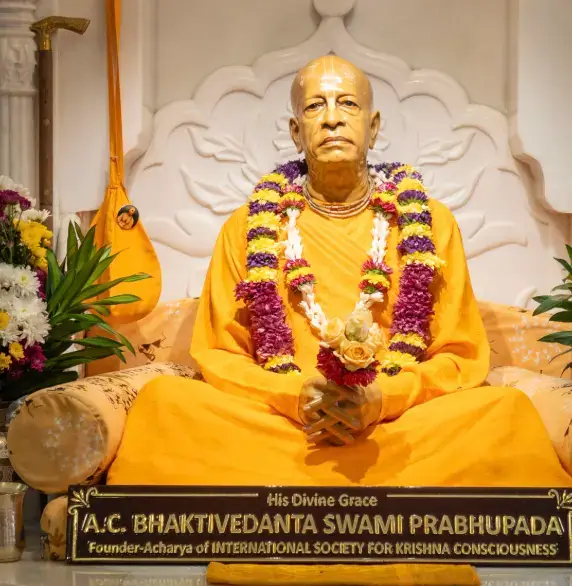
The grain-free rule and the avoidance of onion and garlic follow the Ekadashi fasting standards observed by ISKCON devotees, rooted in the Padma Purana and the teachings of Srila Prabhupada. Foods are chosen for their purity (sattva), cooked in ghee, seasoned with cumin, black pepper, ginger, green chilli and rock salt, and — most importantly — offered to Krishna before being honoured as prasadam.
Whatever level of fasting you keep, the spirit is the same: simplicity, purity and remembrance of the Lord. If you are elderly, unwell, pregnant or very young, take fruits, milk and water as needed and focus on chanting rather than a strict fast.
12 Ekadashi vrat recipes
Every recipe below is grain-free, onion-free and garlic-free — cooked the way Hare Krishna devotees prepare Ekadashi prasadam. Tap any card for the full recipe.
Related pages
Frequently Asked Questions
Can I drink water on Ekadashi?
Yes, unless you are keeping the special nirjala (waterless) Ekadashi. On an ordinary Ekadashi, water, milk and fruit juices are allowed. Only the strict Nirjala Ekadashi requires abstaining from water.
Can I eat fruits on Ekadashi?
Yes. All fresh and dried fruits are permitted and are among the simplest and purest Ekadashi foods. Many devotees keep a phalahar fast of only fruits, milk and water.
Why is onion and garlic not allowed on Ekadashi?
Onion and garlic are considered rajasic and tamasic — they agitate the mind and body. Hare Krishna devotees avoid them all year round, and especially on Ekadashi when the goal is a calm, sattvic consciousness fixed on Krishna.
What salt should I use on Ekadashi?
Use sendha namak (rock salt) instead of ordinary iodised table salt. Rock salt is the traditional fasting-day salt used in all Ekadashi vrat cooking.
Can I eat sabudana on Ekadashi?
Yes. Sabudana (tapioca pearls) is not a grain, so it is allowed. Sabudana khichdi, kheer and vada are among the most popular Ekadashi preparations.
Is milk allowed on Ekadashi?
Yes. Milk and all dairy products — yogurt, paneer and ghee — are permitted and nourishing during the Ekadashi fast. Ghee is used for cooking in place of grain-based oils.