Rath Yatra 2026 — Story, Sacred Rituals and How to Celebrate the Festival of Chariots
Every year on the streets of Puri, Odisha, something extraordinary unfolds. Three towering wooden chariots — each standing over 44 feet tall — move slowly along the Grand Road, pulled by hundreds of thousands of chanting devotees. The air fills with the sound of conch shells, mridanga drums, and the thunderous cry of "Jai Jagannath!" In this single sacred moment, the Lord of the Universe steps out of His temple to shower mercy upon every soul, without exception.
This is Rath Yatra — the Festival of Chariots.
In 2026, Rath Yatra falls on Thursday, July 16, on the Dwitiya Tithi of Ashadha Shukla Paksha. The Return Festival — Bahuda Yatra — follows on Friday, July 24, 2026.
Key Facts at a Glance
- Date in 2026: Thursday, July 16, 2026 (Ashadha Shukla Dwitiya)
- Return (Bahuda) Yatra: Friday, July 24, 2026
- Location: Bada Danda (Grand Road), Puri, Odisha — and ISKCON centres worldwide
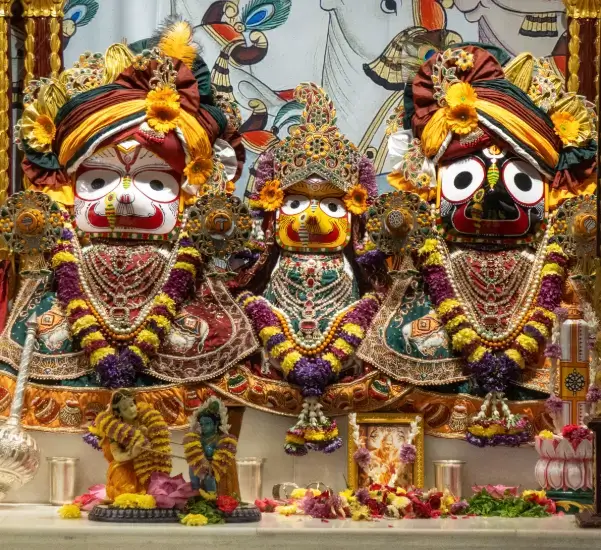
- Presiding Deities: Lord Jagannatha, Lord Baladeva, Devi Subhadra (with Sudarshana Chakra)
- The three chariots: Nandighosa (Jagannatha, ~45 ft, 16 wheels), Taladhwaja (Baladeva, ~44 ft, 14 wheels), Darpadalana (Subhadra, ~43 ft, 12 wheels)
- Scriptural sources: Skanda Purana, Brahma Purana, Padma Purana, Srimad Bhagavatam 10.82, Chaitanya Charitamrita Madhya 13
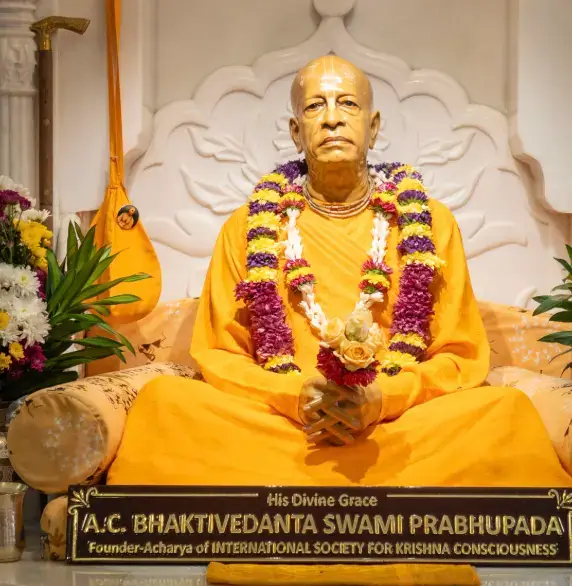
- Founder-acharya for global Rath Yatra: His Divine Grace A. C. Bhaktivedanta Swami Srila Prabhupada (first Western Rath Yatra, San Francisco, 1967)
Who Are the Deities of Rath Yatra?
Three divine siblings ride the chariots together every year:
Lord Jagannatha — the Lord of the Universe, understood in the Vaishnava tradition as Lord Krishna Himself in His most merciful, all-encompassing form. His distinctive form — large round eyes, a broad smile, dark complexion — carries profound spiritual significance. The large eyes represent His all-seeing, all-merciful vision that encompasses every soul in the universe. He is worshipped at the ancient Jagannatha Puri temple in Odisha, one of the four sacred Char Dhamas of India.
Lord Baladeva (Balabhadra) — the elder brother of Lord Jagannatha, understood as Lord Balarama. He is white-complexioned, representing the principle of spiritual strength and protection.
Devi Subhadra — the younger sister of the two Lords, representing divine compassion and the universal mother energy.
Together, these three are known as the Chaturdha Murti — the fourfold form — along with Sudarshana Chakra, which also participates in the procession.
The Story Behind Rath Yatra
The origins of Rath Yatra are recorded in the Skanda Purana, Brahma Purana, and Padma Purana. Several beautiful narratives explain this sacred festival.
The most beloved story in the Vaishnava tradition connects Rath Yatra to Lord Krishna's meeting with the residents of Vrindavana at Kurukshetra. Years after leaving Vrindavana for Mathura and then Dvaraka, Krishna had become a king — surrounded by opulence, queens, soldiers, and royal ceremony. When a solar eclipse brought millions of pilgrims to Kurukshetra, the residents of Vrindavana — the cowherd men, women, and gopis — immediately journeyed there to see their beloved Krishna after years of painful separation.
Srimati Radharani, upon seeing Krishna in His royal splendour, was overwhelmed with feelings of divine love and longing. In that moment, She pulled Krishna — not toward Dvaraka and its formality, but toward Vrindavana, toward the simple, intimate forest pastimes of their childhood. The Srimad Bhagavatam (10.82.48) captures this moment:
tāsām āvirabhūc chauriḥ smayamāna-mukhāmbujaḥ
pītāmbara-dharaḥ sragvī sākṣān manmatha-manmathaḥ"Lord Krishna appeared before them with a smiling lotus face, dressed in yellow garments and wearing a garland — He who enchants even Cupid."
The chariot of Rath Yatra symbolises this moment — Lord Jagannatha being pulled by the ropes of devotion from the formality of the temple into the streets, into the lives of ordinary people, toward the intimacy of pure love. Devotees who pull the chariot ropes are spiritually participating in this divine drama.
Another beloved narrative relates that Goddess Subhadra once expressed her heartfelt wish to visit her maternal home at the Gundicha Temple. In response, her brothers Lord Jagannatha and Lord Baladeva decided to accompany her in grand chariots — and this annual journey has continued ever since.
The Sacred Chariots — Nandighosa, Taladhwaja, and Darpadalana
The three chariots of Rath Yatra are among the most magnificent structures in the world of devotional art. Constructed entirely from sacred wood using no metal nails or fasteners, they are built fresh every single year by hereditary craftsmen following ancient architectural texts. The wood — primarily Dhausa, Phassi, and Dhumari varieties — is sourced from the Dasapalla forests of Odisha and brought to Puri months before the festival. Construction begins on the auspicious day of Akshaya Tritiya.
Nandighosa — Lord Jagannatha's Chariot
The largest and most celebrated of the three, Nandighosa (also called Garudadhwaja) stands approximately 45 feet tall and rolls on 16 enormous wheels. It is draped in red and yellow cloth, symbolising divine energy and spiritual radiance. The chariot carries a flag called Trailokya Mohini ("She who enchants the three worlds") atop its spire. Carvings of deities, horses, and scenes from Krishna Leela adorn its wooden structure. Thousands of devotees pull Nandighosa's ropes with the continuous chant of "Jai Jagannath!"
Taladhwaja — Lord Baladeva's Chariot
Meaning "one with a palm tree flag," Taladhwaja stands approximately 44 feet tall with 14 wheels. It is covered in red and blue cloth, symbolising Baladeva's strength and protective power. Its flag is called Unnani. Lord Baladeva's chariot departs second in the procession, following Lord Jagannatha.
Darpadalana — Devi Subhadra's Chariot
Also called Devadalana or Padmadhwaja, Darpadalana stands approximately 43 feet tall with 12 wheels. It is draped in black and red cloth, representing the goddess's grace and purity. Darpadalana travels between the chariots of her two brothers — always protected, always accompanied.
The Sacred Rituals of Rath Yatra
Rath Yatra is not a single-day event. A sequence of sacred rituals spanning several weeks leads up to and follows the grand procession.
Snana Purnima — The Ceremonial Bath (June 29, 2026)
Eighteen days before Rath Yatra, on the full moon day of Jyeshtha month, the deities are brought out of the temple's inner sanctum for a grand ceremonial bath called Snana Purnima (also Deva Snana Purnima). Priests bathe Lord Jagannatha, Lord Baladeva, Devi Subhadra, and Sudarshana Chakra with 108 pots of sacred water drawn from the Suna Kua (Golden Well) within the temple compound. After the bath, the deities are dressed in a special Hati Vesha — elephant attire — a rare and beloved darshan opportunity for devotees.
Anavasara — The Divine Rest (June 30 — July 14, 2026)
After Their ceremonial bath, the deities are believed to "fall ill" — much as any living being might after being exposed to cold water. For approximately 15 days, they rest in a special chamber called the Anavasara Ghar, away from public view. During this period, Ayurvedic herbal treatments and special preparations are offered. The temple remains closed to general darshan. Devotees mark this as a period of inner reflection and anticipation.
Netrotsava — New Vision (July 15, 2026)
On the day before Rath Yatra, the deities emerge from their rest with a rejuvenated, youthful appearance — a darshan known as Nava Yauvana Darshan (the vision of eternal youth). This is the first public darshan after fifteen days, and the sight of the Lord's freshly painted, luminous form fills devotees with overwhelming joy.
Gundicha Marjana — Cleaning the Gundicha Temple (July 15, 2026)
Also on the day before Rath Yatra, the Gundicha Temple — where the deities will reside for nine days — is ceremonially cleaned and prepared. This tradition was personally established by Sri Chaitanya Mahaprabhu, who taught that purifying the temple represents purifying one's own heart to receive the divine guest. Chaitanya Mahaprabhu Himself cleaned the Gundicha Temple with great enthusiasm, and this event is described beautifully in the Chaitanya Charitamrita.
Pahandi Bije — The Sacred Procession to the Chariots
On the morning of Rath Yatra, the morning rituals of the deities — Mangal Alati, Abakash, Ballabha, and Khichdi Bhoga — are completed. Then the Mangalarpana ritual is performed, and the deities emerge from the sanctum in a ceremonial procession called Pahandi Bije. The four deities come out in sequence — Lord Sudarshana first, then Lord Baladeva, then Devi Subhadra, and finally Lord Jagannatha — each carried by priests using thick ropes and a slow, rocking gait that resembles the movement of an elephant. The procession is accompanied by the sound of drums, conches, cymbals, and devotional chanting. Enormous crowds press forward for a glimpse of the Lord.
Chhera Pahanra — The King Sweeps the Chariot
After the deities are installed on their chariots and decorated with their special Malachula Besha (flower-garland dress), the most moving ritual of Rath Yatra takes place. The Gajapati Maharaja — the King of Puri, considered the first and foremost servant of Lord Jagannatha — arrives in a ceremonial palanquin from the royal palace. Despite being a king, he descends and kneels before the Lord. He sweeps the entire floor of each chariot with a golden-handled broom and sprinkles sandalwood paste and flowers.
This act of the most powerful person in the land sweeping the floor before the Lord sends a profound message: everyone, regardless of wealth, status, or power, is ultimately a servant of the Supreme. As the Gajapati sweeps, devotees watching feel the weight of this teaching — that humility is the foundation of all devotion.
The Grand Procession
After Chhera Pahanra, the chariots begin their journey. The order is fixed: Lord Jagannatha's Nandighosa leads, followed by Lord Baladeva's Taladhwaja, and then Devi Subhadra's Darpadalana. Hundreds of thousands of devotees take hold of the thick ropes and pull the chariots slowly along the Bada Danda (Grand Road) — a ceremonial avenue approximately 3 kilometres long — from the Jagannatha Temple to the Gundicha Temple.
The journey takes many hours. The atmosphere is electric with kirtan, with the chanting of "Jai Jagannath! Jai Baladeva! Jai Subhadra!" The Skanda Purana declares:
"Ratha tu Vamanam drishtvā punar janma na vidyate"
"One who beholds the divine chariot does not take birth again."
Hera Panchami
On the fifth day of the deities' stay at Gundicha Temple, Goddess Lakshmi — described in the scriptures as having been "left behind" at the main temple — visits the Gundicha Temple to search for Lord Jagannatha. This playful pastime between the Lord and His consort is reenacted with great celebration.
Bahuda Yatra — The Return Journey (July 24, 2026)
After nine days at the Gundicha Temple, the deities begin their return journey to the Jagannatha Temple. The Bahuda Yatra is equally celebrated and attracts enormous crowds. During the return, the chariots pause near the Ardhasani Temple, where Goddess Lakshmi is said to meet the Lord and be appeased.
Suna Besha — The Golden Dress
On the return day, the deities are adorned with spectacular gold ornaments on their chariots in a ceremony called Suna Besha. The sight of Lord Jagannatha dressed entirely in gold is considered among the rarest and most auspicious darshans of the entire year.
Niladri Bije — Return to the Sanctum
The festival concludes on the thirteenth day when the deities ceremonially re-enter the Jagannatha Temple and return to their thrones in the inner sanctum.
Chaitanya Mahaprabhu and Rath Yatra
No account of Rath Yatra is complete without Sri Chaitanya Mahaprabhu, who lived in Puri for 18 years and observed every Rath Yatra with overwhelming ecstasy. He would dance before the chariot of Lord Jagannatha in states of divine rapture, leading enormous kirtana parties. His biographers describe Him weeping, dancing, and sometimes fainting with love as the chariot passed.
The Chaitanya Charitamrita (Madhya 13) describes in detail how Mahaprabhu organised seven groups of sankirtan dancers — each group chanting and dancing before one of the chariots — creating a festival of sound and movement that the Lord Himself was said to be pleased by. The tradition of ISKCON Rath Yatra worldwide follows exactly this pattern established by Mahaprabhu.
Bhajans Sung During Rath Yatra
The procession is inseparable from music and devotional singing. Several bhajans and prayers have special significance during Rath Yatra:
Sri Sri Jagannatha Ashtaka — Eight sacred verses glorifying Lord Jagannatha, composed by Adi Shankaracharya. Each verse ends with the prayer "Jagannathah svami nayana-patha-gami bhavatu me" — "May that Lord Jagannatha be the object of my vision." This is perhaps the most important prayer of the entire festival. Read and listen to the full Jagannatha Ashtaka with lyrics and audio.
Jaya Jagannatha — A popular kirtan celebrating the glories of Lord Jagannatha, Baladeva, and Subhadra. Sung enthusiastically during the procession. Listen to Jaya Jaya Jagannatha on our bhajans page.
Hare Krishna Maha-Mantra — The central chant of the Rath Yatra procession in ISKCON celebrations worldwide: Hare Krishna Hare Krishna Krishna Krishna Hare Hare / Hare Rama Hare Rama Rama Rama Hare Hare. Srila Prabhupada established this as the heartbeat of every ISKCON Rath Yatra festival.
Gaura Aarti — Sung in the evening, glorifying Lord Chaitanya who transformed Rath Yatra into the greatest kirtan festival in history. Read the Gaura Aarti with lyrics and audio.
Sri Chaitanya Mahaprabhu's Song of Separation
During Rath Yatra, Sri Chaitanya Mahaprabhu sang a famous verse expressing the mood of Srimati Radharani seeing Krishna on the chariot:
sei ta' nayane dekhi, tabe se sukhī
ye janme marilāṁ āmi, tabu nā pāilāṁ sukhi"My eyes have now seen that face — now I am happy. I have died and taken birth so many times, and yet I was never able to attain this happiness."
This verse captures the essence of Rath Yatra — the indescribable joy of the Lord's darshan after separation.
ISKCON and Rath Yatra Worldwide
Srila Prabhupada brought Rath Yatra to the Western world in 1967 with the first festival outside India in San Francisco. His instruction was simple and visionary: "Take the chariot to the streets, chant Hare Krishna, distribute prasadam, and let everyone see the Lord."
Today ISKCON organises Rath Yatra festivals in over 100 cities worldwide. The London Rath Yatra through Trafalgar Square, the New York festival through Central Park, and the San Francisco festival down Market Street attract tens of thousands of participants from all backgrounds and faiths. In each city the formula is the same — magnificent decorated chariots, continuous kirtan, and free prasadam for everyone.
Key Dates for Rath Yatra 2026
- Snana Purnima (Ceremonial Bath) — June 29, 2026
- Anavasara (Divine Rest period) — June 30 to July 14, 2026
- Netrotsava (New Vision) — July 15, 2026
- Gundicha Marjana (Temple Cleaning) — July 15, 2026
- Rath Yatra (Main Festival) — Thursday, July 16, 2026
- Hera Panchami — July 20, 2026
- Bahuda Yatra (Return Festival) — Friday, July 24, 2026
- Suna Besha (Golden Dress) — July 24, 2026
- Niladri Bije (Return to Sanctum) — July 28, 2026
How to Observe Rath Yatra
At a festival near you
- Arrive early and join the opening kirtan and prayers
- Take hold of the chariot ropes and pull — this act of devotion is the spiritual heart of the festival
- Chant "Jai Jagannath!" and the Hare Krishna maha-mantra throughout
- Accept the prasadam — food offered to the Lord — distributed freely to all
- Visit your nearest ISKCON temple for local Rath Yatra 2026 timings
At home
- Offer morning prayers to Lord Jagannatha at sunrise
- Chant the Jagannatha Ashtaka — the eight prayers composed by Shankaracharya
- Read from the Srimad Bhagavatam — particularly the tenth canto descriptions of Krishna's pastimes
- Cook and offer simple traditional preparations: rice, dal, vegetables — Lord Jagannatha's favourite foods
- Light a ghee lamp and perform a simple evening aarti
- Listen to Rath Yatra kirtans and chant extra rounds of japa
Closing Reflection
Rath Yatra carries a message that is as relevant today as it was thousands of years ago. When Lord Jagannatha rides His chariot through the streets, He comes to everyone — the scholar and the simple, the pure and the fallen, those who feel worthy and those who do not. No qualification is required except the sincere desire to see Him and call out His name.
We offer our humble gratitude to His Divine Grace A. C. Bhaktivedanta Swami Srila Prabhupada, founder-acharya of ISKCON, whose tireless preaching brought Lord Jagannatha's chariot to every corner of the world. As Srila Prabhupada wrote: "Krishna is so kind that He comes out of the temple to give His mercy to everyone in the street. He does not discriminate. He gives His mercy to all."
May the sacred chariot of Lord Jagannatha carry all devotees toward liberation, toward love, toward home.
Hare Krishna 🙏
Sources
- Skanda Purana, Brahma Purana, Padma Purana — Rath Yatra descriptions
- Srimad Bhagavatam 10.82 — Meeting at Kurukshetra
- Chaitanya Charitamrita, Madhya Lila 13 — Mahaprabhu at Rath Yatra
- Srila Prabhupada's lectures and purports on Rath Yatra
- Puri Jagannatha Temple official records
Share this article
Frequently Asked Questions
When is Rath Yatra 2026?
Rath Yatra 2026 falls on Thursday, July 16, 2026 — the Dwitiya Tithi of Ashadha Shukla Paksha. The Return Festival (Bahuda Yatra) is on Friday, July 24, 2026, and the festival concludes with Niladri Bije on July 28, 2026.
What are the three chariots of Rath Yatra and what do they represent?
Lord Jagannatha rides Nandighosa (approx. 45 ft, 16 wheels, red and yellow), Lord Baladeva rides Taladhwaja (approx. 44 ft, 14 wheels, red and blue), and Devi Subhadra rides Darpadalana (approx. 43 ft, 12 wheels, black and red). They are built fresh every year from sacred wood without any metal nails.
Why does Devi Subhadra ride between her two brothers?
Subhadra's chariot Darpadalana travels between Nandighosa and Taladhwaja so that the younger sister is always flanked and protected by her two elder brothers Lord Jagannatha and Lord Baladeva throughout the procession.
Can anyone pull the Rath Yatra chariot ropes?
Yes. Rath Yatra is open to all, regardless of background, caste, or qualification. Lord Jagannatha leaves His temple precisely so that everyone can serve Him, and even touching the rope of the chariot is considered spiritually auspicious.
What was Sri Chaitanya Mahaprabhu's role in Rath Yatra?
Sri Chaitanya Mahaprabhu lived in Puri for 18 years and observed every Rath Yatra. He organised seven sankirtan groups dancing and chanting before the chariots, personally cleaned the Gundicha Temple, and established the kirtan-centred celebration that ISKCON Rath Yatras follow worldwide today.
How can I observe Rath Yatra at home?
Offer morning prayers to Lord Jagannatha, chant the Jagannatha Ashtaka and extra rounds of the Hare Krishna maha-mantra, read Srimad Bhagavatam pastimes of Krishna, cook and offer simple vegetarian preparations like rice, dal and vegetables, light a ghee lamp for an evening aarti, and listen to Rath Yatra kirtans throughout the day.
What is the story behind Lord Jagannatha's unique form?
King Indradyumna arranged for the divine carpenter Vishwakarma (disguised as Ananta Maharana) to carve Lord Jagannatha's form from sacred wood. The condition was that he work undisturbed for 21 days. When the door was opened prematurely after 14 days, the carpenter vanished, leaving the deities incomplete without hands or legs. Lord Brahma then revealed that this was the Lord's desired transcendental form, perfect in its spiritual nature.
Rate This Article
How would you rate this article? Click on a star to rate: