How Srila Prabhupada Brought Lord Jagannatha to the Streets of the World — The Story of the First Rath Yatra Outside India
In short
On July 9, 1967, a rented flatbed truck decorated with flowers carried Lord Jagannatha through San Francisco's Haight-Ashbury — the first Rath Yatra ever held outside India. Organised by Srila Prabhupada with a handful of young devotees, that humble procession of 500 people has grown into festivals in over 100 cities worldwide. This is the fully researched story, with eyewitness accounts and Prabhupada's own 1967 letter.
On the morning of Sunday, July 9, 1967, Shyamasundara dasa drove a yellow Hertz rental truck to the corner of Haight Street and Lyon Street in San Francisco.
The truck had been borrowed from the Diggers — a counterculture group that fed thousands of hippies for free in the Haight-Ashbury district. On its open bed, devotees had nailed five-foot wooden posts supporting a red canopy. Flowers and bells were strung along the canopy. Prints of Krishna were stapled to the posts. On the broad bumper, someone had painted Hare Krishna in Sanskrit. ¹
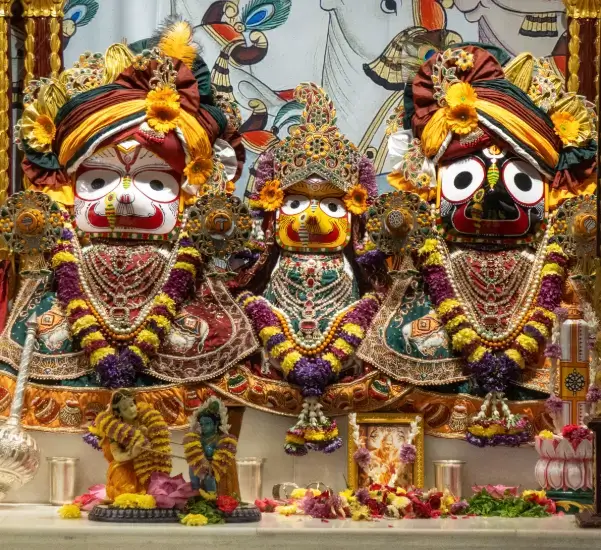
On the back of this truck — this humble, borrowed, flower-decorated flatbed — sat Lord Jagannatha, Lord Baladeva, and Devi Subhadra.
Five thousand miles away in Puri, India, the same deities were riding on 45-foot wooden towers pulled by hundreds of thousands of chanting pilgrims — as they had been every year for at least two thousand years. Here in San Francisco, a handful of young Western men and women in saffron robes were about to do something that had never been done before in the history of the world.
They were about to bring Rath Yatra to the West.
The Man Behind the Vision
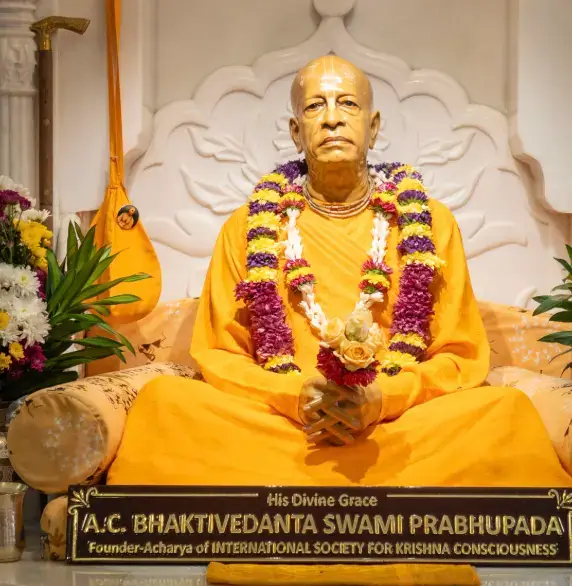
To understand what happened on that July morning in 1967, you have to understand who Srila Prabhupada was — and what he was carrying in his heart.
Born Abhay Charan De in Calcutta in 1896, he grew up in a household soaked in devotion to Lord Jagannatha. His father, Gour Mohan De, was a devoted Vaishnava who bought his young son a small three-foot Rath Yatra cart when he was just five years old. Every year, while the real Rath Yatra was happening in Puri, little Abhay would organise his own neighbourhood festival in Calcutta — pulling the cart through the lanes, playing drums, distributing prasadam, leading his friends in kirtan. ²
The seed of what would become a worldwide movement was planted in the heart of a five-year-old boy pulling a tiny wooden cart through the streets of Calcutta.
Sixty years later, that boy — now His Divine Grace A.C. Bhaktivedanta Swami Prabhupada — arrived in New York City on a cargo ship, having suffered two heart attacks during the crossing. He was 69 years old, with no money, no institutional support, and a trunk of his translations of the Srimad Bhagavatam. His sole instruction from his spiritual master was: "If you ever get the opportunity, spread Krishna consciousness in the English-speaking world." ³
By 1967 he had established a small temple at 26 Frederick Street in San Francisco's Haight-Ashbury district. He was sitting in his room one day, watching the traffic below, when the idea came to him. He noticed the flatbed trucks moving through the street. And in his mind, he saw Lord Jagannatha riding on one.
He called in Shyamasundara dasa. He sketched — actually sketched with his own hand — a truck with a four-pillared canopy on the back, decorated with flags, bells, and flower garlands. "Make me this cart for Ratha-yatra," he said. ⁴
And with those six words, history was made.
"We Just Rented a Flatbed Truck"
The devotee who would become most associated with the San Francisco Rath Yatra was Jayananda dasa — a tall, gentle American who had heard Prabhupada speak and knew immediately, as he later said: "He didn't want to cheat me. So I just wanted to work for him." ⁵
Jayananda threw himself into the preparations with extraordinary energy. He drove all over San Francisco getting donations of fruits and flowers. He found people to help decorate the cart. He installed the sound system on the truck. He distributed posters in stores across the neighbourhood. He was tireless — his enthusiasm inspiring everyone around him. ⁶
The women had been cooking chapattis all day — thousands of them to distribute. Devotees had prepared hundreds of Hare Krishna Rath Yatra balloons to release into the streets as the parade began. ⁶
The police were bewildered. They demanded to know what the procession was about and how long it would take. The devotees explained patiently about Lord Jagannatha. The cops shook their heads, stamped the forms, and complained about hippies. ⁷
Prabhupada himself was not in San Francisco that day. He had been ill and was resting at a friend's house in Stinson Beach. On July 8th, Shyamasundara and Mukunda drove up to tell him about the preparations. Mukunda described how the whole Haight-Ashbury district was buzzing with anticipation.
The next morning — July 9, 1967 — the procession began.
In his own words, Jayananda dasa recalled later:
"The first year, 1967, we just rented a flatbed truck and started out in the Haight-Ashbury district of San Francisco. We decorated the truck with flowers and put the Deities on the back, and the girls passed out fruit. A good crowd walked along with us at the beginning, and when we turned off Haight Street a smaller group of maybe fifty people came with us and we went all the way to the beach." ⁵
— Jayananda dasa, Back to Godhead magazine, Vol. 13, No. 6, 1978
The instruments were amplified. Yamuna dasi played harmonium. Subala danced wildly the entire way. Jayananda jumped up and down playing kartals. The police tried to hurry the procession — but so many people had crowded in that it was obliged to go slowly, exactly as Prabhupada had asked. From the truck, devotees handed out cut oranges, apples, and bananas. Others threw flowers into the crowd. ⁶
And the Hare Krishna maha-mantra rang out on an American street — in the summer of 1967 — for one of the first times in history.
The San Francisco Examiner ran the story the next day under the headline: "S.F. Paraders Hail Hindu God Krishna." ⁸
Prabhupada read the article at Stinson Beach. He praised the devotees, especially Shyamasundara and Jayananda. Two days later, on July 11, 1967, he wrote to his disciple Brahmananda dasa in New York — and this letter, preserved in the Vedabase, is the earliest first-person account of the first Western Rath Yatra:
"Anyway, the devotees are coming here, and the Rathayatra Festival was performed with great pomp. More than 500 people followed the procession to the beach, and there were about two dozen cars. They distributed thousands of chapaties, and at last Shri Jagannatha, Subhadra, and Baladev kindly came here in our house and will stay here for one week and then return." ⁹
— Srila Prabhupada, letter to Brahmananda dasa, July 11, 1967 (vedabase.io)
That is all he wrote. No grand proclamation. No celebration of his own achievement. The quiet, factual account of a man who knew he was simply a postman delivering a letter.
After the festival, one of the devotees reported back. Prabhupada listened and said:
"That was but the beginning. We will inaugurate many such celebrations all over the world. One by one, I will show you." ¹⁰
— Srila Prabhupada (Hayagriva dasa, The Hare Krishna Explosion, Ch. 11)
He was right.
How Lord Jagannatha Found His Way to San Francisco — A Divine Comedy
Before there could be a Rath Yatra, there needed to be a Jagannatha deity. And that story is itself remarkable.
In early 1967, one of Prabhupada's young disciples — Malati devi dasi — was browsing an import shop in San Francisco when she came across a small carved wooden image. She didn't know what it was. But she was attracted to its bright colours — red, black and green — and its large, saucer-like eyes. It was labelled "Made in India."
She brought it back to the temple. When Prabhupada saw it, he immediately offered his full obeisances to the floor. Then he looked up at his astonished disciples and said: "Go back to the shop and get two more like this." ¹¹
He had recognised Lord Jagannatha immediately — the same form he had worshipped since childhood in Calcutta.
Upon Prabhupada's instruction, Shyamasundara dasa recarved the three-inch deities into a much larger size. He worked with such intensity that a splinter lodged in his hand, the wound became infected, and he developed blood poisoning severe enough to hospitalise him. Prabhupada responded with characteristic directness: "Lord Jagannatha is taking away the reactions to Shyamasundara's previous sinful activities." ¹²
Shyamasundara recovered. The deities were completed and placed on the altar of the San Francisco temple. And those very same deities — Jagannatha, Baladeva, and Subhadra, carved by Shyamasundara dasa in 1967 — still ride in the San Francisco Rath Yatra today. ¹³
The Theology Behind the Audacity
Why did Prabhupada choose Rath Yatra as one of the first major public festivals of ISKCON? The answer is deeply theological.
Other swamis and yogis had come to the West before Prabhupada. None of them had brought the deities into the streets of Western cities and invited everyone to celebrate. As Back to Godhead magazine noted: "Although earlier many other swamis and yogis had journeyed to the West, none of them had brought the purity and devotion of Srila Prabhupada. And none of them had had the vision of Srila Prabhupada: to establish ancient India's Krishna conscious culture around the world on its own terms — not watered down, but as it is." ¹⁴
His reason was rooted in the name Jagannatha itself. Jagat means universe. Natha means master or lord. Lord Jagannatha is the Lord of everyone — not just of India, not just of Hindus, not just of initiated devotees. And Rath Yatra is the one festival where He comes OUT of the temple to give His mercy to absolutely everyone.
As Prabhupada said at the 1969 San Francisco Rath Yatra — his third, and the first he personally attended:
"My dear American boys and girls, I thank you very much for your taking part in this great festival known as Lord Jagannatha's Ratha-yatra. It is stated in the Vedic literature that anyone who sees Lord Jagannatha seated on this chariot will never again have to take birth within this miserable material world." ¹⁵
— Srila Prabhupada, San Francisco Rath Yatra, 1969
He was speaking to young Americans with no connection to Jagannatha Puri — and telling them that the same mercy available to Puri pilgrims for two thousand years was available to them, right now, on the streets of San Francisco.
Jayananda — The Saint Who Built the Chariots
No account of ISKCON's Rath Yatra is complete without Jayananda dasa.
From 1967 until his death in 1977, Jayananda was the heart and hands of the San Francisco Rath Yatra. He earned the nickname "Mr. Ratha-yatra" for building the chariots from scratch each year — each year more elaborate, more magnificent, a direct expression of his deepening devotion. ⁵
He was not a grand personality. He was not a scholar. He was a man who had heard Prabhupada speak and simply decided to work for him. He drove around collecting donations. He hammered nails. He cooked prasadam. He carried heavy equipment in the California sun without complaint.
Prabhupada loved him. When Jayananda was dying of leukaemia in 1977, Prabhupada wrote:
"You are a sincere devotee of the Lord. I am confident that Krishna and Jagannatha will look after you." ¹⁶
— Srila Prabhupada, letter to Jayananda dasa, 1977
Jayananda dasa departed this world on May 1, 1977 — just months before Prabhupada himself. He was 37 years old. Today his name is spoken with the reverence reserved for saints at Rath Yatra festivals worldwide.
From One Flatbed Truck to 100 Cities
- 1967 — San Francisco: One rented flatbed truck. Over 500 people. One direction: to the beach. ⁹
- 1968 — San Francisco: First real chariot built by Jayananda, with saffron silk canopies. Approximately 100 people through Golden Gate Park. ⁵
- 1969 — San Francisco: Prabhupada personally attends for the first time, speaking from the chariot: "My dear American boys and girls, I thank you very much…" ¹⁵
- 1969 — London: First UK Rath Yatra. Prabhupada personally present.
- 1970 — Multiple cities: Prabhupada speaks at San Francisco on July 5: "This festival is being observed simultaneously in San Francisco, London, Buffalo, Melbourne, Tokyo, and many other cities." ¹⁷
- 1974 — San Francisco: Prabhupada attends in person — one of the most photographed moments in ISKCON history. He stands on Subhadra devi's chariot, raising his hands, as thousands chant and dance below. ¹³
- 1977: Prabhupada departs this world. Rath Yatra is established on every inhabited continent.
- Today: Over 100 cities worldwide. London's annual festival at Trafalgar Square draws 70,000+ visitors. Durban, South Africa hosts one of the largest public Rath Yatras outside India. New York, Toronto, Sydney, São Paulo, Moscow — the same Lord, the same mercy. ¹⁸
What Prabhupada Said That Changes Everything
Of all his statements about Rath Yatra, one stands above all others in simplicity and depth. After the festival ended on July 9, 1967, as devotees returned to the temple in the San Francisco night air, Prabhupada said:
"That was but the beginning. We will inaugurate many such celebrations all over the world. One by one, I will show you." ¹⁰
— Srila Prabhupada (Hayagriva dasa, The Hare Krishna Explosion, Ch. 11)
He was one man. Seventy years old. Recently recovered from a heart attack. Running a temple from a rented storefront. With perhaps 30 disciples.
And he was making a promise to take this festival to every country in the world.
He kept that promise.
He once explained his confidence this way: "I am simply a postal peon. I have been given a letter to deliver. I do not know what is in the letter. But I am sure the letter will reach its destination."
The letter was Lord Jagannatha's mercy. The postal peon delivered it to the whole world.
The Same Deities. The Same Mercy. 58 Years Later.
When you attend a Rath Yatra this year — in London, New York, São Paulo, or Sydney — you are participating in an unbroken chain of mercy stretching from Puri to Haight-Ashbury to the entire world.
The deities on the chariots today are carved in the same form Malati devi brought from an import shop in 1967. The chariots are built in the tradition Jayananda established with his own hands. The kirtan that rings out is the same kirtan Yamuna dasi played on that yellow rental truck.
And the mercy — the Skanda Purana's promise that a person who sees the Rath Yatra "can purge all kinds of sinful results from his body" — is exactly the same mercy that reached those hippies on a San Francisco street 58 years ago.
Rath Yatra 2026 falls on Thursday, July 16. Find your nearest ISKCON temple. Go. Pull the rope. Chant Hare Krishna.
Srila Prabhupada promised: "If you simply chant Hare Krishna, Krishna will come to you."
On Rath Yatra, He comes to you even without chanting. He rides out on His chariot to find you. All you have to do is show up.
Jai Jagannatha! Jai Srila Prabhupada! 🙏
Read our complete guide: Rath Yatra 2026 — Story, Sacred Rituals and How to Celebrate. Chant along with the Jagannatha Ashtaka and Jaya Jaya Jagannatha, or explore our full bhajans collection.
Sources and Citations
All facts, quotes, and historical details in this article are verified from primary sources:
- Hayagriva dasa, The Hare Krishna Explosion, Chapter 11 "San Francisco Rathayatra" — first-person account of July 9, 1967 festival preparations (theharekrishnamovement.org)
- Krishna.org, "Ratha-Yatra — A Festival For Everyone" — account of Prabhupada's childhood Rath Yatra in Calcutta
- Satsvarupa dasa Goswami, Srila Prabhupada-lilamrta, Vol. 1 — the authorised biography, Bhaktivedanta Book Trust
- Berkeley Art and Interreligious Pilgrimage Project, Graduate Theological Union — documents Prabhupada's sketch of the first chariot (pilgrimage.gtu.edu)
- Jayananda dasa, quoted in Back to Godhead magazine, Vol. 13, No. 6, 1978 — "The Festival of the Chariots" (back2godhead.com)
- ISKCON Berkeley, "History — Rathayatra" — detailed account of 1967 festival preparations (iskconberkeley.us)
- Hayagriva dasa, The Hare Krishna Explosion, Chapter 11 — account of police interactions
- San Francisco Examiner, July 10, 1967 — "S.F. Paraders Hail Hindu God Krishna" (referenced in festivalofindia.org)
- Letter from Srila Prabhupada to Brahmananda dasa, July 11, 1967, Stinson Beach — preserved in the Vedabase (vedabase.io)
- Hayagriva dasa, The Hare Krishna Explosion, Chapter 11
- Malati devi dasi, quoted in Back to Godhead — "Ratha-yatra — An Ancient Festival Comes to the West" (back2godhead.com)
- Berkeley Art and Interreligious Pilgrimage Project, GTU (pilgrimage.gtu.edu)
- ISKCON News, "ISKCON's First Rathayatra Returns to San Francisco" (iskconnews.org)
- Back to Godhead magazine — "The Festival of the Chariots" (back2godhead.com)
- Srila Prabhupada, lecture at San Francisco Rath Yatra, 1969
- Srila Prabhupada, letter to Jayananda dasa, 1977
- Srila Prabhupada, lecture at San Francisco, July 5, 1970 (referenced in iskconbangalore.org)
- Cultureandheritage.org, "The Global Reach of ISKCON", March 2024
Share this article
Frequently Asked Questions
When was the first Rath Yatra outside India?
The first Rath Yatra outside India was held on July 9, 1967, in San Francisco, organised by Srila Prabhupada. The procession started at the corner of Haight and Lyon Streets in the Haight-Ashbury district and ended at the Pacific Ocean beach, with over 500 people participating.
Who organised the first Western Rath Yatra?
Srila Prabhupada conceived and inspired the festival, while Jayananda dasa and Shyamasundara dasa led the practical organisation. Jayananda went on to build the San Francisco Rath Yatra chariots for a decade, earning the nickname "Mr. Ratha-yatra."
Are the original 1967 Jagannatha deities still used today?
Yes — the original Jagannatha, Baladeva, and Subhadra deities carved by Shyamasundara dasa on Srila Prabhupada's instruction in 1967 still ride in the San Francisco Rath Yatra today.
What did Prabhupada say after the first San Francisco Rath Yatra?
After the first festival, Prabhupada said: "That was but the beginning. We will inaugurate many such celebrations all over the world. One by one, I will show you." In his letter of July 11, 1967 he wrote: "The Rathayatra Festival was performed with great pomp. More than 500 people followed the procession to the beach."
When is Rath Yatra 2026?
Rath Yatra 2026 falls on Thursday, July 16, 2026. The Bahuda Yatra (Return Festival) follows on Friday, July 24, 2026.
How many cities celebrate ISKCON Rath Yatra today?
ISKCON organises Rath Yatra in over 100 cities worldwide. The largest festivals outside India include London (70,000+ visitors at Trafalgar Square), Durban, New York, San Francisco, Toronto, Sydney, and São Paulo.
Rate This Article
How would you rate this article? Click on a star to rate: