Sri Guru Carana Padma
Guru Vandana (Verses 1 to 4)
Author: Narottama Dasa Thakura | Book: Prema Bhakti Candrika | Language: Bengali
Verses 1 to 4 are celebrated in ISKCON temples as the "Guru Puja prayers"
Lyrics
(1)
Sri Guru-carana-padma, kevala-bhakati-sadma,
bando mui savadhana mate
jahara prasade bhai, e bhava toriya jai,
krishna-prapti hoy jaha ha'te
(2)
Guru-mukha-padma-vakya, cittete koriya aikya,
ar na koriho mane asa
Sri Guru-carane rati, ei se uttama-gati,
je prasade pure sarva asa
(3)
Cakshu-dan dilo jei, janme janme prabhu sei,
divya jnan hride prokasito
prema-bhakti jaha hoite, avidya vinasa jate,
vede gay jahara carito
(4)
Sri Guru Karuna-sindhu, adhama janara bandhu,
lokanath lokera jivana
ha ha prabhu koro doya, deho more pada-chaya,
ebe jasa ghushuk tribhuvana
Translation
1) The lotus feet of our spiritual master are the only way by which we can attain pure devotional service. I bow to his lotus feet with great awe and reverence. By his grace one can cross the ocean of material suffering and obtain the mercy of Krishna.
2) My only wish is to have my consciousness purified by the words emanating from his lotus mouth. Attachment to his lotus feet is the perfection that fulfills all desires.
3) He opens my darkened eyes and fills my heart with transcendental knowledge. He is my Lord birth after birth. From him ecstatic prema emanates; by him ignorance is destroyed. The Vedic scriptures sing of his character.
4) Our spiritual master is the ocean of mercy, the friend of the poor, and the lord and master of the devotees. O master! Be merciful unto me. Give me the shade of your lotus feet. Your fame is spread all over the three worlds.
Remarks
From original research of the Prema-Bhakti Candrika, the original words were "cittete koribo aikya" Translation of that is, "I will make the teachings from the lotus mouth of the spiritual master be one with my heart and I will not have any other desires." Some renditions will translate this as "hṛdi kori mahā sakya."
This song is mostly rendered in Raga Misra Kafi in Kaherva tala.
About Narottama Dasa Thakura
Narottama Dasa Thakura (c. 1520–1600 CE) was one of the foremost disciples of Sri Lokanatha Goswami and a direct associate of the Six Goswamis of Vrindavana. He is celebrated throughout the Gaudiya Vaishnava tradition as a pure devotee who received the holy name directly from Lord Nityananda in a dream and later became the principal teacher who spread Krishna consciousness throughout Bengal, composing devotional songs in Bengali accessible to every ordinary devotee.
Prema Bhakti Candrika (moonbeams of the nectar of devotion) is one of his most celebrated works — a comprehensive guide to the stages of devotional service, from the beginning of spiritual life to the highest realisation of Vraja-bhakti. "Sri Guru Carana Padma," the opening verses of this text, are sung at every ISKCON Guru Puja ceremony worldwide as the standard prayer to the spiritual master.
When This Bhajan Is Sung
In ISKCON temples, "Sri Guru Carana Padma" is sung every morning immediately after the Mangal Aarti ceremony — during the offering of flowers to the spiritual master's picture, a ceremony called Guru Puja. The devotees typically circumambulate the altar while singing, offering the guru the same mood of loving worship given to the Lord Himself.
Outside the temple, devotees often sing it before beginning their morning japa session as a way of first seeking the guru's blessings, since Prabhupada taught that without the guru's mercy, the holy name cannot fully enter the heart. Hearing or chanting this bhajan even once daily is considered a powerful way to maintain the guru-disciple relationship.
Key Word Meanings
How to Sing This Bhajan
The audio recording above presents the standard ISKCON melody used daily in temples worldwide. The song is sung in Raga Misra Kafi set to Kaherva tala — a gentle, devotional rhythm that conveys the mood of humble supplication before the spiritual master.
Tempo: Begin slowly and reverentially, letting each Bengali word land clearly. The emotional core is verse 1 — "jahara prasade bhai, e bhava toriya jai" (by his mercy alone this ocean of suffering is crossed) — linger on it before moving to the next verse.
Pronunciation guide: Bengali "o" is a pure "o" (not the American diphthong). The letter "c" is pronounced "ch" — so "carana" = "charana." Sing the transliteration as written; the melody will guide natural pronunciation for first-time singers.
Group singing (Guru Puja): During the temple ceremony, devotees stand and circumambulate the altar while singing. The lead devotee sings each line and the congregation repeats. At home, face a photo of your spiritual master and offer flowers or incense while singing — the mood of offering amplifies the prayer.
Spiritual Significance
Scriptural Source & Tradition
Commentary from the Acharyas
When to Sing / Chant
Benefits for the Devotee
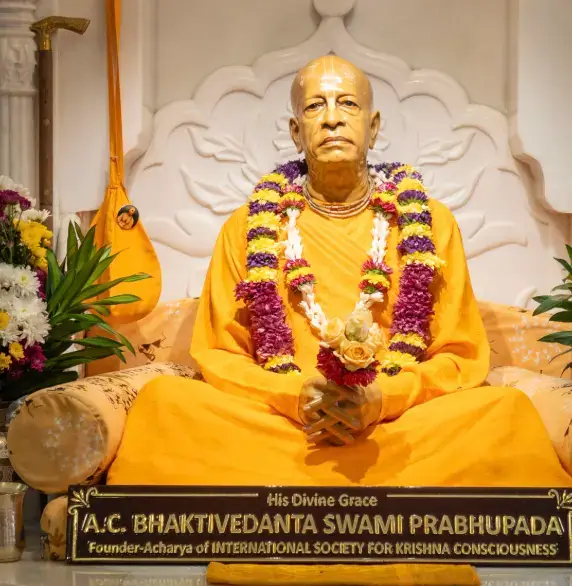
Gratitude to His Divine Grace A.C. Bhaktivedanta Swami Srila Prabhupada
We offer our humble obeisances at the lotus feet of our founder-acharya, His Divine Grace A.C. Bhaktivedanta Swami Srila Prabhupada, without whose causeless mercy the priceless prayers, bhajans and sacred literature of the Gaudiya Vaishnava tradition would have remained inaccessible to most of the world. By his herculean preaching efforts, his unparalleled translations and his founding of the International Society for Krishna Consciousness (ISKCON), the holy names, pastimes and instructions of Sri Sri Radha-Krishna and Sri Chaitanya Mahaprabhu are today chanted in every town and village.
nama om vishnu-padaya krishna-preshthaya bhu-tale
srimate bhaktivedanta-svamin iti namine
namas te sarasvate deve gaura-vani-pracharine
nirvishesha-shunyavadi-pashchatya-desha-tarine
All glories to Srila Prabhupada. All glories to the Vaishnava acharyas in the disciplic succession.