Janmashtami 2026 — Date, Fasting Rules, Midnight Celebration and How Devotees Celebrate Worldwide
In short
On the darkest night of Bhadra, in a locked prison cell in Mathura, the Supreme Lord appeared — and everything changed. Janmashtami 2026 falls on September 4 (Smarta) and September 5 (ISKCON/Vaishnava observance). This complete guide covers the story of Krishna's appearance from Srimad Bhagavatam, fasting rules, the midnight ceremony, how to observe at home, and how devotee communities celebrate worldwide.
It was midnight in Mathura, and the world held its breath.
Outside the prison walls, rain hammered the stone streets and the Yamuna churned in flood. Inside, in a locked cell, a woman who had watched six of her children killed by her own brother waited for her eighth child to be born — the child prophesied to end the tyranny of Kamsa. And then, at the stroke of midnight on the eighth day of the dark fortnight of Bhadra, the cell filled with light. The guards fell into unbreakable sleep. The chains on Vasudeva's wrists opened by themselves.
The Supreme Personality of Godhead had appeared.
More than five thousand years later, on this same night each year, millions of devotees across the world fast, sing, and wait for midnight with the same held breath — because Janmashtami is not the memory of a birth. It is the celebration of the moment the Lord of everything chose, out of pure love, to walk into His own creation.
In 2026, Janmashtami is observed on Friday, September 4 (Smarta tradition) and Saturday, September 5 (Vaishnava/ISKCON tradition). ISKCON temples worldwide observe September 5, with the midnight ceremony that night. Devotees should confirm the date with their local temple, as observance follows the local calendar calculation.
The Story of Krishna's Appearance
The Srimad Bhagavatam's Tenth Canto describes that night in luminous detail. King Kamsa had imprisoned his sister Devaki and her husband Vasudeva after a voice from the sky declared that her eighth son would destroy him. One by one, he murdered their newborn children. But the eighth — the Lord Himself — appeared before His parents not as a helpless infant but in His four-armed form, holding conch, disc, club and lotus, dressed in yellow silk, brilliant as a monsoon cloud lit from within.
The Bhagavatam describes the vision (SB 10.3.9-10):
tam adbhutaṁ bālakam ambujekṣaṇaṁ caturbhujaṁ śaṅkha-gadādy-udāyudham
"Vasudeva saw that wonderful child, His eyes like lotus petals, His four arms holding the conch, club, disc and lotus, the mark of Srivatsa on His chest, the Kaustubha gem at His neck — dressed in yellow silk, as beautiful as a dense rain cloud."
At the Lord's own instruction, Vasudeva carried the child out of the prison — the doors swinging open before him — across the flooding Yamuna, whose waters parted and touched the Lord's feet, while the divine serpent Ananta Sesha spread his hoods above them as an umbrella against the rain. In Gokula, Vasudeva exchanged the infant Krishna for the newborn daughter of Nanda Maharaja and Yashoda, and returned. When Kamsa seized that child to kill her, she slipped from his hands into the sky and revealed herself as Yogamaya: "The one who will destroy you has already been born elsewhere."
The tyrant searched. The Lord grew up in Vrindavana — stealing butter, playing His flute, dancing with the cowherd boys and girls of Vraja — hidden in plain sight as the darling of a village of devotees who loved Him not as God, but as their own.
That is the secret Janmashtami celebrates: the Supreme Lord does not merely rule His creation. He enters it, plays in it, and lets Himself be loved.
Why the Lord Appears — In His Own Words
Krishna explains His descent in the Bhagavad Gita (4.7-8):
yadā yadā hi dharmasya glānir bhavati bhārata / abhyutthānam adharmasya tadātmānaṁ sṛjāmy aham
paritrāṇāya sādhūnāṁ vināśāya ca duṣkṛtām / dharma-saṁsthāpanārthāya sambhavāmi yuge yuge
"Whenever and wherever there is a decline in religious practice, O descendant of Bharata, and a predominant rise of irreligion — at that time I descend Myself. To deliver the pious and to annihilate the miscreants, as well as to reestablish the principles of religion, I Myself appear, millennium after millennium."
Srila Prabhupada explains in his purport that Krishna's appearance is nothing like the birth of a conditioned soul. The Lord is aja — unborn. His "birth" is an act of mercy, staged for the joy of His devotees, the way the sun "rises" without ever having set. To observe Janmashtami is not to commemorate history; it is to participate, right now, in that descent of mercy.
Janmashtami 2026 — Key Details
| Event | Date |
|---|---|
| Janmashtami (Smarta observance) | Friday, September 4, 2026 |
| Janmashtami (ISKCON / Vaishnava observance) | Saturday, September 5, 2026 |
| Midnight ceremony | 12:00 AM, night of September 5 |
| Fast breaking (Parana) | After midnight ceremony, or next morning per local temple |
| Nandotsava | Sunday, September 6, 2026 |
| Srila Prabhupada's Appearance Day | Sunday, September 6, 2026 |
Confirm exact local observance and parana with your nearest ISKCON temple, as tithi calculations vary by location.
Janmashtami Fasting — How Devotees Observe It
Fasting on Janmashtami until midnight is one of the most cherished austerities in the Vaishnava calendar. The fasting standards followed by ISKCON devotees are:
Avoided until midnight (or for the full day):
- All grains and cereals — rice, wheat, dal, beans, corn
- Onion and garlic (never used in Vaishnava cooking)
- Regular salt — sendha namak (rock salt) is used instead
Permitted (for those observing a fruit-and-milk fast):
- All fruits, milk, yogurt, paneer, ghee
- Nuts, makhana (fox nuts), sabudana
- Kuttu, rajgira and singhara flours
- Root vegetables like potato and sweet potato
Many devotees fast completely — some even from water (nirjala) — until the midnight ceremony, then break the fast with prasadam that has been offered to the Lord. Others observe a simpler fruit fast. The scriptures repeatedly glorify this fast: the Brahma-vaivarta Purana states that observing Janmashtami vrata frees one from the reactions of many lifetimes. What matters most is not severity but devotion — fasting as an act of love, keeping the body light so the heart stays fixed on Krishna all day.
If you observe Ekadashi fasting regularly, the same kitchen rules apply — see our complete guide to what to eat on fasting days and our collection of Ekadashi fasting recipes, all of which are suitable for the Janmashtami fast.
How to Observe Janmashtami at Home
You do not need a temple to celebrate the Lord's appearance. Here is a full home observance:
Morning: Rise early, bathe, and dress your altar. If you have a deity or picture of baby Krishna (Laddu Gopal), place fresh flowers and, if available, tulasi leaves. Read Bhagavad Gita 4.7-9 aloud — the Lord's own explanation of this day.
Through the day: Chant extra rounds of the Hare Krishna maha-mantra. Read the birth chapters of the Tenth Canto (Srimad Bhagavatam 10.1-10.6). Play and sing bhajans — explore our bhajans collection with lyrics and meanings. Keep the mood of Vraja: simple, joyful, expectant.
Evening: Bathe the deity or picture with panchamrita (milk, yogurt, ghee, honey, sugar water) or simply clean water. Dress Krishna in His best. Offer a ghee lamp and incense while singing Gaura Aarti.
Midnight: This is the heart of the festival. At 12:00 AM, ring a bell, offer a lamp, and place before the Lord the foods He loves — butter, mishri, milk sweets, fruits. Sing the maha-mantra together as a family:
Hare Krishna Hare Krishna Krishna Krishna Hare Hare / Hare Rama Hare Rama Rama Rama Hare Hare
Then honour the prasadam and break your fast in gratitude. In that moment, your home is Gokula.
How ISKCON Temples Celebrate Worldwide
Srila Prabhupada made Janmashtami the crown jewel of the ISKCON calendar, and today the festival is celebrated in hundreds of temples across every continent — from Vrindavana's Krishna-Balarama Mandir and Mayapur's vast campus, to Bhaktivedanta Manor near London (donated by George Harrison, drawing tens of thousands of visitors), to temples in New York, Moscow, Nairobi, and São Paulo.
The pattern is gloriously similar everywhere: all-day kirtan and Bhagavatam discourses, dramas of Krishna's pastimes, a flower-decorated swing (jhulana) for baby Krishna that visitors take turns rocking, elaborate abhisheka ceremonies bathing the deities in milk, yogurt, honey and rose water — and then the midnight moment, when conches sound, curtains open on the Lord in His freshly decorated altar, and thousands of voices rise together in the maha-mantra. After midnight, a feast of prasadam is served to everyone, often into the early hours.
The first ISKCON Janmashtami in the West was held in 1966 at 26 Second Avenue, New York — a rented storefront, a borrowed harmonium, a handful of young followers, and one 70-year-old devotee of Krishna leading kirtan through the night. From that single room, the celebration has reached the whole world. As Srila Prabhupada wrote to his disciples: "Please take advantage of this Janmashtami day and make your life perfect by chanting Hare Krishna."
Nandotsava and Srila Prabhupada's Appearance — September 6
The day after Janmashtami is Nandotsava — the festival of Nanda Maharaja's joy, when the king of Vraja distributed gifts to the whole village in celebration of his son's birth. Temples continue the festivities with feasting and kirtan.
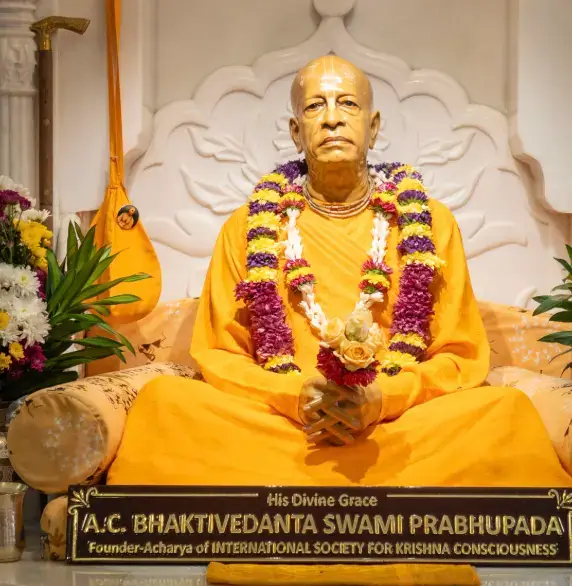
For devotees in Srila Prabhupada's line, September 6, 2026 carries a second, profound sweetness: it is the appearance day of His Divine Grace A.C. Bhaktivedanta Swami Prabhupada himself, born in Calcutta on Nandotsava day in 1896. The devotee who carried Krishna's name to every continent appeared in this world the very day after his Lord — a fact ISKCON devotees cherish as no coincidence. Read more about his life in Who is Srila Prabhupada?
Closing — The Lord Who Waits to Be Loved
Kamsa waited for Krishna in fear, and Krishna came for him. Mother Yashoda waited with a butter churn and open arms, and Krishna came to her lap and never truly left. The same Lord appears to each of us according to how we wait.
This Janmashtami — September 5, 2026 — fast a little, sing a lot, keep a lamp lit at midnight. The Lord who walked out of a locked prison cell has no difficulty entering an open heart.
Hare Krishna Hare Krishna Krishna Krishna Hare Hare
Hare Rama Hare Rama Rama Rama Hare Hare 🙏
Explore more: our Ekadashi Calendar 2026 for all fasting days, Ekadashi recipes for the Janmashtami fast, and our bhajans collection for the midnight kirtan.
Sources and Citations
- Srimad Bhagavatam, Canto 10, Chapters 1–6 — the appearance of Lord Krishna (Bhaktivedanta Book Trust translation, vedabase.io)
- Srimad Bhagavatam 10.3.9-10 — Vasudeva's vision of the four-armed Lord
- Bhagavad Gita As It Is 4.7-8, translation and purport by Srila Prabhupada
- Brahma-vaivarta Purana — glories of the Janmashtami vrata
- Sri Chaitanya Charitamrita — on the Lord's appearance pastimes
- Srila Prabhupada, letters on Janmashtami observance (vedabase.io)
- Drik Panchang / ISKCON Vaishnava calendar — Janmashtami 2026 dates (Smarta Sep 4, Vaishnava Sep 5)
- Satsvarupa dasa Goswami, Srila Prabhupada-lilamrta — the 1966 New York Janmashtami; Prabhupada's appearance on Nandotsava 1896
Share this article
Frequently Asked Questions
When is Janmashtami in 2026?
Janmashtami 2026 is observed on Friday, September 4 (Smarta tradition) and Saturday, September 5 (Vaishnava/ISKCON tradition). ISKCON temples worldwide celebrate on September 5, with the midnight ceremony that night. Confirm with your local temple, as tithi calculations vary by location.
What are the fasting rules for Janmashtami?
Devotees fast until midnight — either completely, or on fruits, milk products, and non-grain foods. Grains, beans, onion, garlic and regular salt are avoided; sendha namak (rock salt) is used. The fast is broken after the midnight ceremony with prasadam, following the fasting standards observed by ISKCON devotees.
Why is Janmashtami celebrated at midnight?
Lord Krishna appeared at exactly midnight on the eighth day (Ashtami) of the dark fortnight of Bhadra, in the prison of Kamsa in Mathura. The midnight ceremony — with abhisheka, arati and kirtan — marks the precise moment of the Lord's appearance.
What is Nandotsava?
Nandotsava, the day after Janmashtami (September 6, 2026), celebrates Nanda Maharaja's festival of joy at Krishna's birth, when he distributed gifts throughout Vraja. It is also the appearance day of Srila Prabhupada, the founder-acharya of ISKCON, born on Nandotsava day in 1896.
Can I celebrate Janmashtami at home without a deity?
Yes. A picture of Krishna, a simple altar with flowers, a ghee lamp, fruits and milk sweets to offer, and heartfelt chanting of the Hare Krishna maha-mantra at midnight constitute a complete home observance. Devotion, not paraphernalia, is the essence.
What foods are offered to Krishna on Janmashtami?
Krishna's favourites — fresh butter, mishri (rock sugar), milk sweets like kheer and pera, panchamrita, and fruits — all prepared without onion or garlic and offered with tulasi leaves where available.
Rate This Article
How would you rate this article? Click on a star to rate: