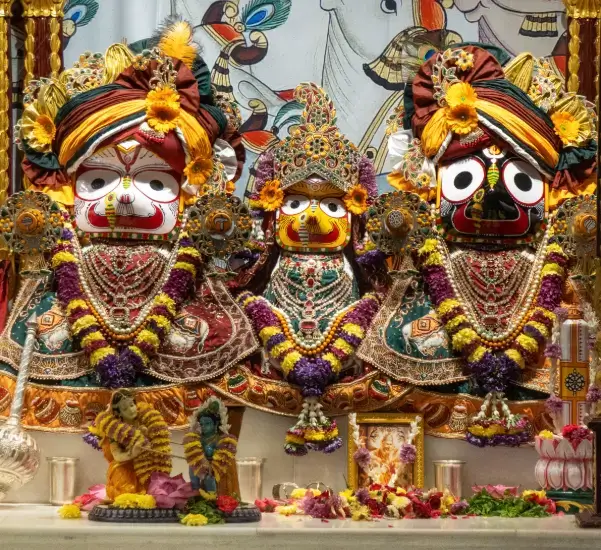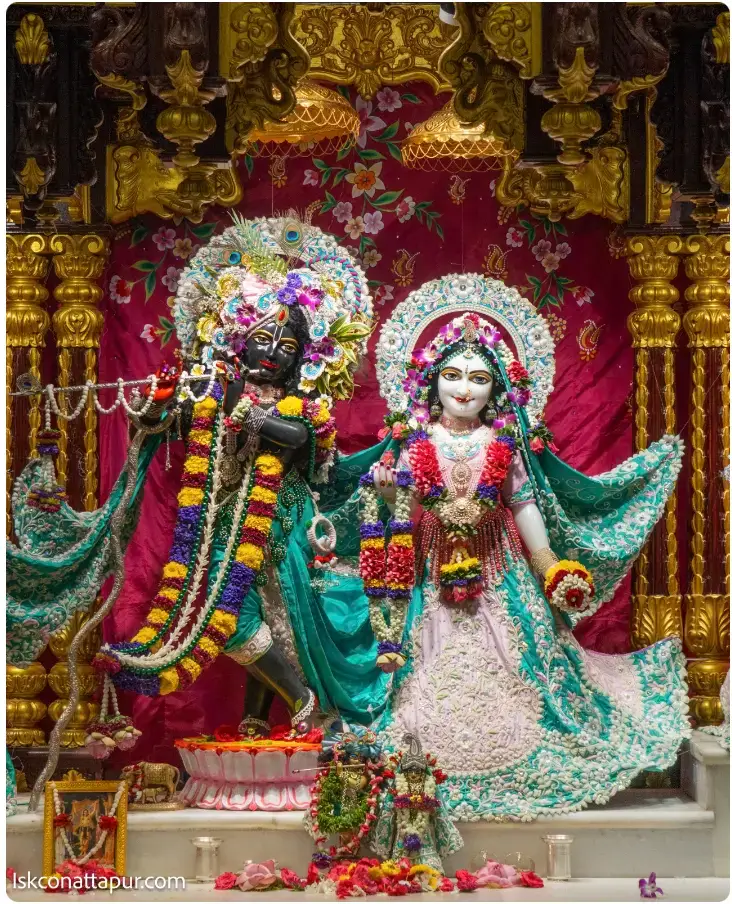
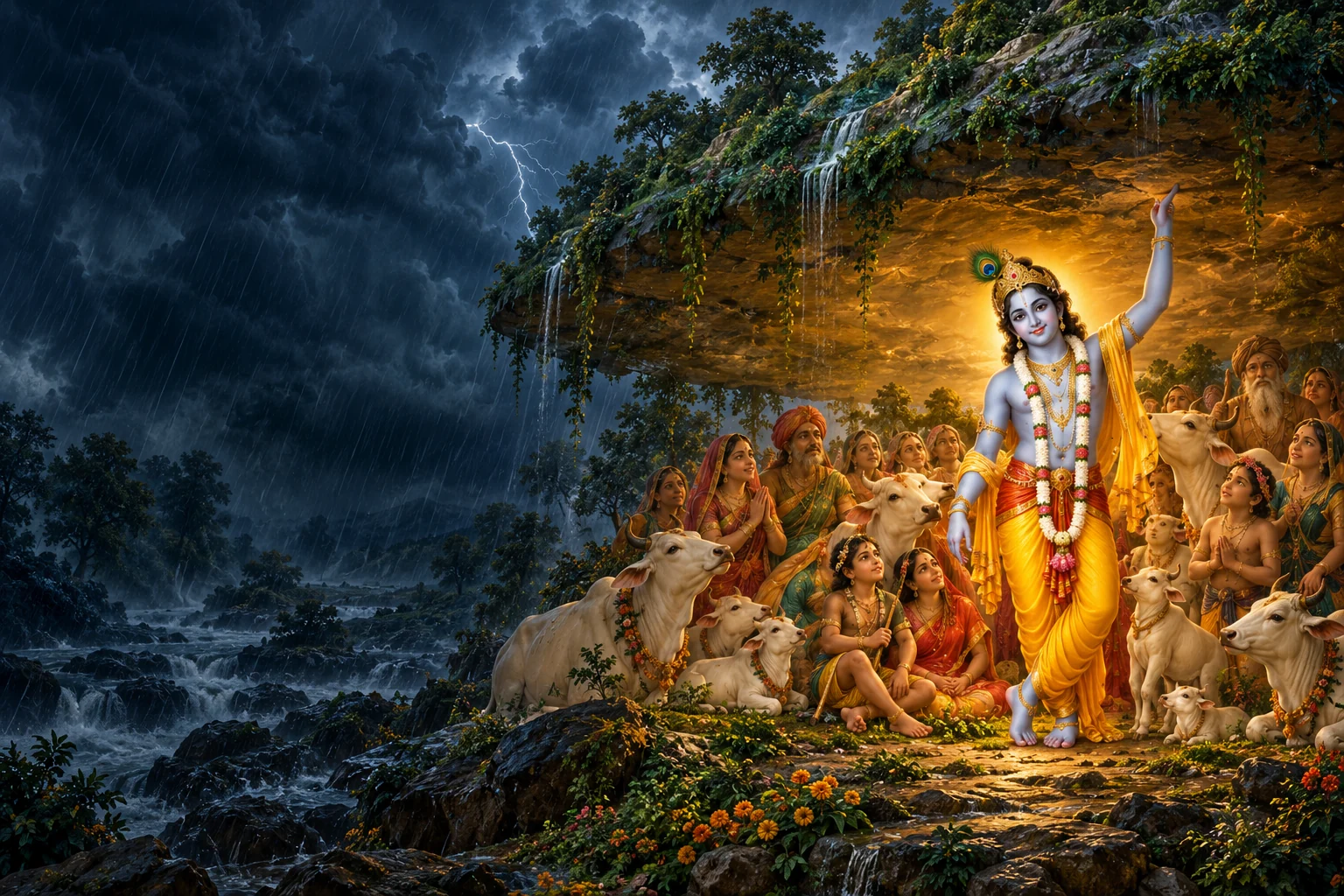
Govardhan Puja 2026A mountain of grace.
Celebrate on November 10 in the cited ISKCON calendars. Discover why Krishna lifted Govardhan, what Annakuta means and how to make a heartfelt offering at home.
A hill becomes a shelter. A feast becomes an offering. A community learns that its deepest security rests in Krishna. Govardhan Puja brings these threads together in a festival of gratitude, devotion and shared prasadam.
Its scriptural account begins with a question about worship and livelihood, moves through a joyful offering to Govardhan, and culminates in Krishna protecting the residents of Vraja from Indra's storm. Reading the whole sequence gives the festival a depth that a single dramatic image cannot convey.[33][34]
This guide brings the story into daily life: what to understand, what to prepare, how to celebrate at home, and where to read further. Quotations have exact sources; modern teachers' reflections are identified as commentary; household suggestions are presented as practical guidance.
What is Govardhan Puja?
Govardhan Puja is a Vaishnava festival honouring Govardhan Hill and Krishna's protection of Vraja. Devotees prepare food offerings, worship, sing Krishna's glories and share prasadam; the food-offering celebration is also known as Annakuta or Annakut. It is observed across the International Society for Krishna Consciousness (ISKCON) and within wider Vaishnava communities worldwide.[33][49]
Girirāja means king of mountains; Annakūṭa means a heap or mountain of food. These names help explain the celebration's visible forms: honouring the sacred hill and arranging a generous offering for the Lord. Prabhupada's Kṛṣṇa, Chapter 24, connects Govardhana-puja with Annakuta and its observance in the Krishna consciousness movement.[33]
Are Govardhan Puja and Annakut the same?
The names often refer to the same festival, with different emphasis. Govardhan Puja names the worship; Annakuta highlights the food offering. Local temples may arrange their displays differently, so a beautiful celebration need not look identical everywhere.[33][49]
Remember Krishna. Honour Govardhan. Care for cows and community. Prepare what you can offer lovingly, then share the Lord's prasadam.[7][8][9][10]
Begin by reading the account before planning decorations. Understanding whom you are honouring will give meaning to the cooking, singing and gathering.
When is Govardhan Puja in 2026?
Govardhan Puja is listed on Tuesday, November 10, 2026 in the cited ISKCON Gurugram and Mayapur calendars. Confirm your local temple's observance and programme time, especially outside India.[45][46]
Reference date from the cited ISKCON calendars.
Check the calendar sources| Occasion | 2026 date | Your next step |
|---|---|---|
| Dipavali | November 9 | Continue your Kartik remembrance. |
| Govardhan Puja / Annakuta | November 10 | Confirm the local offering and programme. |
| Kartik Purnima | November 24 | Complete the month with gratitude. |
The calendar dates above follow the cited temple calendars. Some civil holiday lists show November 9 for Govardhan Puja. A civil holiday entry is not a universal ritual schedule; this guide does not infer one worldwide date or auspicious time from it.[45][46][48]
- Ask your temple which date and programme time to follow.
- Prepare offerings in advance without assuming one global muhurta.
- Use our festival calendar and Kartik guide to plan the surrounding month.
Where did Govardhan Hill come from? The origin story
According to the Garga Saṁhitā, Govardhan Hill did not always rest in Vraja. His arrival in the land of Krishna's pastimes carries its own remarkable account — one that deepens the meaning of the worship offered to Him today.[52]
Birth on Śālmalī-dvīpa
The Garga Saṁhitā describes Govardhan as the son of Droṇācala, born on the island of Śālmalī-dvīpa, glittering with precious stones and jewels. From birth he was extraordinary — a sacred hill destined for a divine purpose.[52]
Pulastya Muni's request
The sage Pulastya Muni, hearing of Govardhan's splendour, travelled to Śālmalī-dvīpa and requested that Droṇācala allow Govardhan to come with him to Kāśī (Varanasi). Droṇācala agreed, grieving at the separation from his beloved son. However, Govardhan Himself set a condition: if Pulastya ever placed Him down upon the earth before reaching Kāśī, He would remain at that very spot and not move again.[52]
Arrival in Vraja — and the curse
Pulastya carried Govardhan in his hand and began the journey. But when he reached the land of Vraja — the very land that would one day ring with Krishna's flute — a call of nature compelled him to set the hill down. When he returned and tried to lift Govardhan again, the hill would not move. Govardhan declared that this was the fulfilment of the condition and that He would remain in Vraja forever. Pulastya, frustrated, cursed Govardhan to slowly shrink a little each day — a curse the hill accepted with equanimity.[52]
Vaishnava teachers in the Gaudiya line understand Govardhan's arrival in Vraja not as misfortune but as the fulfilment of a deeper divine plan. Govardhan is understood to have descended from Goloka Vṛndāvana — the eternal spiritual realm — to be present in the land of Krishna's earthly pastimes. His being set down in Vraja was, in this understanding, the destination all along: the sacred hill waiting for the Lord whose devotees would one day shelter beneath Him.[52]
Why this story matters for the festival
Knowing that Govardhan was present in Vraja long before the events of Chapters 24–27 of the Śrīmad-Bhāgavatam adds a dimension of permanence to the festival. This is not a hill that happened to be nearby. This is Śrī Giriraj — a sacred presence who came to Vraja to serve the Lord and the Lord's devotees. The fact that He was already there when Krishna directed the residents to worship Him is itself part of the pastime's depth.[52][13][14]
Why did Krishna lift Govardhan Hill?
Indra sent a devastating storm after the residents of Vraja redirected their worship to Govardhan at Krishna's instruction. Krishna lifted the hill to protect the people and cows, and held it as their shelter for seven days.[33][34][20]
The offering
Krishna asks Nanda Maharaja about the planned sacrifice and directs the community to honour Govardhan, the cows and the brahmanas. Worship and feeding take place before the storm.[3][7][10]
The storm
Offended by the discontinued sacrifice, Indra sends the Sāṁvartaka clouds; the residents turn to Krishna for protection.[17][18]
The real question Krishna put before Nanda Maharaja
Before there is a storm, there is a conversation. Seeing the elders prepare a great undertaking, Krishna asks Nanda Maharaja what it is for, what result it seeks, whom it is meant to satisfy, how it will be performed and whether it rests on scripture or local custom. Nanda answers with the pastoral logic of Vraja: their livelihood depends on rain, and Indra is the deva who governs the rain-bearing clouds. The cowherds therefore had inherited a custom of honouring him with the produce made possible by rain. The account gives that tradition real weight; it is not presented as a casual mistake.[3][4]
Why Krishna redirected the worship
Krishna then speaks about action, nature and the duties of a cow-protecting community. He draws the residents' attention to the forests, cows, brahmanas and Govardhan Hill that are woven into Vraja's actual life, and tells them to use the gathered ingredients for worship of Govardhan, service to the cows and generous hospitality. The text records the argument; the later Bhaktivedanta Book Trust (BBT) purport cautions readers not to treat this strategic line of reasoning as Krishna's final theological statement. The deeper purpose unfolds through the rest of the pastime.[5][7][10]
The new celebration is strikingly concrete: many foods and milk preparations, worship conducted by qualified brahmanas, grass for cows, food shared widely, and a festive circumambulation. Then Krishna manifests a vast form of Govardhan, accepts the offering and joins the residents in worship. This is why Annakuta is not only a decorative food display; in the narrative it is worship, care and shared prasadam made visible.[8][10][11][6]
Why Indra was offended — and who sent the rain
Indra learns that his sacrifice has been set aside and reacts with wounded pride. He condemns the cowherds for following Krishna and commands the Sāṁvartaka clouds to destroy their settlement and cattle. The clouds then bring unseasonal torrents, hail, thunder, lightning and floods over Vraja.[17][34]
The Sāṁvartaka clouds are clouds of universal dissolution — described in Vedic literature as the clouds that appear at the end of a cosmic cycle to flood the world. In the Govardhan pastime, Indra dispatches them as a weapon against the residents of Vraja. They are not Indra himself; Indra is the offended rain-controlling deva who commands them. The distinction matters: Indra retains his identity and later approaches Krishna for forgiveness; the Sāṁvartaka clouds are the instrument of his anger, not its subject.[17][34]
A shelter for every resident of Vraja
The storm is not an abstract spectacle. The Bhāgavatam describes cows pressing their calves beneath their bodies, and the frightened residents approaching Krishna for protection. Krishna recognises Indra's attack and resolves to guard the cowherd community as His own family. He lifts Govardhan with one hand, calls the people, cows, wagons and companions beneath it, and tells them not to fear the mountain or the rain. The root verse says one hand and seven days; Prabhupada's Kṛṣṇa, Chapter 25, gives the beloved detail of the little finger of His left hand.[18][58][16][20][34]
Mercy is the ending, not humiliation
When Indra sees that his storm cannot move Krishna or harm Vraja, he calls the clouds back. Later he approaches privately with Surabhi, prays for forgiveness and admits that disrupted sacrifice and false prestige had driven his offence. Krishna explains that the correction was mercy: it was meant to restore Indra's remembrance and remove intoxication with power, not to cancel his responsibility. The story ends not with an enemy defeated, but with a servant restored to his proper service.[19][29][22][23]
The Govinda naming ceremony — abhiṣeka by Indra and Surabhi
Śrīmad-Bhāgavatam 10.27 describes a sacred ceremony that follows Indra's repentance. The divine cow Surabhi — representative of all cows — bathes Krishna with her milk as an act of love and veneration. Indra then performs abhiṣeka, a bathing ceremony, using the sacred water carried by his elephant Airāvata drawn from the celestial Gaṅgā. In the presence of the great sages and the god Brahmā, Indra confers upon Krishna the name Govinda — "one who gives pleasure to the cows, to the senses and to the land." The sacred lake nearby, formed by these waters, is named Govinda-kuṇḍa and remains a site of pilgrimage in Braj today.[28]
Govinda (Sanskrit: go — cows, senses, the earth; vinda — one who gives pleasure or finds) is one of Krishna's most celebrated names, conferred at this moment by Indra himself. The Bhāgavatam records that the celestial musicians sang, flowers were showered, and all the assembled devas rejoiced. This is why the conclusion of Govardhan Puja is not simply the end of a storm, but the revelation of the Lord's name and nature.[28]
A later BBT purport attributes to Śrīdhara Svāmī the view that the pastime corrects Indra's pride while establishing the festival and increasing loving exchange in Vraja. Another later purport attributes to Viśvanātha Cakravartī Ṭhākura the insight that the danger intensifies the residents' loving absorption in Krishna. These are labelled commentarial readings: they deepen the event recorded in the verses; they do not replace it.[30][31]
Read the full narrative: Śrīmad-Bhāgavatam, Canto 10, Chapters 24–27; and Srila Prabhupada's Kṛṣṇa, Chapters 24–27. The summaries above are paraphrases, with later acharya readings separately labelled.
Why is Govardhan Puja celebrated, and what is its significance?
Govardhan Puja cultivates loving dependence on Krishna, gratitude for what sustains life and practical service. The narrative also addresses pride: Indra's authority does not place him above Krishna, and his correction leads back to responsible service.[7][22][23]
Take shelter.
Krishna's protection is central to the seven-day pastime. Hearing it can deepen trust and remembrance.[20]
Serve with humility.
Indra's correction offers a warning against allowing responsibility to become arrogance.[22][23]
Honour what sustains.
The festival includes the hill, cows and the community's livelihood. Care should accompany celebration.[7][9]
Share the offering.
Krishna's instructions include feeding people beyond a privileged inner circle, as well as giving grass to cows.[10]
Why is Govardhan worshipped?
In Śrīmad-Bhāgavatam 10.21.18, the gopis praise Govardhan's service to Krishna, Balarama, their companions and cows through water, grass and other provisions. In the festival account, Krishna manifests a great form and identifies Himself with Govardhan. Both passages matter: the hill is celebrated for service and is honoured in a special relationship with Krishna.[1][13][14]
hari-dāsa-varyaḥ — “the best among the servants of Hari.”
Śrīmad-Bhāgavatam 10.21.18 · literal translation of the phrase[1]
What is Go Puja, and how does cow care belong in the festival?
Go-pūjā is worship honouring the cows. Krishna includes cows in the original ceremony and specifically directs that they receive grass. Their place in the celebration is therefore grounded in the account, rather than added merely as decoration.[7][10]
A meaningful household application is to learn about a trustworthy cow-care programme and its ongoing work. In deciding how to help, look for clear information about daily care and how support is used. Feeding or caring for animals should follow the advice of their responsible caretakers. That practical care carries the festival's gratitude beyond one day.[7][10]
Does this mean worshipping nature independently of Krishna?
The Gaudiya Vaishnava account keeps Krishna at the centre. His identification with the hill and the offering made at His instruction are essential to the meaning. Reducing the festival to prosperity worship or to a general nature celebration loses that devotional context.[13][14][33]
What should change in our lives after the puja?
A useful personal application is to pair gratitude with an act of service: support responsible cow care, share food respectfully, help a neighbour or volunteer. These are practical ways to carry the festival's themes into conduct; they are not promises of a particular material reward.
Read Bhagavad Gita Chapter 12 alongside the festival story. Its verses 13–14 describe kindness, humility, self-control and steady devotion—qualities that make a meaningful daily reflection.[56]
What is Govardhan Parikrama, and why is it significant?
Govardhan Parikrama is the circumambulation of Govardhan Hill — a walk of approximately seven kos (roughly 21 kilometres) that encircles the entire hill, passing through the forests and sacred sites associated with Krishna's pastimes. For Vaishnava pilgrims it is one of the most revered acts of devotion in the Braj region.[11][53]
The scriptural basis for parikramā
The original Govardhan festival account in Śrīmad-Bhāgavatam 10.24.29 includes the residents of Vraja circumambulating the hill together with their cows after the offering. The word parikramā (circumambulation) therefore belongs to the festival account itself, not only to a later pilgrimage tradition. Walking around Govardhan with love is, in this understanding, a continuation of what Krishna's own community did on the day of the first celebration.[11]
Śrī Caitanya Mahāprabhu's parikramā
The Caitanya Caritāmṛta, Madhya-līlā, Chapter 18, records that Śrī Caitanya Mahāprabhu performed parikramā of Govardhan Hill during His pilgrimage to Braj. The text describes His arrival at Govardhan, His overwhelming joy at seeing the sacred hill, and His circumambulation in deep devotion. His visit and the sacred spots He honoured have established the parikramā route as a living devotional tradition for Gauḍīya Vaishnavas up to the present day.[53]
The ~21 km route passes through several sacred sites: Rādhā-kuṇḍa and Śyāma-kuṇḍa — the most sacred lakes in Braj; Govinda-kuṇḍa — the lake formed when Indra performed abhiṣeka on Krishna; Kusum Sarovara — where Krishna gathered flowers for Rādhārāṇī; Mānas Gaṅgā — the sacred lake at the hill's base; and Dān Ghaṭī — the site of Krishna's playful toll-collecting pastime. Devotees typically begin at Jatipura, on the southeastern side of the hill, and walk in a clockwise direction.[53][11]
Daṇḍavat parikramā
Some pilgrims perform daṇḍavat parikramā — prostrating the entire body full-length on the ground, rising, taking one step forward, and prostrating again, for the entire 21 km circuit. This practice, which can take several days, is understood as the deepest physical expression of surrender to Śrī Giriraj. It is not required of all pilgrims; the regular walking parikramā is the standard form observed by most devotees.[53]
How to participate
If you are visiting Braj for Govardhan Puja or at any other time, contact your local ISKCON temple or a trusted Braj pilgrimage service for guidance on the parikramā. The walk is typically done barefoot out of respect for the sacred ground; start before dawn to avoid the midday heat; and maintain silent remembrance of Krishna and Govardhan throughout. For devotees unable to travel to Braj, the parikramā's spirit can be carried into a home circumambulation of a Govardhan śilā (a stone from the hill kept on the home altar) or into a reading of the Govardhan account with loving attention.[53][11]
How can you perform Govardhan Puja at home?
A home celebration can include hearing Krishna's pastime, preparing a modest vegetarian offering, singing, offering worship according to your learned practice and sharing prasadam. ISKCON News explicitly describes making a small food-hill with a few preparations, so an elaborate temple-sized display is not necessary.[49]
A simple home celebration, step by step
Suggested household sequence, inspired by the sources below. Follow your guru's or temple's guidance for formal Deity worship.
- 01
Prepare a clean space
Arrange a picture of Krishna lifting Govardhan or your established worship altar. Set out flowers, water and the items used in your normal worship.
- 02
Hear the pastime
Read a short passage from Prabhupāda's Kṛṣṇa, Chapters 24–25. Explain to children that the offering, the storm and the protection form one connected story.
- 03
Cook with care
Choose a manageable number of fresh vegetarian dishes suitable for offering to Krishna. Follow your temple's kitchen and offering standards.
- 04
Arrange the Annakuta
Make a modest hill-shaped food offering if practical. A small cooked-rice hill with a few dishes can be enough; do not let the display create avoidable waste.
- 05
Offer, sing and remember
Offer the food according to the practice you have learned. Sing the Hare Krishna maha-mantra or suitable bhajans, remembering Krishna and Govardhan.
- 06
Share and serve
Distribute prasadam with care for cleanliness and dietary needs. Plan an act of service that extends the spirit of the celebration beyond your household.
The festival's scriptural anchors include offerings and cooking in Śrīmad-Bhāgavatam 10.24.25–26, feeding and cow care in 10.24.28, circumambulation in 10.24.29–30, and devotional singing in 10.24.34. The modern household arrangement above is a practical adaptation, not a verbatim ritual manual.[7][8][10][11][12][49]
Keep it simple. Make it heartfelt.
Use this optional checklist while planning. Selections stay only while this page is open.
Which prayers or songs can you use?
The scriptural celebration includes singing Krishna's glories. Begin with the Hare Krishna maha-mantra and select songs from the bhajans collection. Since Govardhan Puja falls within the cited Kartik observance, you can also continue your evening Damodarashtakam practice; it is a Kartik companion, rather than a substitute for hearing the Govardhan account.[12][45]
What is Annakuta, and do you need 56 dishes?
Annakuta is the food-offering celebration associated with Govardhan Puja. A fixed count of 56 dishes is not required by the Bhagavatam verses cited here; Krishna's instructions describe several kinds of food without prescribing that number.[33][8]
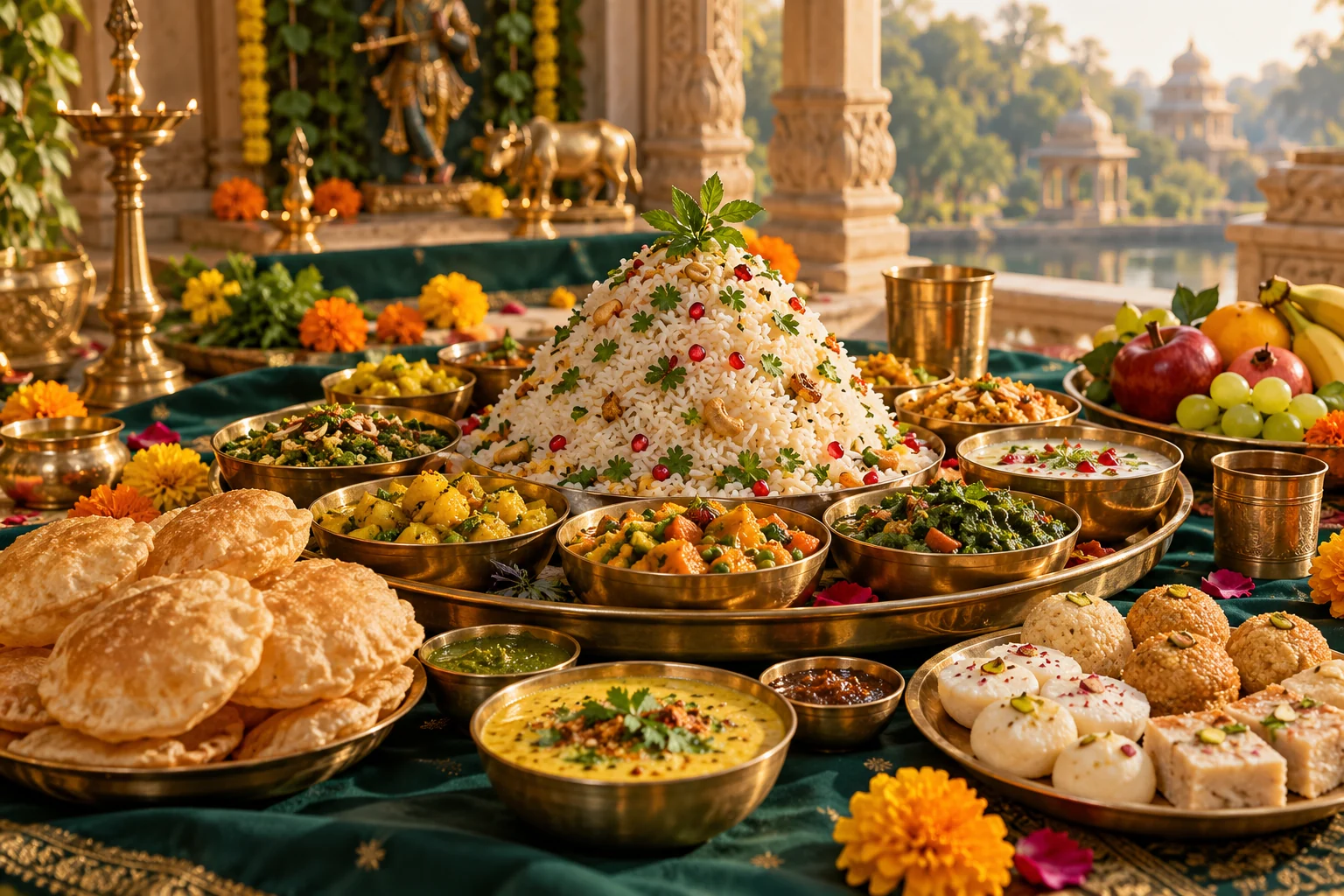
Śrīmad-Bhāgavatam 10.24.26 names rice preparations, sweet rice, cakes and milk products. Temples and households adapt their arrangements according to their circumstances. The home guide published by ISKCON News supports a small food-hill with a few preparations.[8][49]
| Part of the offering | Simple household idea |
|---|---|
| A central preparation | A small rice hill, prepared with clean utensils and ingredients suitable for offering. |
| Something savoury | One vegetable preparation and a suitable bread or other staple. |
| Something sweet | A modest sweet or milk preparation appropriate to your household and worship practice. |
| Something fresh | Washed fruit and drinking water. |
| A plan for sharing | Portions and storage arranged before cooking; ingredients identified for guests. |
Is a larger offering spiritually better?
Let the scale serve devotion and responsible sharing. Bhagavad-gītā 9.26 makes love and devotion central even to a simple offering. It is not a numerical recipe for Annakuta, but it is an important principle for households deciding what they can genuinely prepare.[32]
Choose what you can cook attentively, offer respectfully and distribute well. A grand display can be beautiful; a modest offering can also be sincere. Neither should become a reason to compare devotees or burden a family.
In the scriptural instructions, feeding extends beyond the main ritual participants. Consider how your celebration can include someone who might otherwise be left out. This is an application of the passage's inclusive spirit.[10]
Explore a simple sweet recipeWhere is Govardhan, and where can you celebrate?
Govardhan Hill is near Vrindavan in Mathura district, Uttar Pradesh, India. The celebration is also observed in Krishna-conscious communities beyond Braj, and a household can take part through hearing, worship and a modest Annakuta offering.[55][33][49]
What is Govardhan parikrama?
Parikramā means circumambulation. The original festival account includes the community circumambulating Govardhan with the cows. That scriptural act helps explain the place of circumambulation in the tradition.[11]
If you are visiting Braj, seek local temple guidance about respectful participation and the requirements of your own observance. A full pilgrimage is not a prerequisite for the home celebration described here. This guide does not prescribe a walking distance, a travel itinerary or a universal route.
How is Govardhan connected with Govinda?
After Indra's prayers, the account describes Surabhi's worship and a bathing ceremony for Krishna. Śrīmad-Bhāgavatam 10.27.22–23 connects this episode with His name Govinda. Reading that conclusion adds gratitude and reconciliation to the better-known image of the lifted hill.[28]
Find devotional association.
Explore our Nallagandla satsang information to learn about the community and contact options. Please ask directly about current festival arrangements; this article does not announce a confirmed Govardhan Puja programme.
Explore the satsang communityElsewhere in India or abroad, contact your own local ISKCON temple for the date and programme. Use the published sources for understanding and local guidance for participation.
What did Srila Prabhupada say about Govardhan Puja?
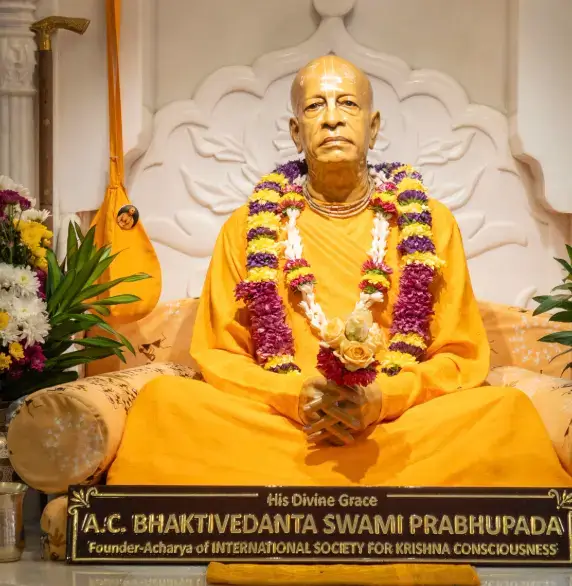
Srila A. C. Bhaktivedanta Swami Prabhupada, ISKCON's Founder-Acharya, explains the festival in Kṛṣṇa, the Supreme Personality of Godhead, Chapters 24–27, and in a Govardhana Puja lecture delivered on November 14, 1966, in New York. His account connects the celebration with following Krishna's instruction.[33][34][37]
“The sacrifice known as Govardhana-pūjā is observed in the Kṛṣṇa consciousness movement.”
Srila Prabhupada · Kṛṣṇa, the Supreme Personality of Godhead, Chapter 24[33]
For a direct reading of the history, begin with Chapter 24, then continue to Chapter 25 for Krishna's protection during the storm. The account of lifting the hill specifically with the left little finger appears in Prabhupada's Chapter 25; Śrīmad-Bhāgavatam 10.25.19 itself describes one-handed lifting.[34][16]
“Because we are devotees of Kṛṣṇa, we are trying to follow His instruction.”
Srila Prabhupada · Govardhana Pūjā lecture, November 14, 1966, New York[37]
Take that instruction into preparation: hear first, offer with understanding, and preserve time for chanting and service. For the devotional lessons in Indra's subsequent prayers and Krishna's response, continue reading the original narrative rather than stopping at the miracle.[22][23]
Where should you begin reading the original texts?
| Read | What to look for |
|---|---|
| Śrīmad-Bhāgavatam 10.24.25–29[7][11] | The offering, feeding, cow care and circumambulation. |
| Śrīmad-Bhāgavatam 10.25.18–23[58][20] | Krishna's resolve to protect Vraja and the seven-day shelter. |
| Śrīmad-Bhāgavatam 10.27.15–17[22][23] | Mercy, remembrance and responsible service. |
| Prabhupada's Kṛṣṇa, Chapters 24–25[33][34] | A continuous retelling to read together as a household. |
Source care: later portions of the English Tenth Canto were completed by Prabhupada's disciples. This page does not automatically attribute those later purports to him. His personal quotations above come from his book and his dated lecture.[15]
What have ISKCON preachers, Maharajas and senior Vaishnavas taught about Govardhan Puja?
The named teachers below draw out worship's purpose, humility and service from the Govardhan narrative. These are attributed summaries of particular talks, not invented quotations or additional compulsory rituals.
His Holiness Jayapataka Swami
ISKCON sannyasi and spiritual teacher[42]In his October 23, 1987 address at New Talavan, USA, Jayapataka Swami explains Govardhana Puja as direct worship of Krishna expressed through chanting, offerings and cow care. A useful personal application is to connect the feast with active devotional participation.[38]
Read the dated talkHis Holiness Giriraj Swami
ISKCON sannyasi and initiating guru[43]In his October 26, 2003 Houston talk on Śrīmad-Bhāgavatam 2.7.32, Giriraj Swami asks devotees to understand worship's purpose rather than follow custom blindly. He discusses Indra's correction as a lesson in overcoming pride. Read one passage together before beginning your own celebration.[40]
Read the talk and its contextHis Holiness Radhanath Swami
ISKCON sannyasi and bhakti teacher[44]In his contribution to the October 22, 2006 joint Govardhan programme in San Diego, Radhanath Swami connects Indra's attachment and anger with the need for humility, service and cooperation. A practical reflection is to notice whether preparing the festival makes us more considerate of the people serving alongside us.[41]
Read the speaker-labelled transcriptHis Holiness Jayapataka Swami
ISKCON sannyasi and spiritual teacher[42]In a November 3, 2005 lecture at Śrī Māyāpur Dhāma on Śrīmad-Bhāgavatam 10.25.19, Jayapataka Swami reflects on how Krishna's protection of the residents of Vraja provides the essential model for devotional shelter. He draws attention to the verse's detail of Krishna holding Govardhan for seven days without eating or sleeping, making the point that the Lord's care for His devotees is total and unconditional.[39]
Read the Māyāpur 2005 talkHis Holiness Radhanath Swami
ISKCON sannyasi and bhakti teacher[44]In a November 1991 Govardhana Puja talk in Mumbai — one of his earliest recorded lectures on this festival — Radhanath Swami explains Govardhan as a symbol of divine shelter and the importance of sincere surrender. Drawing from the Bhāgavatam account, he reflects on how the hill held up for seven days mirrors the steadiness of Krishna's care, and encourages devotees to reflect on what it means to genuinely take shelter.[54]
Visit the Radhanath Swami archivesTeacher commentary offers guidance for reflection. The source library identifies the talk, date and location so you can inspect its context; the Radhanath Swami passage is available in a transcript mirror with speaker labels.
What should you avoid misunderstanding about the festival?
Keep the scriptural account, local custom and personal household choices distinct. The most useful preparation is accurate understanding paired with a realistic offering.
- Do not reverse the story.
The Govardhan offering precedes the storm; Krishna's protection follows Indra's response. Read Chapters 24–25 in order.[33][34]
- Do not turn 56 dishes into a universal obligation.
The cited cooking instructions do not give that count, and the ISKCON home guidance allows a modest offering.[8][49]
- Do not treat the festival as a guaranteed bargain for wealth.
The passages emphasise Krishna's protection, worship, feeding and the correction of pride. This guide makes no promise of specific material results.[10][20][22]
- Do not confuse it with an Ekadashi fasting prescription.
Govardhan Puja is presented here as a festival of offerings and prasadam. For Ekadashi dates and disciplines, consult the separate Ekadashi calendar and local guidance.[45][49]
- Do not make the decoration more important than the devotion.
Choose an offering you can prepare without neglecting hearing, chanting, respectful service or the people around you.
Gratitude becomes an offering.
Love becomes service.
Where can your devotion go next?
Let one festival become a beginning: a prayer you return to, a chapter you understand, or a community where you can serve.
Your Kartik companion
Daily lamp offering, Damodarashtakam and the festival calendar, gathered in one illustrated guide.
Explore KartikBRING A SONG HOMEHear. Learn. Sing.
Explore our devotional song collection and find a prayer to make part of your daily practice.
Browse the bhajansDEEPEN YOUR UNDERSTANDINGLive the path of bhakti
Read Bhagavad Gita Chapter 12 and reflect on the qualities Krishna describes as dear to Him.
Read Chapter 12Your Govardhan
questions, answered.
A starting point for newcomers.
A companion for returning devotees.
01What is Govardhan Puja?
Govardhan Puja is a festival of worship of Govardhana Hill in relation to Krishna. It remembers His direction to the residents of Vraja and His protection of them, with offerings, remembrance and shared prasadam.[7][33][25]
02When is Govardhan Puja in 2026?
Govardhan Puja is Tuesday, November 10, 2026 in the cited ISKCON Gurugram and Mayapur calendars. Confirm the date and programme with your local temple; civil holiday lists can differ.[45][46][48]
03Is Govardhan Puja always the day after Diwali?
It usually follows Diwali, but its observance depends on Pratipada and local calendar rules. A gap is possible, so consult a location-specific calendar rather than assuming a fixed interval.[47]
04What is Annakut or Annakuta?
Annakuta refers to a mountain of food offerings presented to the Lord. The offered food is then shared as prasadam; a home offering can be modest.[51][50][49]
05Why are cows honoured on Govardhan Puja?
Krishna includes the cows in His instructions for the original worship, with grass and care for them. Go Puja recalls this relationship and can inspire continuing cow service.[7][10]
06Can I celebrate Govardhan Puja at home?
Yes. ISKCON News suggests a small home food-hill made with a few preparations rather than a temple-scale display. Hear the pastime, offer according to your learned worship standards, sing and share prasadam.[49][12]
07Must I offer exactly 56 dishes?
The cited Bhagavatam passage requests varied foods without specifying 56. Institutional home guidance permits a small offering; ask your teacher about any particular vow or temple custom.[8][49]
08What food can I offer for Govardhan Puja?
The narrative names sweet rice, vegetable preparations, cakes and milk preparations. A home menu can be manageable and should respect existing vows and the worship practice you have learned.[8][49]
09Where is Govardhan Hill?
Govardhan is near Vrindavan in Mathura district, Uttar Pradesh, India, within the sacred Braj region. The hill’s geographical location is distinct from the many places where the festival is celebrated.[55][49]
10Do I have to travel to Govardhan to celebrate?
No pilgrimage is needed to begin a home observance. Home celebrations and local temple programmes are documented; pilgrimage is a separate opportunity to plan with appropriate guidance.[49]
11Why do devotees walk around Govardhan?
Circumambulation is part of Krishna’s instructions in the original worship account. Temple celebrations also circumambulate a representation of the hill; follow the practice you have learned.[11][49]
12Is Govardhan Puja the same as Gopashtami?
They are distinct observances. The cited 2026 Gurugram calendar places Govardhan Puja on November 10 and Gopashtami on November 17.[45]
13Which finger did Krishna use, and how long did He hold the hill?
Prabhupada’s Kṛṣṇa, Chapter 25, describes Krishna lifting Govardhan with the little finger of His left hand. Śrīmad-Bhāgavatam 10.25.19 describes one-handed lifting, and 10.25.23 gives seven days.[34][16][20]
Which sources support this guide?
Scripture establishes the narrative. Prabhupada's books and dated lecture establish his teachings. Named teachers' talks provide commentary; calendar and community publications support practical details. Numbered links in the article lead to the records below.
- Scripture
Śrīmad-Bhāgavatam 10.21.18The gopis praise Govardhana as the foremost servant, providing for Krishna, Balarama, Their companions and cows.
- Scripture
Śrīmad-Bhāgavatam 10.24.12The narrator identifies Krishna’s intention in questioning the Indra ceremony.
- Scripture
Śrīmad-Bhāgavatam 10.24.1–7Krishna asks Nanda and the elders about their undertaking, its intended result, recipient, procedure and authority.
- Scripture
Śrīmad-Bhāgavatam 10.24.8–11Nanda explains the inherited Indra sacrifice: Indra is described as lord of the rain-bearing clouds and rain supports their livelihood.
- Scripture
Śrīmad-Bhāgavatam 10.24.13–24Krishna gives His reasoning about work, nature and Vraja’s cow-protecting life before instructing the new worship.
- Scripture
Śrīmad-Bhāgavatam 10.24.31–38The first Govardhana worship culminates in Krishna’s great Govardhana form accepting the offerings.
- Scripture
Śrīmad-Bhāgavatam 10.24.25Krishna proposes worship of cows, brahmanas and Govardhana using the collected preparations.
- Scripture
Śrīmad-Bhāgavatam 10.24.26Varied foods are requested; this passage does not specify a mandatory number of dishes.
- Scripture
Śrīmad-Bhāgavatam 10.24.27Qualified brahmanas conduct the formal sacrifice in the original ceremony.
- Scripture
Śrīmad-Bhāgavatam 10.24.28Food distribution extends beyond socially honoured people and includes animals; cows receive grass.
- Scripture
Śrīmad-Bhāgavatam 10.24.29Circumambulation follows eating and festive preparation.
- Scripture
Śrīmad-Bhāgavatam 10.24.34The gopis sing Krishna’s glories during the procession.
- Scripture
Śrīmad-Bhāgavatam 10.24.35Krishna manifests a vast form identified with Govardhana and accepts offerings.
- Scripture
Śrīmad-Bhāgavatam 10.24.36Krishna joins the residents in bowing to the Govardhana manifestation.
- Scripture
Śrīmad-Bhāgavatam 10.24.38 and chapter colophonThe conclusion of the first Govardhan worship. The chapter colophon identifies the later purports as the work of Prabhupada’s servants.
- Scripture
Śrīmad-Bhāgavatam 10.25.19The verse describes Krishna lifting the hill with one hand; Prabhupada’s Kṛṣṇa, Chapter 25, supplies the left-little-finger detail.
- Scripture
Śrīmad-Bhāgavatam 10.25.1–10Indra, angered by the discontinued sacrifice, orders the Sāṁvartaka clouds to devastate Vraja; the storm follows.
- Scripture
Śrīmad-Bhāgavatam 10.25.11–17The rain, hail, thunder and flooding distress the residents and cows, who approach Krishna for shelter.
- Scripture
Śrīmad-Bhāgavatam 10.25.24–26Seeing Krishna’s power, Indra understands his error and calls off the clouds; the weather clears.
- Scripture
Śrīmad-Bhāgavatam 10.25.23Seven days of holding the hill are explicit.
- Scripture
Śrīmad-Bhāgavatam 10.25.24Indra’s pride is checked and he calls off the storm.
- Scripture
Śrīmad-Bhāgavatam 10.27.15Krishna explains the correction of Indra as mercy restoring remembrance.
- Scripture
Śrīmad-Bhāgavatam 10.27.17Indra is directed to resume his responsibilities without pride.
- Scripture
Śrīmad-Bhāgavatam, Canto 10, Chapter 24The primary account of initiating Govardhana worship.
- Scripture
Śrīmad-Bhāgavatam, Canto 10, Chapter 25Indra’s storm and Krishna’s protection of Vraja.
- Scripture
Śrīmad-Bhāgavatam, Canto 10, Chapter 26Cowherds discuss Krishna’s extraordinary deeds; verses 3 and 14 identify Him as seven years old.
- Scripture
Śrīmad-Bhāgavatam, Canto 10, Chapter 27Indra’s prayers, mercy and return to duty.
- Scripture
Śrīmad-Bhāgavatam 10.27.22–23Surabhi and Indra bathe Krishna, who is named Govinda.
- Scripture
Śrīmad-Bhāgavatam 10.27.1–7Indra approaches Krishna privately with Surabhi and offers prayers after the storm.
- Ācārya commentary
BBT purport to Śrīmad-Bhāgavatam 10.24.12A later BBT purport attributes to Śrīdhara Svāmī the reading that Krishna arranged the pastime to correct Indra’s pride, establish the festival and enjoy loving exchange with His devotees.
- Ācārya commentary
BBT purport to Śrīmad-Bhāgavatam 10.25.14A later BBT purport attributes to Viśvanātha Cakravartī Ṭhākura an interpretation of the storm’s role in intensifying Vraja’s loving absorption in Krishna.
- Scripture
Bhagavad-gītā As It Is 9.26The general principle of simple offerings made with love and devotion; not a complete festival ritual manual.
- Prabhupada
Srila Prabhupada, Kṛṣṇa, the Supreme Personality of Godhead, Chapter 24Worshiping Govardhana Hill: Annakuta, offerings, distribution and Govardhana’s relation to Krishna.
- Prabhupada
Srila Prabhupada, Kṛṣṇa, the Supreme Personality of Godhead, Chapter 25Devastating Rainfall in Vṛndāvana: explicitly describes the little finger of Krishna’s left hand.
- Prabhupada
Srila Prabhupada, Kṛṣṇa, the Supreme Personality of Godhead, Chapter 26Wonderful Kṛṣṇa: the cowherds reflect on His deeds.
- Prabhupada
Srila Prabhupada, Kṛṣṇa, the Supreme Personality of Godhead, Chapter 27Prayers by Indra: pride, dependence and restored understanding.
- Prabhupada
Srila Prabhupada, Govardhana Pūjā Lecture, November 14, 1966, New YorkPrimary dated festival lecture transcript, archive code 661114GP-NEW_YORK.
- Teacher commentary
His Holiness Jayapataka Swami, Govardhana Puja address, October 23, 1987, New Talavan, USAAttributed commentary on direct devotion, chanting, offerings, surrender and cow care.
- Teacher commentary
His Holiness Jayapataka Swami, Śrīmad-Bhāgavatam 10.25.19 lecture, November 3, 2005, MayapurAttributed discussion of Krishna’s divinity and prasadam.
- Teacher commentary
His Holiness Giriraj Swami, Sri Govardhana-puja, October 26, 2003, HoustonA talk on Śrīmad-Bhāgavatam 2.7.32 about understanding worship and the correction of pride. The transcript distinguishes the purport from the speaker’s comments.
- Teacher commentary
His Holiness Radhanath Swami, joint Govardhana talks with Giriraj Swami, October 22, 2006, San DiegoSpeaker-labelled published transcript of the joint talks; Radhanath Swami’s section discusses humility, service and cooperation.
- Teacher biography
ISKCON GBC biography: Jayapataka SwamiOfficial biographical information supporting the speaker’s designation.
- Teacher biography
Giriraj Swami official biographySupports ISKCON sannyasi and initiating guru designation.
- Teacher biography
ISKCON GBC biography: Radhanath SwamiSupports ISKCON sannyasi and bhakti teacher designation.
- Calendar
ISKCON Gurugram, Vaishnava Calendar 2026Lists Dipavali November 9, Govardhan Puja November 10 and Gopashtami November 17, 2026.
- Calendar
Mayapur Festival Calendar 2026–2027Independently lists Govardhan Puja November 10, 2026.
- Calendar
Drik Panchang, Govardhan Puja 2026, New DelhiLocation-specific New Delhi calendar giving November 10, with Pratipada and worship timings for that location.
- Calendar
LBSNAA-hosted 2026 civil holiday calendarCivil holiday calendar listing November 9; compare the temple observance calendars cited above.
- Practice
ISKCON News, Happy Govardhan PujaPractical home celebration guidance, including a small food hill with a few preparations.
- Practice
ISKCON News, Annakuta Festival at ISKCON VrindavanA historical report of Annakuta offerings, Go Puja and prasadam distribution at Krishna-Balaram Mandir.
- Practice
ISKCON Jaipur, Govardhana PujaInstitutional explanation of Annakuta as a mountain of food offerings.
- Scripture
Garga Saṁhitā, Golokakaṇḍa, Chapter 15 — Appearance of Girirāja GovardhanAccount of Govardhan's origin: born on Śālmalī-dvīpa as a child of Droṇācala, brought to Vraja at the request of the sage Pulastya, with the condition that if set down He would remain; accepted the curse of slowly shrinking each day. Gaudiya understanding: Govardhan descended from Goloka Vṛndāvana.
- Scripture
Caitanya Caritāmṛta, Madhya-līlā, Chapter 18 — Śrī Caitanya Mahāprabhu at GovardhanAccount of Caitanya Mahāprabhu performing parikramā of Govardhan Hill; reference for the tradition of circumambulation and the sacred spots associated with the pastime.
- Teacher commentary
His Holiness Radhanath Swami, Govardhana Puja lecture, November 1991, MumbaiEarly talk in which Radhanath Swami explains the significance of Govardhan as a symbol of divine shelter and the importance of sincere surrender, drawing from the Bhāgavatam account.
- Geography
Uttar Pradesh government NRI Department, Govardhan HillOfficial geographical information locating Govardhan near Vrindavan in Mathura district, Uttar Pradesh, India.
- Scripture
Bhagavad-gītā As It Is 12.13–14Kindness, humility, self-control and steady devotion as qualities dear to Krishna.
- Scripture
Śrīmad-Bhāgavatam 10.25.12The cows approach Krishna while sheltering their calves from the storm.
- Scripture
Śrīmad-Bhāgavatam 10.25.18Krishna resolves to protect His cowherd community as His own family.
Celebrate the shelter.
Carry the service into every day.