Vraja Jana Mana Sukha Kari
Radhe Syam — a Braja Bhasha bhajan glorifying Lord Krishna, the joy of all Vrajavasis
By Srila Bhaktivedanta Narayana Goswami Maharaja — Braja Bhasha bhajan in the Gaudiya Vaishnava tradition
Share this article
Also available in:
Srila Narayana Maharaja — A Great Vaishnava Acharya
Srila Bhaktivedanta Narayana Goswami Maharaja (1921–2010) was a prominent Vaishnava acharya in the Gaudiya tradition, a close associate of Srila Bhakti Prajnana Kesava Goswami Maharaja, and a lifelong preacher of suddha-bhakti. He composed and popularized many devotional bhajans in the Braja Bhasha and Hindi traditions, and traveled extensively worldwide to share the teachings of Rupa Goswami and the Gaudiya Vaishnava sampradaya. This bhajan, Vraja Jana Mana Sukha Kari, glorifies Lord Krishna as the giver of joy to all Vrajavasis — the residents of Vraja — and concludes with Verse 4's profound insight that Sri Radha-Krsna together descended as Sri Chaitanya Mahaprabhu to preach kirtana-dharma.
Refrain / Dhruva
vraja-jana-mana-sukhakārī rādhe syām syāmā syām
Krsna gives happiness in the hearts of all the Vrajavasis — Radhe! Syama! Syama! Syama!
Verse 1
mor mukuṭa makarākṛta-kuṇḍala, gala vaijayantī-māla caraṇana nūpura rasāla rādhe syām syāmā syām
He wears a peacock feather mukuta, swinging makara-shaped earrings and a vaijayanti garland around His neck, and the sound of His anklebells is full of rasa! Radhe! Syama! Syama! Syama!
Verse 2
sundara vadana kamala-dala locana, bākī cita-vana-hārī mohana-vaḿśī-vihārī rādhe syām syāmā syām
His lotus face is very beautiful and His eyes are like lotus-petals. Wandering here and there, He charms everyone with His flute and threefold curved form! Radhe! Syama! Syama! Syama!
Verse 3
vṛndāvana mê dhenu carāve, gopī-jana manahārī śrī govardhana-dhārī rādhe syām syāmā syām
In Vrndavana He tends the cows in the pastures, steals the gopis' minds, and holds up Sri Govardhana Hill! Radhe! Syama! Syama! Syama!
Verse 4
rādhā-kṛṣṇa mili aba dou, gaura-rūpa avatārī kīrtana dharma pracārī rādhe syām syāmā syām
Sri Radha-Krsna have united and now the two have come as the beautiful golden avatara, preaching kirtana-dharma. Radhe! Syama! Syama! Syama!
Verse 5
tum vinā mere aur na koi, nāma-rūpa avatārī caraṇana meń balihārī nārāyaṇa balihārī rādhe syām syāmā syām
I have no one but You in this world. You descend as the avatara of the beautiful name and beautiful form. Your lotus feet fill me with wonder — so this Narayana is filled with delight! Radhe! Syama! Syama! Syama!
Copy all text
Spiritual Significance
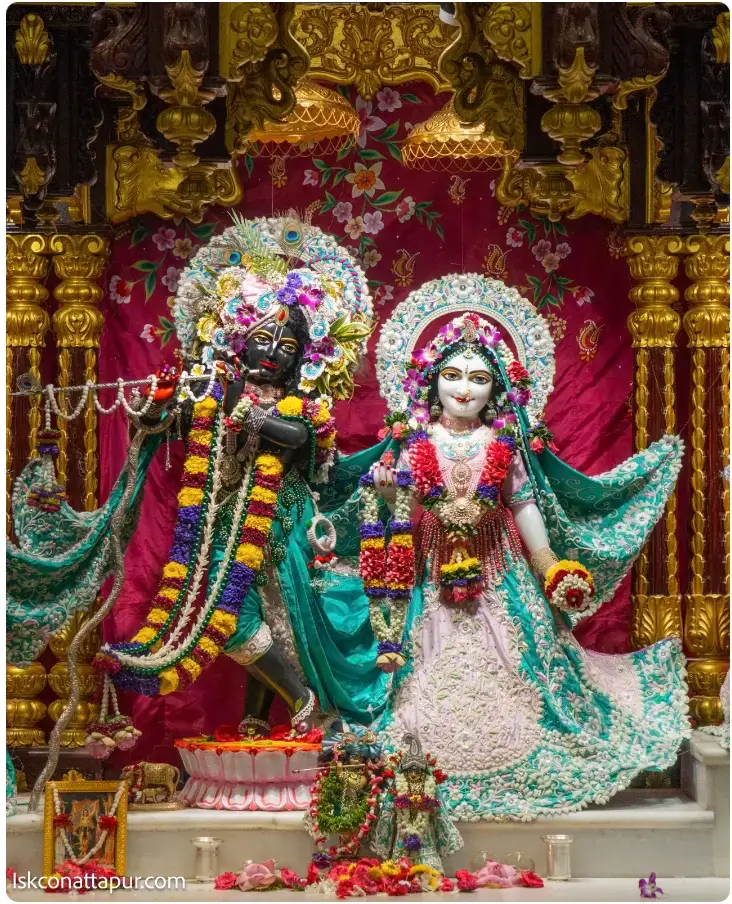
The refrain "Radhe Syam" is the combined glorification of the Divine Couple — Radhe invoking Srimati Radharani, the personification of the Lord's pleasure potency, and Syam invoking Sri Krsna, the all-attractive dark-complexioned Lord of Vraja. To sing Their names together is to glorify not Krsna alone but Krsna in the fullness of His most intimate loving relationships. This is the heart of Gaudiya Vaishnava bhakti: Radha and Krsna are one truth in two forms, and Their names sung together awaken the mood of pure devotional love.
Scriptural Source & Tradition
The bhajan was composed and popularized by Srila Bhaktivedanta Narayana Goswami Maharaja (1921–2010), a prominent acharya in the Gaudiya Vaishnava line and a close associate of Srila Bhakti Prajnana Kesava Goswami Maharaja. Its most profound theology appears in Verse 4: rādhā-kṛṣṇa mili aba dou, gaura-rūpa avatārī — "Radha and Krsna have united and now the two have come as the golden avatara." This declares that Sri Radha and Sri Krsna together descended as Sri Chaitanya Mahaprabhu — Krsna adopting the mood and golden complexion of Radha — expressly to preach kirtana-dharma, the congregational chanting of the holy names.
Commentary from the Acharyas
The term vraja-jana — the residents of Vraja — points to the Vrajavasis who live in constant, spontaneous loving relationship with Krsna: His parents, cowherd friends, the gopis, and even the cows, trees and rivers of Vrndavana. Krsna is their sukha-kari, the very source of their joy, and He in turn relishes serving and being loved by them. The bhajan moves from Krsna's enchanting form (peacock crown, makara earrings, vaijayanti garland, flute) through His Vraja pastimes (tending cows, lifting Govardhana) to the culminating revelation of His descent as Gaura, and finally to the singer's own surrender in Verse 5.
When to Sing / Chant
- In daily kirtan and satsang glorifying Sri Radha-Krsna
- During Vrindavana pilgrimage and Vraja-mandala parikrama
- On festivals such as Radhastami, Janmashtami and Gaura Purnima
- While meditating on Krsna's beauty and Vraja pastimes
- As a prayer of surrender — "I have no one but You"
Benefits for the Devotee
- Awakens loving remembrance of Sri Radha and Sri Krsna together
- Deepens attraction to Krsna's beautiful form and Vraja lila
- Connects the singer to the golden mission of Sri Chaitanya Mahaprabhu
- Purifies the heart through joyful glorification (kirtana)
- Cultivates the mood of exclusive surrender to the Lord
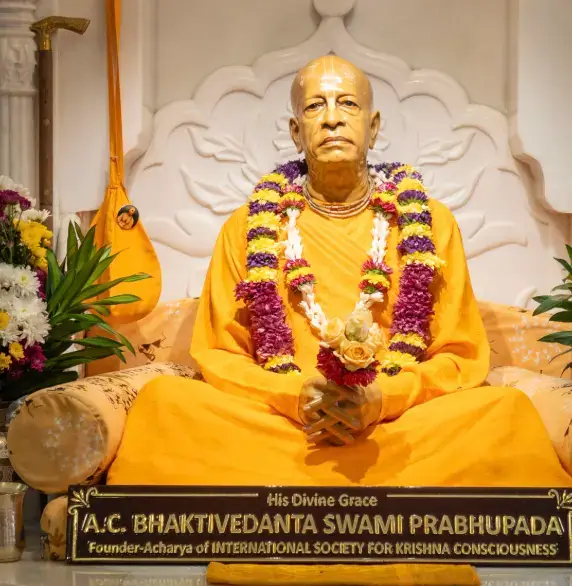
Gratitude to His Divine Grace A.C. Bhaktivedanta Swami Srila Prabhupada
We offer our humble obeisances at the lotus feet of our founder-acharya, His Divine Grace A.C. Bhaktivedanta Swami Srila Prabhupada, without whose causeless mercy the priceless prayers, bhajans and sacred literature of the Gaudiya Vaishnava tradition would have remained inaccessible to most of the world. By his herculean preaching efforts, his unparalleled translations and his founding of the International Society for Krishna Consciousness (ISKCON), the holy names, pastimes and instructions of Sri Sri Radha-Krishna and Sri Chaitanya Mahaprabhu are today chanted in every town and village.
nama om vishnu-padaya krishna-preshthaya bhu-tale
srimate bhaktivedanta-svamin iti namine
namas te sarasvate deve gaura-vani-pracharine
nirvishesha-shunyavadi-pashchatya-desha-tarine
All glories to Srila Prabhupada. All glories to the Vaishnava acharyas in the disciplic succession.
Share this article