Ahe Nila Shaila
By Salabega — Odia Bhajan for Rath Yatra
ଆହେ ନୀଳ ଶୈଳ — a Muslim devotee's prayer that stopped the Rath Yatra chariot
Also available in:
Salabega — The Devotee Who Stopped the Chariot
Salabega (also written Salabeg) was a Muslim poet-devotee of Lord Jagannatha who lived in approximately the 17th century in Odisha. Born to a Muslim father and a Hindu mother, Salabega became one of the most ardent devotees of Lord Jagannatha of Puri, composing devotional songs in Odia that are still sung to this day.
The most famous episode in his life: one year, Salabega fell ill while traveling to Puri to witness Rath Yatra. Unable to arrive in time, he composed an anguished prayer asking the Lord to wait for him. According to the tradition of Odisha, the Rath Yatra chariot stopped and could not be moved — by the combined efforts of hundreds of devotees — until Salabega arrived and had darshan. From that day, his prayer "Ahe Nila Shaila" became one of the most beloved bhajans of the Jagannatha tradition.
Verse 1
Ahe Nila Shaila, prabala matta barana Mo arata nalini banaku kara dalana Ahe Nila Shaila
O Lord of the Blue Mountain, mighty as a rutting elephant! Do grace my afflicted lotus-pond. O Lord of the Blue Mountain.
Verse 2
Gajaraja chinta kala thai ghora jalena Chakra pesi nakra nasi uddharila apana Ahe Nila Shaila
The king of elephants prayed in troubled waters. Thou saved him by killing the crocodile with Thy Sudarshana disc. O Lord of the Blue Mountain.
Verse 3 — The Miracle of Rath Yatra
Ghora bane mruguni padithila kasana Kede bada bippati ru kariacha tarana Ahe Nila Shaila
Like a doe trapped in a dense forest, Draupadi was in desperate peril. From such great danger Thou protected her. O Lord of the Blue Mountain.
Verse 4
Kuru sabha tale suni Draupadi ra janana Koti vastra dei hele lajya kala barana Ahe Nila Shaila
Hearing Draupadi's cry from the Kuru assembly hall, Thou saved her honour by providing infinite cloth. O Lord of the Blue Mountain.
Verse 5
Kahe Salabega hina jati re mun jabana Sriranga charana tale karuachi janana Ahe Nila Shaila
Thus entreats Salabega — lowly by caste, a Muslim by birth — Seeking refuge at the lotus feet of Sri Ranga (Lord Jagannatha). O Lord of the Blue Mountain.
Copy all text
Ahe Nila Shaila and Rath Yatra 2026
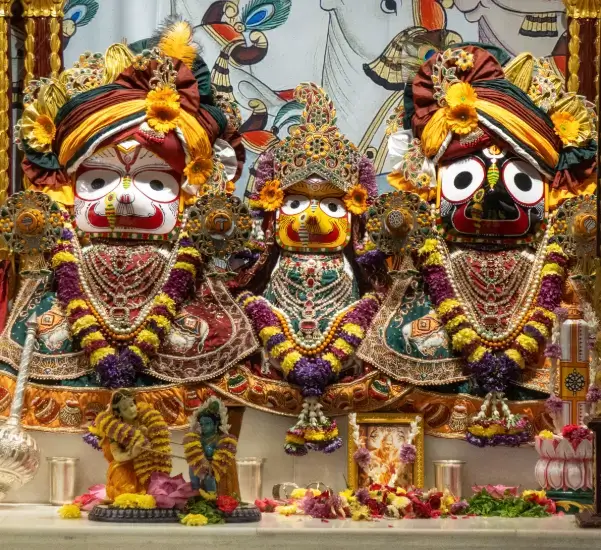
Rath Yatra 2026 falls on Thursday, July 16, 2026 in Puri, Odisha. Salabega's bhajan is one of the most beloved songs sung as the three chariots of Lord Jagannatha, Lord Balabhadra and Goddess Subhadra proceed down the Grand Road (Bada Danda) toward the Gundicha Temple.
The story of the chariot stopping for Salabega is a living testimony to Lord Jagannatha's title Patitapavana — the Purifier of the fallen. His temple in Puri is known as a place where caste, birth and social station are set aside: only devotion matters.
Spiritual Significance
Salabega's devotion transcends the ordinary boundaries of religious identity. As a Muslim who composed Odia bhajans to Lord Jagannatha, he embodies the teaching of the Bhagavad-gita (18.55): "bhaktyā mām abhijānāti" — "Through devotion one comes to know Me." Lord Jagannatha, whose name means Lord of the Universe, is the universal God who accepts the love of every sincere heart.
Scriptural Source & Tradition
Salabega's songs are part of the classical Odia pada (devotional poetry) tradition that flourished from the 12th to 17th centuries alongside the great Panchasakha movement. His poems are preserved in Odia literature and continue to be sung at the Jagannatha temple in Puri and at ISKCON Rath Yatras worldwide. The miracle of the chariot stopping is a tradition known throughout Odisha.
Commentary from the Acharyas
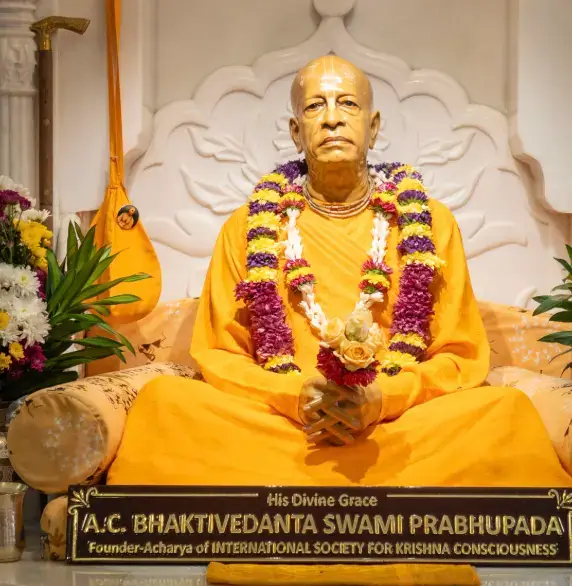
Srila Prabhupada emphasized that Lord Jagannatha is Patitapavana — the savior of the most fallen. He introduced Rath Yatra outside India in 1967 in San Francisco, declaring that anyone who sees the Lord on the chariot receives tremendous spiritual benefit, regardless of birth or background. Salabega's life and prayer are the perfect illustration of this universal mercy.
When to Sing / Chant
- During Rath Yatra processions and kirtan programs
- On Snana Yatra (bathing festival of Lord Jagannatha)
- During Jagannatha darshan at any ISKCON temple
- When contemplating the universal mercy of Lord Jagannatha
- As a prayer of longing when one cannot be present at Rath Yatra
Benefits for the Devotee
- Awakens intense longing for Lord Jagannatha's darshan
- Deepens understanding of Patitapavana — the Lord who saves the most fallen
- Connects the singer to the miracle of Rath Yatra
- Inspires transcendence of social barriers through pure devotion
- Invokes the special mercy of Lord Jagannatha for all sincere seekers
Gratitude to His Divine Grace A.C. Bhaktivedanta Swami Srila Prabhupada
We offer our humble obeisances at the lotus feet of our founder-acharya, His Divine Grace A.C. Bhaktivedanta Swami Srila Prabhupada, without whose causeless mercy the priceless prayers, bhajans and sacred literature of the Gaudiya Vaishnava tradition would have remained inaccessible to most of the world. By his herculean preaching efforts, his unparalleled translations and his founding of the International Society for Krishna Consciousness (ISKCON), the holy names, pastimes and instructions of Sri Sri Radha-Krishna and Sri Chaitanya Mahaprabhu are today chanted in every town and village.
nama om vishnu-padaya krishna-preshthaya bhu-tale
srimate bhaktivedanta-svamin iti namine
namas te sarasvate deve gaura-vani-pracharine
nirvishesha-shunyavadi-pashchatya-desha-tarine
All glories to Srila Prabhupada. All glories to the Vaishnava acharyas in the disciplic succession.
Share this article