
Weekly Satsang Sessions
Confirm your attendance for our upcoming ISKCON Krishna Consciousness sessions.
Next session details coming soon
Our coordinators will announce the next satsang shortly. You can still see live counts below as soon as a session is scheduled. Hare Krishna!
Live Attendee List
You can cancel your own entry below. To edit details, please cancel and re-submit.
Be the first to confirm — your name will appear here.
Confirm your attendance
Attendance opens once the next session is scheduled. Please check back soon.
Location & Schedule
When
Every Saturday
6:00 PM – 8:00 PM
Where
Nallagandla, Hyderabad
Telangana, India
Our weekly satsang is held in the Nallagandla neighbourhood of western Hyderabad (Cyberabad corridor), conveniently accessible from Gachibowli, Kondapur, Manikonda and Tellapur. The exact venue address is shared with registered attendees — use the RSVP form above to receive location details on WhatsApp.
First-Time Visitor's Guide
No experience required. Whether you have never chanted a mantra or have practised bhakti for years, you will feel at home. There is no dress code, no membership and no registration fee — just come with an open mind and comfortable, modest clothes.
What to expect on arrival. The session begins with group chanting of the Hare Krishna maha-mantra (kirtan), followed by a verse-by-verse Bhagavad-gita or Srimad-Bhagavatam class. After the class there is time for questions and answers, then everyone honours prasadam — delicious vegetarian food offered to Krishna. The whole programme typically runs about two hours.
Families and children are warmly encouraged to attend. Children typically join the kirtan and can participate in age-appropriate devotional activities.
What to bring. Nothing is required, but you may bring a copy of the Bhagavad-gita As It Is if you have one. Prasadam is provided. If you have a dietary restriction, let us know in advance via WhatsApp.
What is Satsang?
Satsang (Sanskrit: sat — eternal truth; sanga — association) is the time-honoured Vedic practice of gathering with like-minded seekers to hear, chant and discuss the science of self-realisation. Srimad-Bhagavatam (3.25.25) declares that even a moment's association with pure devotees can completely change the course of one's life: satam prasangan mama virya-samvido / bhavanti hrt-karna-rasayanah katha.
Lord Krishna Himself says in Bhagavad-gita (10.9), mac-citta mad-gata-prana / bodhayantah parasparam — His devotees enlighten each other and derive great satisfaction by always conversing about Him. A weekly Krishna-conscious satsang preserves this current of pure consciousness in our busy modern lives.
What Happens in Our Sessions
- Kirtan — group chanting of the Hare Krishna maha-mantra and traditional Gaudiya Vaishnava bhajans
- Bhagavad-gita / Srimad-Bhagavatam class — verse-by-verse study using Srila Prabhupada's translations and purports
- Discussion & Q&A — clarifying doubts and applying scripture to everyday life
- Prasadam — sanctified vegetarian food offered to Lord Krishna and honoured together
- Children's engagement — age-appropriate activities so the whole family benefits
Benefits of Regular Satsang
- Steady reduction of stress, anxiety and mental restlessness
- Practical guidance on applying Bhagavad-gita to work, relationships and decisions
- Inspiration to maintain a daily japa and reading practice
- A protective spiritual community for children and elders alike
- Direct, experiential answer to "Who am I?" and "What is the goal of life?"
Who Should Attend?
Everyone is welcome — no prior knowledge of Sanskrit, scripture or chanting is required. Whether you are a long-time follower of Srila Prabhupada, a first-time visitor, a curious student of Indian philosophy, or simply someone searching for peace, you will find a place here. There is no fee, no membership, no obligation — only the heartfelt invitation to come, hear, and taste the holy name.
The Bhagavad Gita — Our Study Text
The centerpiece of our weekly study session is the Bhagavad-gita As It Is, Srila Prabhupada's landmark translation and commentary. The Bhagavad-gita is a 700-verse dialogue between Lord Krishna and the warrior Arjuna, spoken on the battlefield of Kurukshetra approximately 5,000 years ago. In it, Krishna covers the entire science of self-realization — the nature of the eternal soul, the difference between the body and the self, the mechanics of karma, the path of devotion, and the ultimate purpose of human life. The text is not a sectarian scripture but a precise philosophical investigation that begins with the question every human being eventually asks: "Who am I, and what is the goal of my existence?"
Srila Prabhupada's "As It Is" translation is distinguished by its fidelity to the original teacher. Rather than filtering Krishna's words through modern interpretations, Prabhupada presents each verse with word-by-word Sanskrit meaning, a clean translation, and a purport that contextualizes the verse within the broader Vaishnava philosophical tradition and applies it to contemporary life. Thousands of people across religious backgrounds — Hindus, Christians, agnostics, scientists, students — have found this translation to be not only philosophically rigorous but genuinely transformative when read with regular study and discussion.
At our weekly sessions, we study one or two verses at a time with discussion, questions, and personal application. This slow, deliberate pace allows every concept to land — there is no rush through the text. Newcomers are encouraged to ask any question, no matter how basic. The goal is not to finish the book but to let the book finish us — to let its wisdom gradually reshape how we see ourselves, our relationships, and our purpose.
Kirtan — The Heart of Satsang
Kirtan is the congregational chanting of the Lord's names — typically the Hare Krishna Maha-mantra (Hare Krishna Hare Krishna Krishna Krishna Hare Hare / Hare Rama Hare Rama Rama Rama Hare Hare) along with traditional Gaudiya Vaishnava bhajans. The format is simple: one person or a small group sings a line, and everyone else repeats it. This call-and-response pattern — known as sankirtan — creates an immediate sense of participation, so that even someone who has never heard these mantras before can join in from the very first session. There are no performance expectations, no right or wrong way to participate, and no minimum volume requirement. Whether you chant quietly or sing out, the holy name reaches the heart.
The Srimad-Bhagavatam and Chaitanya-Charitamrita describe kirtan as the most powerful spiritual practice of the current age — more accessible than meditation, more sustainable than strict austerity, and more inclusive than ritualistic sacrifice. Sri Chaitanya Mahaprabhu began His movement of kirtan in 15th-century Bengal precisely because it required no qualification, no caste, no prior knowledge — only an open ear and a willing voice. Srila Prabhupada brought this same kirtan to the West in 1966, introducing the Hare Krishna mantra in New York's Tompkins Square Park. Today the same mantra echoes in our Nallagandla sessions every Saturday, connecting us to an unbroken chain of chanters stretching back five hundred years.
Prasadam — Sanctified Food
Every session ends with the honouring of prasadam — vegetarian food that has been prepared with devotion, offered to Lord Krishna on the altar with prayers and mantras, and then received by the devotees. The Vedic principle is straightforward: Krishna is the Supreme enjoyer, and when food is first offered to Him, it becomes spiritually transformed. The scripture Bhagavad-gita (9.26) records the Lord's own words: "If one offers Me with love and devotion a leaf, a flower, fruit, or water, I will accept it." What is offered with devotion and received back from the Lord is no longer ordinary food — it carries His mercy, and honouring it is itself a form of devotional service.
The practical implication is simple: all food prepared for our satsang is purely vegetarian, contains no onion or garlic (which are considered in the mode of ignorance), and is cooked and offered by devotees. Newcomers sometimes wonder why these distinctions matter — the answer is that what we eat affects how we think and feel. The Bhagavad-gita (17.8–10) categorizes foods by their influence on consciousness. Prasadam — offered food received from Krishna — is considered the most spiritually elevating of all. Sharing prasadam together at the end of satsang is not just a meal; it is a direct experience of the Lord's grace extending from the altar to the community.
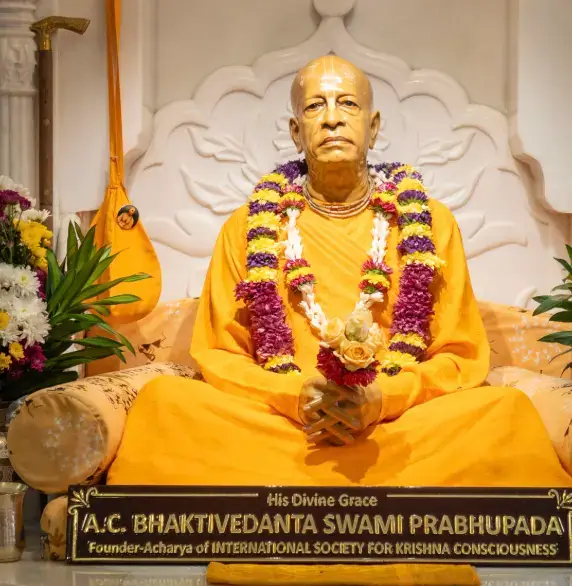
Gratitude to His Divine Grace A.C. Bhaktivedanta Swami Srila Prabhupada
We offer our humble obeisances at the lotus feet of our founder-acharya, His Divine Grace A.C. Bhaktivedanta Swami Srila Prabhupada, without whose causeless mercy the priceless prayers, bhajans and sacred literature of the Gaudiya Vaishnava tradition would have remained inaccessible to most of the world. By his herculean preaching efforts, his unparalleled translations and his founding of the International Society for Krishna Consciousness (ISKCON), the holy names, pastimes and instructions of Sri Sri Radha-Krishna and Sri Chaitanya Mahaprabhu are today chanted in every town and village.
nama om vishnu-padaya krishna-preshthaya bhu-tale
srimate bhaktivedanta-svamin iti namine
namas te sarasvate deve gaura-vani-pracharine
nirvishesha-shunyavadi-pashchatya-desha-tarine
All glories to Srila Prabhupada. All glories to the Vaishnava acharyas in the disciplic succession.