Vrindavan Ramyasthan
Beautiful description of divine Vrindavan
Sanskrit Verses
Verse 1
Vrindabana ramya-sthana divya-cintamani-dhama ratana-mandira manohara avrta kalindi-nire raja-hamsa keli kore tahe sobhe kanaka-kamala
Verse 2
tara madhye hema-pitha asta-dale vestita asta-dale pradhana nayika tara madhye ratnasane bosi' achen dui-jane syama-sange sundari Radhika
Verse 3
o-rupa-lavanya-rasi amiya poriche khasi' hasya-parihasa-sambhasane narottama-dasa koy nitya-lila sukha-moy sadai sphuruka mora mane
Translation
1) Beautiful Vrndavana is filled with cintamani gems and many jewelled palaces and temples. Many regal swans play in the waters of the Yamuna, and in those waters a splendid golden lotus flower grows.
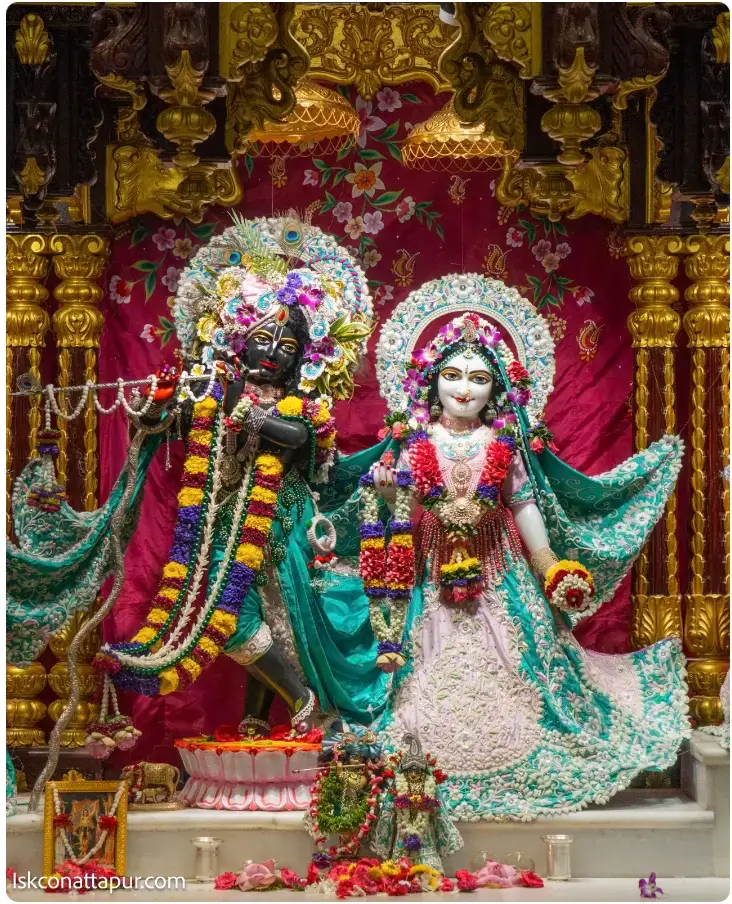
2) In the middle of that lotus is a golden place surrounded by eight petals. On these eight petals the eight principal gopis reside, and in the center Lord Syamasundara and beautiful Srimati Radharani sit on a jewelled throne.
3) The great beauty of the Divine Couple, and Their charming joking and laughter appears to be constantly showering nectar everywhere. Narottama dasa says: I pray that these blissful eternal transcendental pastimes of the Divine Couple may be always manifest in my heart.
Spiritual Significance
Vrindabana Ramya-sthana by Srila Narottama Dasa Thakura is a meditative description of the eternal spiritual Vrindavan — not merely the geographical town on Earth, but the chintamani-dhama: a self-luminous abode of touchstone jewels, jewelled temples, golden lotuses on the Yamuna, and the eight principal gopis surrounding Sri Sri Radha-Syamasundara on their jewelled throne. By singing this bhajan one is engaging in manasi-seva, internal devotional service that the Goswamis of Vrindavan declared to be the goal of all sadhana.
Scriptural Source & Tradition
The song belongs to Prarthana, the prayer-book compiled by Srila Narottama Dasa Thakura (1531-1611) — a direct recipient of mercy from Sri Lokanatha Goswami and Sri Krishnadasa Kaviraja, the author of Sri Chaitanya-charitamrita. The description matches the meditation given in Sri Brahma-samhita (5.2-5.6) on Goloka Vrindavan and in Srila Rupa Goswami's Sri Krishna-bhavanamrita.
Commentary from the Acharyas
Srila Prabhupada explained in his Brahma-samhita purports that Goloka Vrindavan is described as "chintamani-prakara-sadmasu kalpa-vriksha" — built of wish-fulfilling gems where every tree is a desire-tree. Narottama Dasa Thakura's verses are an eyewitness account by a self-realised soul; reading them is considered as effective as personal pilgrimage by many acharyas of the line.
Srila Visvanatha Chakravarti Thakura, commenting on the ashta-sakhi arrangement, points out that the eight principal gopis (headed by Lalita and Vishakha) form a permanent lotus around the Divine Couple, and that each devotee in raganuga-bhakti seeks shelter under one of these sakhis.
When to Sing / Chant
- During the holy month of Kartik (Damodara-vrata)
- At sunset arati and before evening Krishna-katha
- On Radhastami, Vrindavan Yatra, and Kartik parikrama programs
- For internal meditation while remembering Vrindavan from any city
Benefits for the Devotee
- Develops attachment for the spiritual Vrindavan above the material body
- Awakens taste (ruchi) for hearing of Radha-Krishna's pastimes
- Purifies the mind of mundane imagery by replacing it with Goloka's beauty
- Forms the basis of asta-kaliya-lila smaranam — eightfold daily meditation
- Prepares the sadhaka for eventual entry into Krishna's eternal pastimes
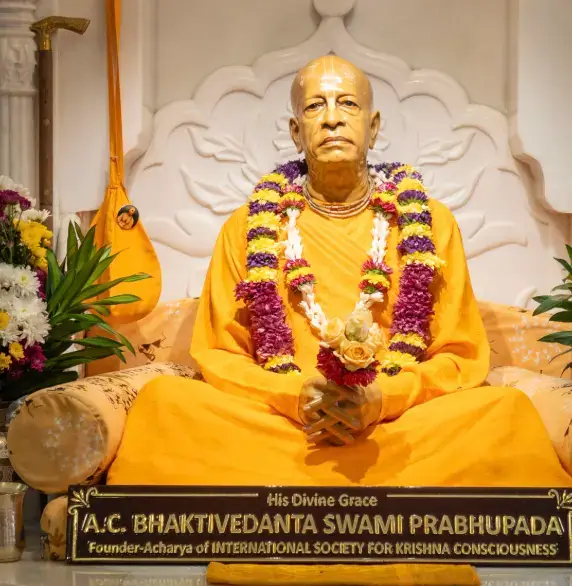
Gratitude to His Divine Grace A.C. Bhaktivedanta Swami Srila Prabhupada
We offer our humble obeisances at the lotus feet of our founder-acharya, His Divine Grace A.C. Bhaktivedanta Swami Srila Prabhupada, without whose causeless mercy the priceless prayers, bhajans and sacred literature of the Gaudiya Vaishnava tradition would have remained inaccessible to most of the world. By his herculean preaching efforts, his unparalleled translations and his founding of the International Society for Krishna Consciousness (ISKCON), the holy names, pastimes and instructions of Sri Sri Radha-Krishna and Sri Chaitanya Mahaprabhu are today chanted in every town and village.
nama om vishnu-padaya krishna-preshthaya bhu-tale
srimate bhaktivedanta-svamin iti namine
namas te sarasvate deve gaura-vani-pracharine
nirvishesha-shunyavadi-pashchatya-desha-tarine
All glories to Srila Prabhupada. All glories to the Vaishnava acharyas in the disciplic succession.