
The Ten Offenses to the Holy Name
Important guidelines from Padma Purana by Vyasadeva.
Every devotee who claims to be a Vaishnava must guard against these offenses in order to quickly achieve the desired success — Krishna Prema.
Understanding the Ten Offenses
The ten offenses to the holy name (nama-aparadha) are found in the Padma Purana (Brahma-khanda) and were quoted by Sri Sanatana Goswami in the Hari-bhakti-vilasa, the authoritative code of Vaishnava conduct. Sri Chaitanya Mahaprabhu's associates — particularly Srila Jiva Goswami in his Bhakti-sandarbha — discussed these offenses in depth, and Srila Bhaktivinoda Thakura devoted an entire treatise, Sri Harinama-chintamani, to explaining each one and its remedy.
Srila Prabhupada personally emphasized these as the greatest danger to spiritual progress, declaring that "offensive chanting will not bear fruit." These are not minor technicalities — they describe the specific attitudes and behaviors that block the transformative power of the holy name. The good news is that the holy name itself, chanted continuously with the sincere desire to be free from offense, will gradually purify the chanter of all aparadhas.
Offense 1: Blaspheming the Devotees of the Lord
To blaspheme the devotees who have dedicated their lives for propagating the holy name of the Lord.
A sadhu is one who has surrendered everything to spread Krishna consciousness, and finding fault with such a person — even internally — poisons the heart against the very source of spiritual inspiration. Srila Prabhupada taught that the Lord takes blasphemy of His devotee more seriously than blasphemy of Himself, because the devotee is dearer to the Lord than His own body. When we criticize a sincere preacher of the holy name, we indirectly reject the Lord who sent him.
Offense 2: Equating Demigods with the Supreme Lord
To consider the names of demigods like Lord Shiva or Lord Brahma to be equal to or independent of the name of the Lord Vishnu.
Demigods are exalted souls fully deserving of respect, but the offense arises when one treats their names as interchangeable with the Supreme Lord's names. The Padma Purana is clear that Vishnu alone is the Supreme Personality of Godhead; Shiva and Brahma are His devoted servants. Chanting 'Shiva Shiva' with the belief that it awards the same result as 'Hare Krishna' is the specific offense — it conflates the energetic with the source of all energy.
Offense 3: Disobeying the Orders of the Spiritual Master
To disobey the orders of the spiritual master.
The guru is not merely a teacher — he is the medium through whom the Lord's mercy reaches the disciple. The Vedic principle is that the holy name enters the heart through the guru's grace, so deliberately rejecting the guru's instructions while chanting cuts off that very channel. This offense refers not to accidental failures but to a willful attitude of disobedience — the conviction that one's own understanding supersedes the guru's realization.
Offense 4: Blaspheming the Vedic Scriptures
To blaspheme the vedic scriptures or scriptures in pursuance to the vedic version.
The Vedas, Upanishads, Puranas, and scriptures following the Vedic conclusion are the Lord's guidance in textual form. To dismiss them as myth, superstition, or mere cultural narrative is to reject the very source that reveals the holy name's glories and instructs how to chant it properly. Without this scriptural foundation, the chanter has no basis for the faith that makes chanting transformative — because it is the scriptures that establish the holy name as non-different from the Lord Himself.
Offense 5: Considering the Glories of the Holy Name to Be Imagination
To consider the glories of chanting Hare Krishna to be an imagination.
This may be the most widespread offense in the modern age: treating the scriptural declaration that 'chanting Hare Krishna delivers one from all suffering' as poetic exaggeration. The scriptures are unambiguous — the holy name is the para-shakti, the supreme potency of the Lord, not a metaphor or cultural symbol. Doubting its power while mechanically chanting is like taking medicine while convinced it will not work — the medicine is real, but doubt prevents its absorption.
Offense 6: Giving Material Interpretations to the Holy Name
To give some interpretations to the holy name of the Lord.
The holy name is complete in itself and does not need 'translation' into psychological symbolism, vibration science, or cultural metaphor to function. When someone chants 'Hare Krishna' while understanding it only as 'cosmic positive energy' rather than a direct address to the Lord and His divine energy Hara, the transcendental dimension of the name is bypassed. Srila Prabhupada consistently warned that the holy name must be received in its original transcendental form through the devotional channel — not filtered through the material mind.
Offense 7: Committing Sins on the Strength of the Holy Name
To commit sinful activities on the strength of the holy name.
This is the deliberate spiritual exploitation of the holy name's mercy: thinking 'I can sin freely because I will simply chant and be forgiven afterward.' The holy name does indeed have the power to destroy unlimited sins — but this power serves one who takes shelter out of genuine remorse and surrender, not one who uses the name as a license for continued wrongdoing. The Srimad-Bhagavatam (6.2.9–10) draws this distinction explicitly, calling the deliberate sin-after-chanting approach a form of the greatest deceit.
Offense 8: Equating the Holy Name with Karma-kanda Rituals
To consider the chanting of Hare Krishna as one of the auspicious ritualistic activities which are offered in the Vedas as frutive activities (Karma kanda).
Vedic literature prescribes many yajnas and ritualistic activities for material purification, prosperity, and merit — these constitute karma-kanda. The holy name operates on a categorically different level: it acts directly on the soul, not merely the material body or destiny, and its benefit is transcendental rather than temporary. To rank nama-kirtana as another seasonal religious duty is to miss its absolute superiority over all other spiritual processes and to approach it with a transactional rather than devotional consciousness.
Offense 9: Instructing a Faithless Person in the Glories of the Holy Name
To instruct a faithless person about the glories of the holy name.
This offense does not prohibit sharing Krishna consciousness broadly — the entire mission of ISKCON is preaching. The specific problem is sharing the deepest glories of the holy name with someone who has clearly expressed contempt for it. Such a person cannot receive the teaching and may blaspheme, creating harm for both parties. The instruction is therefore to first cultivate basic respect and interest, then progressively reveal the holy name's deeper glories as the other person's faith grows — discernment in preaching protects both the message and the listener.
Offense 10: Inattention and Maintained Material Attachment
To not have complete faith in the chanting of the holy name and to maintain material attachments, even after understanding so many instructions on this matter. It is also an offense to be inattentive while chanting.
This final offense is the subtlest and most persistent for practicing devotees. Even after intellectually understanding all nine of the above offenses, if the chanter lets the mind wander freely to material plans, worries, and desires during japa, the holy name's full potency cannot manifest in the heart. Srila Prabhupada taught that sixteen rounds of japa chanted with full attention far exceed sixty-four rounds of distracted repetition. The antidote is the 'hearing mood' — genuinely listening to each syllable of the holy name as it passes the lips.
How to Be Free from Offenses
The process for becoming free from offenses (aparadha-bhanjana) involves three sincere steps: recognizing the offense, genuinely repenting with a humble heart, and continuing to chant with corrected consciousness in the association of advanced devotees. Srila Bhaktivinoda Thakura writes in Sri Harinama-chintamani that the holy name is so merciful it will forgive all offenses if the chanter sincerely approaches it with remorse — the name itself is the healer.
However, there is one critical warning the scriptures repeat emphatically. The verse namnad balad yasya hi papa-buddhih declares: one who commits sins thinking "the holy name will protect me anyway" commits namaparadha of the most serious kind. This is the seventh offense taken to its extreme — the deliberate exploitation of the Lord's mercy. For such a person, the Lord withholds His full presence in the name until genuine repentance arises.
The practical remedy, taught by Sri Chaitanya Mahaprabhu Himself, is humility — trnad api sunicena: "be more humble than a blade of grass." A devotee who cultivates genuine lowliness naturally avoids most offenses, because arrogance is the root from which they all grow. The Mahaprabhu also specifically recommended seeking forgiveness from any Vaishnavas one has offended, directly if possible, as the most effective means of clearing aparadha from the heart.
Taking shelter of the association of devotees (sadhu-sanga) is the most powerful protection against offenses. When we regularly sit in the company of those who are genuinely free from aparadha, their consciousness elevates our own. The Srimad-Bhagavatam (3.25.25) confirms: in the association of pure devotees, discussion of the Lord's glories becomes the greatest pleasure for both heart and ear.
The Significance of Chanting Without Offense
When one chants the holy name free from all ten offenses — what is called shuddha-nama, the pure holy name — the result is described in the scriptures as swift and certain. Srila Rupa Goswami writes in Bhakti-rasamrta-sindhu that shuddha-nama quickly awards krishna-prema, pure love of God, which is the highest achievement of human life and a goal that far exceeds even liberation from the cycle of birth and death. The pure holy name does not merely cleanse sins — it awakens the dormant love for Krishna that exists in the heart of every living being.
The classic example of the holy name's extraordinary mercy is the story of Ajamila from the Sixth Canto of Srimad-Bhagavatam. Ajamila was a fallen Brahmin who spent his life in adultery, theft, and intoxication. At the moment of death, the messengers of Yamaraja came to take him to punishment. In his panic, he called out to his youngest son, whose name happened to be Narayana — and in that instant, the Vishnu-dutas appeared and drove away the Yamadutas, declaring that even this unconscious utterance of the Lord's name had awarded Ajamila liberation. He was not chanting offenselessly — he was not even deliberately chanting at all — yet even namabhasa (the shadow of the holy name) was powerful enough to deliver him. This gives us immense hope: if even the shadow of the name carries such potency, what does the full shuddha-nama accomplish in a heart that has genuinely taken shelter, free from the ten offenses?
Spiritual Significance
The Ten Offences to the Holy Name(nama-aparadha) are the single most important checklist for any practitioner of mantra-meditation. Sri Chaitanya Mahaprabhu personally taught that while the holy name has the power to deliver any soul, that power is obstructed when the chanter cultivates offensive attitudes. Understanding and consciously avoiding these ten offences is what transforms mechanical chanting into shuddha-nama — the pure holy name that quickly awakens love of God.
Scriptural Source & Tradition
The list is from the Padma Purana and is quoted in Sri Hari-bhakti-vilasa (the Vaishnava code-book compiled by Sri Sanatana Goswami) and in Sri Chaitanya- Charitamrita (Madhya 24.330–333). Srila Jiva Goswami discusses it extensively in his Bhakti-sandarbha.
Commentary from the Acharyas
Srila Prabhupada wrote in The Nectar of Devotion that "in the beginning, an offender chanting the holy name does not attain pure love, but if he continues to chant without committing these ten offences, the holy name itself will cleanse his heart of all aparadhas." This is the great hope in the system: the medicine cures even those who initially take it wrongly.
Srila Bhaktivinoda Thakura, in his Sri Harinama-chintamani, devotes an entire book to explaining each of the ten offences in detail and gives the practical remedy — sincere remorse and continued chanting in the association of advanced devotees.
When to Sing / Chant
- Reviewed weekly by every sincere japa practitioner
- Read out at the start of nama-hatta groups and bhakti-shastri classes
- Taught to all new initiates before they receive japa-mala
- Referred to whenever chanting feels dry or distracted — to diagnose the cause
Benefits for the Devotee
- Rapidly clears the inner obstacles that block the experience of the holy name
- Cultivates respect for Vaishnavas — the most important quality in bhakti-yoga
- Protects the devotee from the most subtle and dangerous form of misuse
- Develops the discrimination needed to mature from namabhasa to shuddha-nama
- Ultimately opens the door to krishna-prema, the goal of human life
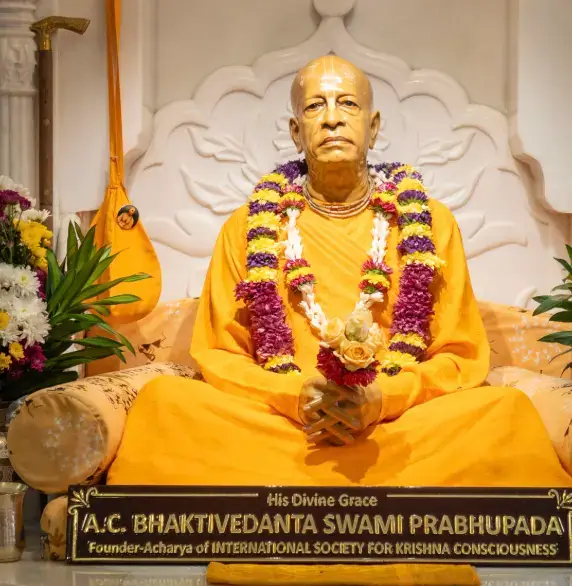
Gratitude to His Divine Grace A.C. Bhaktivedanta Swami Srila Prabhupada
We offer our humble obeisances at the lotus feet of our founder-acharya, His Divine Grace A.C. Bhaktivedanta Swami Srila Prabhupada, without whose causeless mercy the priceless prayers, bhajans and sacred literature of the Gaudiya Vaishnava tradition would have remained inaccessible to most of the world. By his herculean preaching efforts, his unparalleled translations and his founding of the International Society for Krishna Consciousness (ISKCON), the holy names, pastimes and instructions of Sri Sri Radha-Krishna and Sri Chaitanya Mahaprabhu are today chanted in every town and village.
nama om vishnu-padaya krishna-preshthaya bhu-tale
srimate bhaktivedanta-svamin iti namine
namas te sarasvate deve gaura-vani-pracharine
nirvishesha-shunyavadi-pashchatya-desha-tarine
All glories to Srila Prabhupada. All glories to the Vaishnava acharyas in the disciplic succession.