
Sri Nama-kirtana
Chanting of the Holy Names from Gitavali by Srila Bhaktivinoda Thakura
About Sri Nama-kirtana
Sri Nama-kirtana is composed by Srila Bhaktivinoda Thakura (1838–1914), one of the most revered Vaishnava acharyas of the 19th century and the father of Srila Bhaktisiddhanta Sarasvati Thakura, who is the spiritual master of Srila Prabhupada. The song appears in his celebrated collection Gitavali, a treasury of original Bengali devotional songs that describe the philosophy and pastimes of Krishna consciousness in the mood of loving devotion.
Sri Nama-kirtana is sung at evening kirtan programs and nama-sankirtana gatherings throughout the Gaudiya Vaishnava world. Its structure is intentional: the opening verse (beginning with yasomati-nandana) glorifies Krishna through His intimate names in Vrindavana, while the second verse turns to glorify the holy names themselves — amala harinam amiya-vilasa, "these pure, holy names of Lord Hari are full of nectarean pastimes." Each subsequent verse weaves together descriptions of Krishna's qualities, His relationships, and His divine activities, culminating in the final verse where Bhaktivinoda Thakura signs the song as bhakativinod-asraya — "the shelter of Bhaktivinoda" — a traditional practice of Vaishnava poets who place themselves as the last devotee seeking refuge at the Lord's feet.
The bhajan is notable for its density of Krishna's names: in just four verses, the Thakura strings together over twenty distinct names and qualities of the Lord. This is not mere poetic ornamentation — each name describes a specific aspect of Krishna's personality and relationship with His devotees, and hearing them sung in the bhajan creates a profound meditation on the Lord's transcendental form.
Sanskrit Verses
Verse 1
yasomati-nandana, braja-baro-nagara, gokula-ranjana kana gopi-parana-dhana, madana-manohara, kaliya-damana-vidhana
Verse 2
amala harinam amiya-vilasa vipina-purandara, navina nagara-bora, bamsi-badana suvasa
Verse 3
braja-jana-palana, asura-kula-nasana nanda-godhana-rakhowala govinda madhava, navanita-taskara, sundara nanda-gopala
Verse 4
yamuna-tata-cara, gopi-basana-hara, rasa-rasika, kripamoya sri-radha-vallabha, brindabana-natabara, bhakativinod-asraya
Translation
1) Lord Krishna is the beloved son of mother Yasoda; the transcendental lover in the land of Vraja; the delight of Gokula; Kana [a nickname of Krishna]; the wealth of the lives of the gopis. He steals the mind of even Cupid and punishes the Kaliya serpent.
2) These pure, holy names of Lord Hari are full of sweet, nectarean pastimes. Krishna is the Lord of the twelve forests of Vraja, He is ever-youthful and is the best of lovers. He is always playing on a flute, and He is an excellent dresser.
3) Krishna is the protector of the inhabitants of Vraja; the destroyer of various demoniac dynasties; the keeper and tender of Nanda Maharaja's cows; the giver of pleasure to the cows, land, and spiritual senses; the husband of the goddess of fortune; the butter thief; and the beautiful cowherd boy of Nanda Maharaja.
4) Krishna wanders along the banks of the River Yamuna. He stole the garments of the young damsels of Vraja who were bathing there. He delights in the mellows of the rasa dance; He is very merciful; the lover and beloved of Srimati Radharani; the great dancer of Vrindavana; and the shelter and only refuge of Thakura Bhaktivinoda.
The Glories of the Holy Name in Scripture
The practice of nama-kirtana — congregational chanting of the holy names — is declared in the Vedic scriptures to be the yuga-dharma, the primary spiritual practice for this age of Kali. The Srimad-Bhagavatam (12.3.51) states: kaler dosa-nidhe rajann / asti hy eko mahan gunah / kirtanad eva krishnasya / mukta-sangah param vrajet — "My dear King, although Kali-yuga is an ocean of faults, there is still one good quality about this age: simply by chanting the Hare Krishna maha-mantra, one can become free from material bondage and be promoted to the transcendental kingdom." The word kirtanad — "by kirtana" — encompasses both the individual japa and the congregational singing of the Lord's names, both of which are glorified in Sri Nama-kirtana.
Sri Chaitanya Mahaprabhu explained in Chaitanya-Charitamrita (Antya 20.9) the extraordinary position of the holy name in this age: harer nama harer nama / harer namaiva kevalam / kalau nasty eva nasty eva / nasty eva gatir anyatha — "In this age of Kali there is no other way, no other way, no other way for self-realization than to chant the holy name, chant the holy name, chant the holy name of Lord Hari." The triple repetition of "no other way" is deliberate — it emphasizes that in the current age, when sacrificial rituals, yoga practice, and philosophical study are all difficult to execute perfectly, nama-kirtana alone can fully carry a sincere practitioner to liberation and beyond.
Srila Prabhupada, commenting on this verse, wrote: "The process of chanting the Hare Krishna maha-mantra is so powerful that even if one chants with offenses, the chanting will gradually cleanse the dirt from the mirror of the mind and reveal the pure self." The song Sri Nama-kirtana, by stringing together the Lord's names in their natural Vrindavana context — the cowherd boy who steals butter, who dances the rasa dance, who plays the flute by the Yamuna — creates exactly the meditative environment in which the holy name can work most deeply on the consciousness.
Spiritual Significance
Sri Nama-kirtana is a dense garland of Krishna's transcendental names from Gitavali. Each name describes a different facet of the Lord — His relationships (son of Yasoda, lover of Radha), His pastimes (Kaliya-slayer, butter-thief, Govardhan-lifter), and His qualities (all-attractive, ever-youthful, supremely merciful). By singing these names together in kirtan, the chanter meditates on the complete picture of Vrindavana Krishna and invites His transcendental presence.
Scriptural Source & Tradition
Composed by Srila Bhaktivinoda Thakura and published in his Gitavali. The verses draw on imagery and theology from the Srimad-Bhagavatam Tenth Canto, particularly the descriptions of Krishna's childhood pastimes in Vrindavana, His subduing of the Kaliya serpent, and the rasa-lila chapters.
Commentary from the Acharyas
Srila Bhaktivinoda Thakura signs this song in its final line as bhakativinod-asraya — "the shelter of Bhaktivinoda" — placing himself at the feet of the Lord as the last and least of His servants. This is a traditional mark of the Vaishnava poet, a gesture of humility that reminds both author and listener that all spiritual accomplishment is a gift of the Lord's grace.
The second verse contains the heart of the song: amala harinam amiya-vilasa — "the pure, holy names of Lord Hari are full of nectarean pastimes." This single line encodes the entire theology of nama-tattva: the holy name is pure (amala — spotless), and it contains within itself the complete sweetness (amiya-vilasa) of the Lord's transcendental activities.
When to Sing / Chant
- Evening kirtan programs and nama-sankirtana gatherings
- Before or after the Hare Krishna maha-mantra japa
- During Kartika (Damodara month) lamp-offering ceremonies
- As a meditation on the names of Krishna for newcomers learning bhajan
Benefits for the Devotee
- Meditates on over twenty transcendental names of Lord Krishna simultaneously
- Creates a vivid inner vision of Vrindavana and the Lord's eternal pastimes
- Accessible to beginners and experienced chanters alike — the melody is simple
- Directly applies the Bhagavatam's instruction to chant the Lord's glories in association
- Honors Srila Bhaktivinoda Thakura, whose writings revived pure Vaishnavism in Bengal
Gratitude to His Divine Grace A.C. Bhaktivedanta Swami Srila Prabhupada
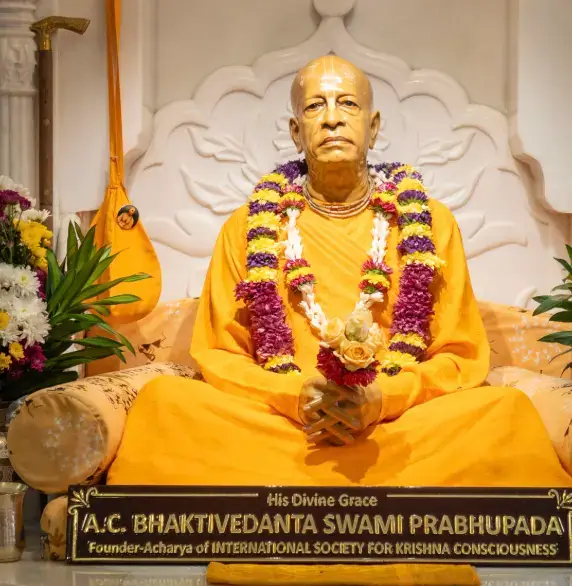
We offer our humble obeisances at the lotus feet of our founder-acharya, His Divine Grace A.C. Bhaktivedanta Swami Srila Prabhupada, without whose causeless mercy the priceless prayers, bhajans and sacred literature of the Gaudiya Vaishnava tradition would have remained inaccessible to most of the world. By his herculean preaching efforts, his unparalleled translations and his founding of the International Society for Krishna Consciousness (ISKCON), the holy names, pastimes and instructions of Sri Sri Radha-Krishna and Sri Chaitanya Mahaprabhu are today chanted in every town and village.
nama om vishnu-padaya krishna-preshthaya bhu-tale
srimate bhaktivedanta-svamin iti namine
namas te sarasvate deve gaura-vani-pracharine
nirvishesha-shunyavadi-pashchatya-desha-tarine
All glories to Srila Prabhupada. All glories to the Vaishnava acharyas in the disciplic succession.
Spiritual Significance
Scriptural Source & Tradition
Commentary from the Acharyas
When to Sing / Chant
Benefits for the Devotee
Gratitude to His Divine Grace A.C. Bhaktivedanta Swami Srila Prabhupada
We offer our humble obeisances at the lotus feet of our founder-acharya, His Divine Grace A.C. Bhaktivedanta Swami Srila Prabhupada, without whose causeless mercy the priceless prayers, bhajans and sacred literature of the Gaudiya Vaishnava tradition would have remained inaccessible to most of the world. By his herculean preaching efforts, his unparalleled translations and his founding of the International Society for Krishna Consciousness (ISKCON), the holy names, pastimes and instructions of Sri Sri Radha-Krishna and Sri Chaitanya Mahaprabhu are today chanted in every town and village.
nama om vishnu-padaya krishna-preshthaya bhu-tale
srimate bhaktivedanta-svamin iti namine
namas te sarasvate deve gaura-vani-pracharine
nirvishesha-shunyavadi-pashchatya-desha-tarine
All glories to Srila Prabhupada. All glories to the Vaishnava acharyas in the disciplic succession.