Also available in:
Pranam Mantras
Essential prayers and obeisances chanted at the beginning of every japa session, kirtan, and ISKCON class
In every ISKCON temple and home, these three pranam mantras are chanted at the start of each spiritual practice. The sequence is deliberate: first we bow to the guru who initiates us into spiritual life, then we offer respects to Sri Chaitanya Mahaprabhu and His four associates through the Panca-tattva mantra, and finally we invoke the maha-mantra itself. Srila Prabhupada taught that chanting these mantras before japa is not optional etiquette but a protective practice that helps us avoid the ten offences against the holy name. Together they take fewer than thirty seconds to chant, yet they establish the most important mood for all devotional practice: humility before the guru, gratitude to Lord Gauranga, and surrender to Krishna.
Sanskrit Mantras
Sri Guru Pranama
om ajnana-timirandhasya jnananjana-salakaya cakshur unmilitam yena tasmai sri-gurave namah
Panca-tattva Maha-mantra
(jaya) sri-krishna-caitanya prabhu nityananda sri-advaita gadadhara srivasadi-gaura-bhakta-vrinda Hare Krishna Hare Krishna Krishna Krishna Hare Hare Hare Rama Hare Rama Rama Rama Hare Hare
Hare Krishna Maha-mantra
HARE KRISHNA HARE KRISHNA KRISHNA KRISHNA HARE HARE HARE RAMA HARE RAMA RAMA RAMA HARE HARE
Translations
Sri Guru Pranama
I offer my respectful obeisances unto my spiritual master, who has opened my eyes, which were blinded by the darkness of ignorance, with the torchlight of knowledge.
Panca-tattva Maha-mantra
(All glories to) Lord Sri Krishna Caitanya, Prabhu Nityananda, Sri Advaita, Gadadhara, Srivasa and all the devotees of Lord Gauranga.
Hare Krishna Maha-mantra
The great chant for deliverance, consisting of the holy names of the Lord.
Word-by-Word Meanings
Sri Guru Pranama
Panca-tattva Maha-mantra
Hare Krishna Maha-mantra
How to Offer Pranama
Physical posture (dandavat-pranama). To offer full obeisances, lie flat face-down with hands extended above the head, palms together — like a stick (danda). This is the most complete offering of respect in the Vaishnava tradition and is offered to the spiritual master, the Deity, and senior Vaishnavas. Women in ISKCON offer a standing pranam with hands folded at the chest.
When to offer. Offer pranama upon entering the temple room, whenever you see the spiritual master or his photograph, before sitting down to chant japa, and when greeting senior devotees. The Sri Guru Pranama is chanted during the physical act of prostration — the words and the body act together as one offering.
The mood. Srila Prabhupada taught that pranama is not mere formality — it is an act of genuine surrender. The words "om ajnana-timirandhasya" acknowledge our actual condition: we are blinded by ignorance and completely dependent on the guru's grace. Offering pranama with this understanding, even once a day, establishes the correct spiritual posture for all other practices.
Receiving pranama. When a senior devotee or the spiritual master receives your pranama, they typically respond with a blessing: "Hare Krishna" or by placing their hand briefly on your head. Never offer pranama to someone who is eating, sleeping, or otherwise occupied — it places an obligation on them to reciprocate at an inappropriate moment.
Additional Pranam Mantras
Vaishnava Pranama Mantra
vāñchā-kalpatarubhyaś ca kṛpā-sindhubhya eva ca patitānāṁ pāvanebhyo vaiṣṇavebhyo namo namaḥ
Translation: I offer my respectful obeisances unto all the Vaishnava devotees of the Lord. They can fulfill the desires of everyone, just like desire trees, and they are full of compassion for the fallen conditioned souls.
When offered: Offered whenever one enters the association of devotees — in the temple, at satsang, or when greeting a Vaishnava. It is also sung as a collective offering at the beginning of kirtan programs and at the end of classes. The mantra acknowledges that Vaishnavas, by their own devotion and compassion, can award blessings that only the Lord Himself otherwise gives.
Tulasi Pranama Mantra
vṛndāyai tulasī-devyai priyāyai keśavasya ca viṣṇu-bhakti-prade devi satyavatyai namo namaḥ
Translation: I offer my obeisances to Vrnda, the goddess Tulasi, who is very dear to Keshava. O goddess, you bestow devotion to Lord Vishnu. I offer my obeisances to you, Satyavati.
When offered: Chanted during the daily Tulasi puja — the offering of water and circumambulation of the Tulasi plant performed each morning in every ISKCON temple and many Vaishnava homes. Srila Prabhupada instructed that Tulasi Devi is a pure devotee in plant form and must be honored with this pranama before watering. The mantra is also sung when circumambulating Tulasi three, four, or seven times after the watering.
Bhumi (Earth) Pranama
samudra-vasane devi parvata-stana-maṇḍale viṣṇu-patni namas tubhyaṁ pāda-sparśaṁ kṣamasva me
Translation: O goddess Earth, who is dressed by the oceans and whose breasts are the mountains, who is the wife of Lord Vishnu — I offer my obeisances to you. Please forgive me for touching you with my feet.
When offered: Chanted each morning immediately upon getting out of bed, before the feet touch the floor. The Vedic understanding is that the earth — Bhumi Devi or Bhudevi — is a goddess, the consort of Lord Vishnu, who patiently bears all living beings. Walking on her with our feet is an act that deserves acknowledgment and apology. This simple morning pranama establishes the day's first act as one of gratitude and humility toward the Lord's creation.
Pranama in Daily Sadhana
In the ISKCON morning program, the pranama mantras follow a precise sequence that mirrors the Gaudiya Vaishnava philosophical hierarchy. Before stepping out of bed, the Bhumi pranama is offered — the first act of gratitude to the Lord's creation. Upon entering the temple room or sitting area, the Guru Pranama is chanted, acknowledging the guru as the doorway through which all other blessings flow. Before beginning japa, the Panca-tattva Maha-mantra is sung to invoke Lord Chaitanya and His associates, then the Hare Krishna Maha-mantra follows. During Tulasi puja — watering and circumambulating Tulasi Devi — the Tulasi Pranama is chanted. Whenever senior Vaishnavas or the guru are greeted, the Vaishnava Pranama provides the correct devotional acknowledgment.
The cumulative effect of these pranamas, practiced daily with sincerity, is described in the scriptures as a comprehensive attitude of surrender (sharanagati). Each pranama builds a specific quality: humility before the guru, gratitude to the Lord's associates, respect for the devotee community, reverence for sacred plants, and acknowledgment of the divinity within the natural world. Srila Prabhupada said that a devotee who performs all these pranamas sincerely every morning has already completed significant spiritual practice before the day's formal work begins.
For new practitioners, even chanting just the Guru Pranama and the Maha-mantra before japa is a significant beginning. The pranamas are not prerequisites that must be mastered before starting — they are the very practice through which the devotional mood naturally develops over time. The tradition asks only for sincerity and regularity, and in return gives the experience of the Lord's presence from the very first moment of the day.
Spiritual Significance
These three pranam (obeisance) mantras form the foundational opening of every japa session, kirtan and class in ISKCON. They establish the correct mood — first humbly acknowledging the guru as the doorway to all spiritual realisation, then offering respect to Sri Chaitanya Mahaprabhu's Panca-tattva, and finally invoking the maha-mantra itself. Together they encode the entire Gaudiya Vaishnava theology in less than thirty seconds of chanting.
Scriptural Source & Tradition
- Sri Guru Pranama — from the Gautamiya Tantra, popularised by the Six Goswamis
- Panca-tattva Maha-mantra — composed by Srila Vrindavan Dasa Thakura, author of Sri Chaitanya-Bhagavata
- Hare Krishna Maha-mantra — from the Kali-Santarana Upanishad of the Yajur Veda, declared by Sri Chaitanya Mahaprabhu as the only means of deliverance in Kali-yuga
Commentary from the Acharyas
Srila Prabhupada explained that chanting the Panca-tattva mantra before the maha-mantra is essential, because Sri Chaitanya Mahaprabhu and His four associates personally distribute the holy name. "Without taking shelter of the Pancha-tattva," he wrote, "one cannot relish the maha-mantra in its full sweetness." (CC Adi 7.4 purport)
The Sri Guru Pranama is a direct quotation from theMantra-muktavali and was sung by Srila Bhaktisiddhanta Sarasvati Thakura before each lecture. Srila Prabhupada followed the same tradition and instructed his disciples to always begin classes with these obeisances — a practice preserved in every ISKCON temple today.
When to Sing / Chant
- Before every round of japa (sit, chant pranams, then begin)
- At the start of any kirtan, class or spiritual gathering
- Before honouring prasadam (especially in mixed company unfamiliar with longer prayers)
- Before reading scripture — Bhagavad-gita, Srimad-Bhagavatam, Chaitanya-charitamrita
- By children as their very first daily devotional offering
Benefits for the Devotee
- Establishes the proper humble mood for spiritual practice
- Invokes the blessings of guru, Gauranga and Krishna simultaneously
- Helps avoid offences (aparadha) at the start of chanting
- Strong, simple foundation that any new devotee can adopt immediately
- Connects the chanter to the unbroken disciplic succession (parampara)
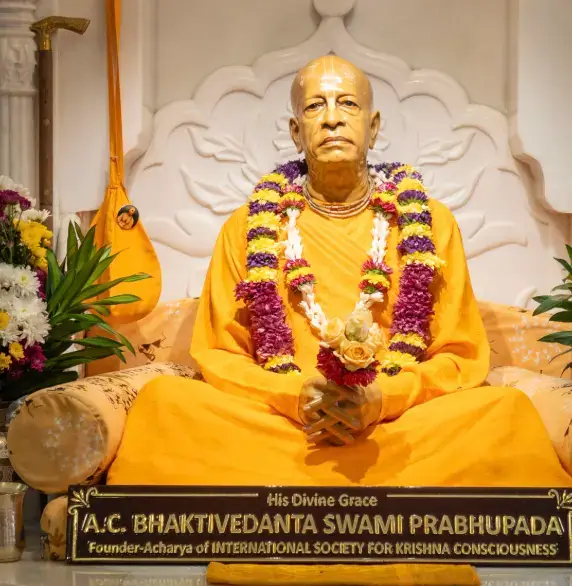
Gratitude to His Divine Grace A.C. Bhaktivedanta Swami Srila Prabhupada
We offer our humble obeisances at the lotus feet of our founder-acharya, His Divine Grace A.C. Bhaktivedanta Swami Srila Prabhupada, without whose causeless mercy the priceless prayers, bhajans and sacred literature of the Gaudiya Vaishnava tradition would have remained inaccessible to most of the world. By his herculean preaching efforts, his unparalleled translations and his founding of the International Society for Krishna Consciousness (ISKCON), the holy names, pastimes and instructions of Sri Sri Radha-Krishna and Sri Chaitanya Mahaprabhu are today chanted in every town and village.
nama om vishnu-padaya krishna-preshthaya bhu-tale
srimate bhaktivedanta-svamin iti namine
namas te sarasvate deve gaura-vani-pracharine
nirvishesha-shunyavadi-pashchatya-desha-tarine
All glories to Srila Prabhupada. All glories to the Vaishnava acharyas in the disciplic succession.