Nrsimha Kavaca
Protective prayers to Lord Nrsimhadeva
Lord Nrsimhadeva — The Half-Man, Half-Lion Avatara
Lord Nrsimhadeva is the fourth principal avatara among the Dasavatara — the ten principal descents of Lord Vishnu described in the Srimad-Bhagavatam. His name means nara (human) + simha (lion): He appeared with a human body and a lion's head, a form so unprecedented that He bypassed every condition of the benediction Hiranyakasipu had received from Lord Brahma. He is simultaneously the most terrifying and the most protective form of the Lord — bhishanam bhadram, "fearsome yet auspicious."
The story of His appearance is told in the Seventh Canto of Srimad-Bhagavatam. The demon king Hiranyakasipu had performed severe austerities to obtain a benediction from Lord Brahma: he could not be killed by any created being, neither man nor animal nor demigod; neither by weapon nor by hand; neither indoors nor outdoors; neither during day nor night; neither on earth nor in the sky. Convinced he was now immortal, he declared himself the supreme lord of the universe and made worship of Lord Vishnu punishable by death.
His own son, Prahlada Maharaja, was born a great devotee of Lord Vishnu. Despite his father's tortures — poison, elephant attacks, fire, being thrown from cliffs — Prahlada remained unharmed, sustained entirely by his unwavering devotion to the Lord. When Hiranyakasipu finally mocked him by striking a palace pillar and demanding, "Is your God in this column?"— Lord Nrsimha erupted from that pillar. He placed Hiranyakasipu on His lap (neither earth nor sky), at the palace doorway (neither indoors nor outdoors), at twilight (neither day nor night), and tore the demon apart with His bare fingernails (neither weapon nor hand). Every condition of the benediction was technically honored — yet the devotee's protector could not be restrained.
This pastime establishes the most fundamental principle of the Bhagavatam: the Lord will assume any form, violate any law of nature, and appear from any location to protect a pure devotee. Lord Nrsimha did not come to establish a new religion or teach a philosophy — He came for one purpose: to protect Prahlada. This is the essence of the Nrsimha Kavaca: by calling on the Lord who came to protect His devotee, we invoke that same protective shelter for ourselves.
What is a Kavaca?
The Sanskrit word kavaca means "armor" or "shield." A kavaca is a protective prayer in the Vedic tradition that invokes divine protection over the chanter's body, mind, and spiritual practice. The principle behind a kavaca is nama-rupa-abhinnatva — the non-difference between the Lord's holy name and His personal presence. When the name "Nrsimha" enters the heart with sincere faith and devotion, the Lord Himself is said to personally stand guard over that devotee. A kavaca is not a magical formula — it is an act of surrender that invites the Lord's active protection.
Kavaca prayers for Lord Nrsimha appear in multiple Vedic texts, including the Nrsimha-tapani Upanishad, the Brahma-yamala Tantra, and within the daily puja literature compiled by Srila Gopala Bhatta Goswami, one of the Six Goswamis of Vrindavana. The tradition of chanting Nrsimha protection mantras before travel, before sleep, and at times of danger is thousands of years old and continues in Vaishnava families across India and worldwide. In many ISKCON homes, the main Nrsimha bija mantra is taught to children as a bedtime prayer — a daily reminder that the Lord who appeared to protect Prahlada is ever-present and ever-willing to protect His devotees.
The Nrsimha Kavaca Mantras
Nrsimha Bija Mantra
IAST Transliteration:
ugram vīraṁ mahā-viṣṇuṁ jvalantaṁ sarvato mukham nṛsiṁhaṁ bhīṣaṇaṁ bhadraṁ mṛtyur mṛtyuṁ namāmy aham
Translation:
I offer my obeisances to Lord Narasimha who is fierce and heroic, the great Lord Vishnu, blazing with light in all directions, terrifying yet auspicious, the death of death itself.
Nrsimha Pranama Mantra
IAST Transliteration:
namas te narasiṁhāya prahladāhlāda-dāyine hiraṇyakaśipor vakṣaḥ- śilā-ṭaṅka-nakhālaye
Translation:
I offer my obeisances to Lord Narasimha, who gives joy to Prahlada Maharaja and whose nails are like chisels splitting the stonelike chest of the demon Hiranyakasipu.
Nrsimha Sharanagati Mantra
IAST Transliteration:
ito nṛsiṁhaḥ paro nṛsiṁho yato yato yāmi tato nṛsiṁhaḥ bahir nṛsiṁho hṛdaye nṛsiṁho nṛsiṁham ādiṁ śaraṇaṁ prapadye
Translation:
Lord Narasimha is here and Lord Narasimha is there. Wherever I go, Lord Narasimha is there. He is outside and He is in the heart. I take shelter of Lord Narasimha, the beginning of all.
When to Chant the Nrsimha Kavaca
The Nrsimha Kavaca may be chanted at any time, but Vaishnava tradition identifies several occasions when it is especially recommended:
- Daily morning practice: Many devotees include the Nrsimha bija mantra in their morning prayers alongside the Panca-tattva mantra and Guru Pranama, establishing the Lord's protective presence for the day ahead.
- Before travel: Long journeys, night travel, and travel to unfamiliar or potentially unsafe locations are traditional occasions for chanting Nrsimha protection. The verse ito nrsimhah paro nrsimho — "Nrsimha is here, Nrsimha is there, wherever I go, Nrsimha is there" — is specifically suited to this purpose.
- During Nrsimha Caturdasi: The appearance day of Lord Nrsimhadeva, celebrated on the 14th day of the bright fortnight of Vaishaka (April–May), is the primary occasion for extended Nrsimha prayer and kavaca chanting. Devotees fast until dusk and spend the day chanting Nrsimha's names and reading the 7th Canto of Srimad-Bhagavatam.
- During the Damodara month (Kartika): Nrsimha prayers are sometimes added to the evening lamp-offering ceremony during Kartika as prayers for protection throughout the spiritually intensive month.
- When fearful or in danger: Just as Prahlada called out to the Lord in his moment of greatest danger, any devotee facing fear, illness, or threat may call on Lord Nrsimha with confidence that He will respond.
- For children's protection: In Vaishnava families, children are taught the Nrsimha bija mantra as a protective bedtime prayer — the same Lord who never left Prahlada's side remains ever-present for every sincere devotee.
Prahlada's Prayer to Lord Nrsimha
After Lord Nrsimha killed Hiranyakasipu, the demigods, sages, and the divine mother Lakshmi all approached the Lord's ferocious form but were too afraid to draw near. It was young Prahlada — the five-year-old devotee for whose protection the Lord had appeared — who alone walked forward and offered his obeisances. His prayers in the Seventh Canto of Srimad-Bhagavatam are among the most beautiful expressions of pure devotion in all of Vedic literature. Prahlada prays not for personal safety or reward but entirely for the benefit of all living beings, and he attributes any good quality he possesses entirely to the Lord's mercy.
The opening verse of the Nrsimha Pranama Mantra — chanted in ISKCON temples as an offering of obeisances to Lord Nrsimhadeva — encapsulates Prahlada's relationship with the Lord:
Nrsimha Pranama
IAST:
namas te narasiṁhāya
prahladāhlāda-dāyine
hiraṇyakaśipor vakṣaḥ-
śilā-ṭaṅka-nakhālaye
Translation:
I offer my respectful obeisances to Lord Narasimha, who gives joy to Prahlada Maharaja and whose nails are like chisels on the stonelike chest of the demon Hiranyakasipu.
This verse summarizes the entire Nrsimha avatara in four lines: the one who appeared (narasimhaya), the devotee He came for (prahlada-ahlada-dayine — "one who gives joy to Prahlada"), and the demon He destroyed (hiranyakasipor vaksah sila-tanka-nakhalaye — "whose nails split the stonelike chest of Hiranyakasipu").
Spiritual Significance
The Nrsimha Kavaca is a concentrated "armour" (kavaca = protective shield) of Lord Nrsimhadeva. The principal bija mantra in just four lines invokes the Lord as ugram (ferocious), viram (heroic), maha-vishnum (the Supreme Lord), jvalantam sarvato mukham (blazing with faces on every side) and mrityu-mrityum (the death of death). Chanted with attention, it forms a spiritual perimeter around the practitioner that demoniac influences cannot penetrate.
Scriptural Source & Tradition
The main bija verse appears in the Nrsimha-tapani Upanishadand is also found in the Nrsimha Purana. It is included in the Sat-kriya-sara-dipika compiled by Srila Gopala Bhatta Goswami — one of the Six Goswamis of Vrindavana — and is part of the daily liturgy in many Gaudiya Vaishnava temples, particularly Mayapur and Sri Rangam. The story of Lord Nrsimha's appearance is told in detail in the Seventh Canto of Srimad-Bhagavatam.
Commentary from the Acharyas
Srila Prabhupada said in a Bhagavatam class (Mayapur, 1976): "Lord Nrsimhadeva is so kind. He came simply to protect His devotee Prahlada. So if you become a devotee, He will also protect you. There is no doubt about it."
Srila Bhaktivinoda Thakura, in his Sajjana-toshani articles, explains that the kavaca works not by magic but by the principle of nama-rupa-abhinnatva — the non-difference between the holy name and the Lord. When the name "Nrsimha" enters the heart with faith, the Lord Himself personally enters and stands guard.
When to Sing / Chant
- Before Namaste Narasimhaya as part of the protective set
- On Nrsimha Caturdashi and during the Damodara month
- Before travel, especially night journeys
- When entering a new house or starting a new project
- For children's protection — taught as a bedtime mantra in many Vaishnava families
Benefits for the Devotee
- Comprehensive spiritual protection — front, back, inside, outside
- Removes obstacles to bhakti — negative association, distractions, fear
- Strengthens determination during difficult phases of sadhana
- Relieves fear of death by invoking the "death of death" Himself
- Directly connects the chanter to the Lord who appeared for the pure devotee Prahlada
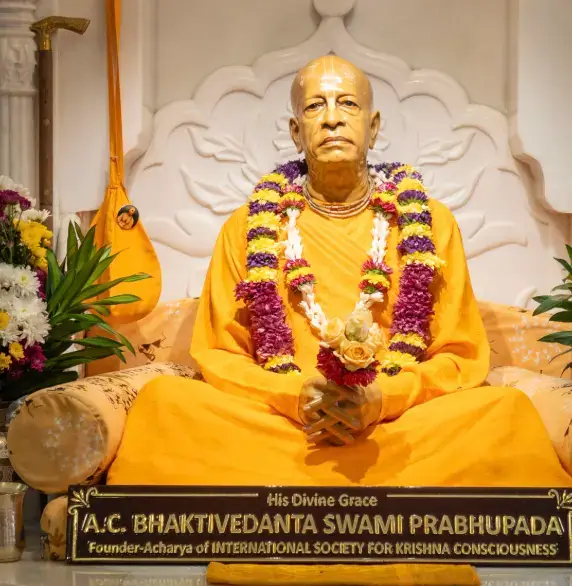
Gratitude to His Divine Grace A.C. Bhaktivedanta Swami Srila Prabhupada
We offer our humble obeisances at the lotus feet of our founder-acharya, His Divine Grace A.C. Bhaktivedanta Swami Srila Prabhupada, without whose causeless mercy the priceless prayers, bhajans and sacred literature of the Gaudiya Vaishnava tradition would have remained inaccessible to most of the world. By his herculean preaching efforts, his unparalleled translations and his founding of the International Society for Krishna Consciousness (ISKCON), the holy names, pastimes and instructions of Sri Sri Radha-Krishna and Sri Chaitanya Mahaprabhu are today chanted in every town and village.
nama om vishnu-padaya krishna-preshthaya bhu-tale
srimate bhaktivedanta-svamin iti namine
namas te sarasvate deve gaura-vani-pracharine
nirvishesha-shunyavadi-pashchatya-desha-tarine
All glories to Srila Prabhupada. All glories to the Vaishnava acharyas in the disciplic succession.