Nava Gaura Varam
Sacisutastakam — Eight Prayers to the Son of Mother Saci
Author: Sarvabhauma Bhattacarya · Language: Sanskrit · Traditionally sung in Raga Kafi, Bhajani Tala
About Nava Gaura Varam
Nava Gaura Varam, officially titled Sacisutastakam — "eight prayers to the son of Mother Saci" — is a Sanskrit stotra of eight verses composed by Sarvabhauma Bhattacarya, the celebrated Vedantist of Puri who became one of the earliest and most intimate associates of Sri Caitanya Mahaprabhu. Each verse begins with the word nava ("ever-fresh"), painting Gauranga as forever new — new complexion, new moods, new dances, new laughter, new love — and closes with the same devotional refrain: praṇamāmi śacī-suta-gaura-varam, "I bow down to Gaura, the beautiful son of Mother Saci."
Sarvabhauma Bhattacarya was originally a strict Advaita scholar. It was only after Sri Caitanya Mahaprabhu revealed His true identity in Puri that Sarvabhauma surrendered, composing the famous Sarvabhauma-shataka of one hundred verses — of which this stotra is a jewel — glorifying Mahaprabhu as Krishna Himself in the mood of His own devotee. Reading these verses today, one hears the direct, awestruck realization of a scholar who saw the Lord face to face.
Srila Prabhupada, translating the Chaitanya-charitamrita, gave the world Sarvabhauma's story so that every sincere seeker could benefit from this transformation. By singing Nava Gaura Varam, the sadhaka enters that same current of grace — approaching Sri Chaitanya not through dry logic but through humble prayer, exactly as Sarvabhauma did.
Lyrics
(1)
nava gaura-varaṁ nava-puṣpa-śaraṁ nava-bhāva-dharaṁ nava-lāsya-param nava-hāsya-karaṁ nava-hema-varaṁ praṇamāmi śacī-suta-gaura-varam
(2)
nava-prema-yutaṁ nava-nīta-śucaṁ nava-veśa-kṛtaṁ nava-prema-rasam navadhā vilasat śubha-prema-mayaṁ praṇamāmi śacī-suta-gaura-varam
(3)
hari-bhakti-paraṁ hari-nāma-dharaṁ kara-japya-karaṁ hari-nāma-param nayane satataṁ praṇayāśru-dharaṁ praṇamāmi śacī-suta-gaura-varam
(4)
satataṁ janatā-bhava-tāpa-haraṁ paramārtha-parāyaṇa-loka-gatim nava-leha-karaṁ jagat-tāpa-haraṁ praṇamāmi śacī-suta-gaura-varam
(5)
nija-bhakti-karaṁ priya-cārutaraṁ naṭa-nartana-nāgara-rāja-kulam kula-kāmini-mānasa-lāsya-karaṁ praṇamāmi śacī-suta-gaura-varam
(6)
karatāla-valaṁ kala-kaṇṭha-ravaṁ mṛdu-vādya-suvīṇikayā madhuram nija-bhakti-guṇāvṛta-nātya-karaṁ praṇamāmi śacī-suta-gaura-varam
(7)
yuga-dharma-yutaṁ punar nanda-sutaṁ dharaṇī-sucitraṁ bhava-bhāvocitam tanu-dhyāna-citaṁ nija-vāsa-yutam praṇamāmi śacī-suta-gaura-varam
(8)
aruṇaṁ nayanaṁ caraṇaṁ vasanaṁ vadane skhalitaṁ svaka-nāma-dharam kurute su-rasaṁ jagataḥ jīvanaṁ praṇamāmi śacī-suta-gaura-varam
Translation
1) His complexion is the hue of fresh cream tinged with kunkum. He is the ever-fresh Cupid who shoots arrows of newly blossoming flowers. He bears newer and newer moods of emotional ecstasies. He is fond of performing novel dances. He makes ever-new jokes that cause much laughter. His brilliant luster is like freshly cast gold. I bow down to Gaura, the beautiful son of Mother Saci.
2) He is endowed with ever-fresh love of Godhead. His radiant luster is like the color of fresh butter. His fresh attire is arranged in ever-new fashions. He relishes ever-new mellows of love for Krsna. He shines in nine-fold new ways while executing the nine-fold processes of devotion. He is permeated with a most auspicious loving nature. I bow down to Gaura, the beautiful son of Mother Saci.
3) He is absorbed in devotion to Sri Hari. He maintains the chanting of the names of Hari. While chanting He counts the holy names on the fingers of His hands. He is addicted to the name of Hari. He always has tears of love welling in His eyes. I bow down to Gaura, the beautiful son of Mother Saci.
4) He is always removing the suffering of material existence for mankind. He is the goal of life for persons who are dedicated to their supreme interest. He inspires men to become like honeybees (eager for the honey of Krsna-prema). He removes the burning fever of the material world. I bow down to Gaura, the beautiful son of Mother Saci.
5) He motivates pure devotion unto Himself. He is most attractive to His beloved servitors. By His dramatic dancing He exhibits the characteristics of the King of paramours. He causes the minds of beautiful young village women to dance. I bow down to Gaura, the beautiful son of Mother Saci.
6) He plays karatals as His throat emits sweet melodious sounds and the vibrant notes of the vina are softly played. He thus inspires the devotees to perform dramatic dancing that is infused with aspects of His own devotional service. I bow down to Gaura, the beautiful son of Mother Saci.
7) He is accompanied by the sankirtana movement, which is the religious practice for the age of Kali. He is the son of Nanda Maharaja come again. He is the extraordinarily brilliant ornament of the earth. His preaching mood is suitably adapted to the cycle of birth and death. His consciousness is fixed in meditation on His own form of Krsna. He is always accompanied by His transcendental abode. I bow to Gaura, the beautiful son of Mother Saci.
8) His eyes, the soles of His feet, and His clothing are reddish like the color that heralds the rising sun. As He utters His own names, His voice falters. He awakens a sweet flavor to life throughout the universe. I bow down to Gaura, the beautiful son of Mother Saci.
Spiritual Significance
Nava Gaura Varam (Sacisutastakam) is one of the most complete Sanskrit meditations on Sri Caitanya Mahaprabhu ever composed. In just eight verses, Sarvabhauma Bhattacarya presents Gauranga's form, mood, complexion, dancing, laughter, kirtan, tears of love, and identity as Krishna Himself — all bound together by the ever-repeating word nava, "ever-fresh," which is the very definition of the transcendental.
Scriptural Source & Tradition
Authored by Sarvabhauma Bhattacarya — the great Vedanta scholar of Puri whose surrender to Sri Caitanya Mahaprabhu is celebrated in the Madhya-lila of Sri Chaitanya-charitamrita. The stotra is preserved in the Gaudiya tradition of Gauranga-stotras and continues to be sung in Gaudiya Math and ISKCON temples worldwide.
Commentary from the Acharyas
Srila Prabhupada often emphasized that Sri Caitanya Mahaprabhu is the most magnanimous incarnation, because He freely distributes love of Krishna — the very thing Krishna Himself keeps hidden. Every verse of this prayer echoes that magnanimity: Gauranga's tears, His dancing, His kirtan, His removal of the world's burning fever — all point to a Lord who has come only to give.
Sarvabhauma's own life is the living commentary. From a proud impersonalist he became a servant of the servant of Mahaprabhu. Singing this stotra with attention plants the same seed of surrender in the heart of every sincere devotee.
When to Sing / Chant
- On Gaura Purnima — the appearance day of Sri Caitanya Mahaprabhu
- During Gaura-arati and evening sandhya kirtans
- Throughout the month of Phalguna and during Navadvipa-mandala parikrama
- Before Bhagavatam or Chaitanya-charitamrita class, to invoke Mahaprabhu's mercy
- As a personal meditation whenever one seeks shelter of Sri Gauranga's compassion
Benefits for the Devotee
- Awakens deep attraction for the golden form of Sri Caitanya Mahaprabhu
- Invokes the special mercy of Gauranga, who forgives all offenses of the sincere chanter
- Strengthens faith in the Nama-sankirtana movement of Kali-yuga
- Provides an authentic Sanskrit devotional meditation for daily sadhana
- Connects the devotee to the sampradaya of Sarvabhauma, Ramananda Raya and the Six Goswamis
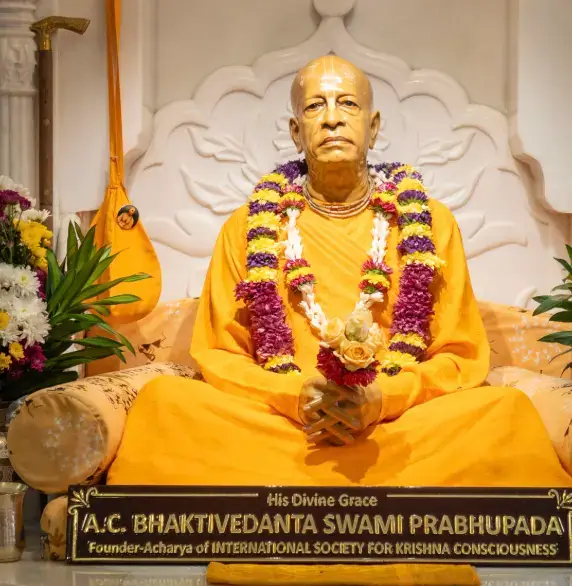
Gratitude to His Divine Grace A.C. Bhaktivedanta Swami Srila Prabhupada
We offer our humble obeisances at the lotus feet of our founder-acharya, His Divine Grace A.C. Bhaktivedanta Swami Srila Prabhupada, without whose causeless mercy the priceless prayers, bhajans and sacred literature of the Gaudiya Vaishnava tradition would have remained inaccessible to most of the world. By his herculean preaching efforts, his unparalleled translations and his founding of the International Society for Krishna Consciousness (ISKCON), the holy names, pastimes and instructions of Sri Sri Radha-Krishna and Sri Chaitanya Mahaprabhu are today chanted in every town and village.
nama om vishnu-padaya krishna-preshthaya bhu-tale
srimate bhaktivedanta-svamin iti namine
namas te sarasvate deve gaura-vani-pracharine
nirvishesha-shunyavadi-pashchatya-desha-tarine
All glories to Srila Prabhupada. All glories to the Vaishnava acharyas in the disciplic succession.