Nama-sankirtana
Congregational chanting of holy names
Sanskrit Verses
Verse 1
hari haraye namah krishna yadavaya namah yadavaya madhavaya kesavaya namah
Verse 2
gopala govinda rama sri-madhusudana giridhari gopinatha madana-mohana
Verse 3
sri-caitanya-nityananda sri-advaita-sita hari guru vaishnava bhagavata gita
Translation
1) O Lord Hari, O Lord Krishna, I offer my obeisances to You, who are known as Hari, Yadava, Madhava, and Kesava.
2) O Gopala, Govinda, Rama, Sri Madhusudana, Giridhari Gopinatha, and Madana-mohana!
3) All glories to Sri Caitanya and Nityananda! All glories to Sri Advaita Acarya and His consort, Sri Sita Thakurani. All glories to Lord Hari, to the spiritual master, the Vaishnavas, Srimad-Bhagavatam, and Srimad Bhagavad-Gita.
Spiritual Significance
Nama-sankirtana — congregational chanting of the holy names — is declared by the scriptures as the yuga-dharma, the prescribed spiritual practice for the present age of Kali. These verses bundle together the most beloved names of the Lord (Hari, Krishna, Yadava, Madhava, Kesava, Gopala, Govinda, Rama, Madhusudana, Giridhari, Gopinatha, Madana-mohana) so that even one round of singing engages the tongue in a vast offering.
Scriptural Source & Tradition
The principle is rooted in Brihan-naradiya Purana(38.126): "harer nama harer nama harer namaiva kevalam / kalau nasty eva nasty eva nasty eva gatir anyatha" — in this age, there is no other way, no other way, no other way for self-realisation than the chanting of the holy name. Sri Chaitanya Mahaprabhu inaugurated the sankirtan movement 500 years ago in Sridhama Mayapur and ISKCON has carried it to every continent.
Commentary from the Acharyas
Srila Prabhupada wrote, "Chanting the holy name of the Lord is the only means to attain Krishna consciousness in this age. One should chant in the association of devotees; that is called sankirtana." (CC Adi 7.74 purport). He emphasised that congregational chanting is many times more powerful than solitary chanting, because the holy name is amplified by the combined faith of all participants.
The third verse — sri-caitanya-nityananda, sri-advaita-sita / hari guru vaishnava bhagavata gita — is a complete invocation of the Pancha-tattva and of the principal sources of spiritual authority. Singing it ensures one offers respect to the entire parampara before chanting the maha-mantra.
When to Sing / Chant
- At every group program — temple, home, college, online satsang
- During Harinama-sankirtan in public streets and parks
- At birthdays, weddings, housewarmings as auspicious invocation
- In times of distress in the community — illness, calamity, bereavement
- Whenever devotees gather, even for a few minutes
Benefits for the Devotee
- Counteracts the contamination of Kali-yuga (anxiety, hypocrisy, quarrel)
- Awakens dormant love for God — the natural condition of the soul
- Unites devotees across language, caste and culture in a single mood
- Easy to learn — even children and newcomers can join from the first round
- Said to be the only spiritual process completely free of strict rules and regulations
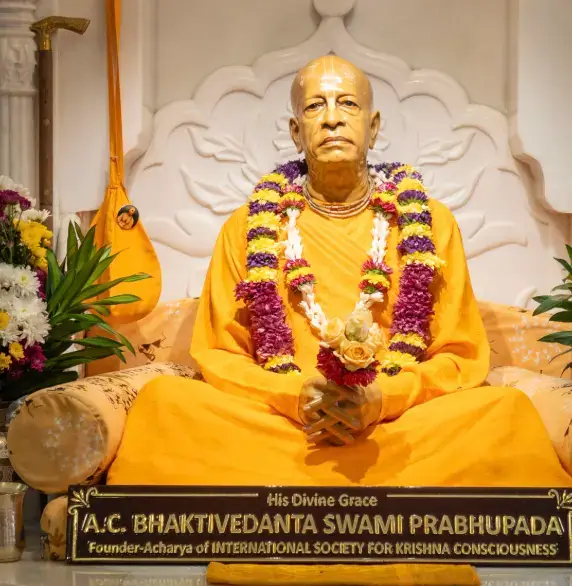
Gratitude to His Divine Grace A.C. Bhaktivedanta Swami Srila Prabhupada
We offer our humble obeisances at the lotus feet of our founder-acharya, His Divine Grace A.C. Bhaktivedanta Swami Srila Prabhupada, without whose causeless mercy the priceless prayers, bhajans and sacred literature of the Gaudiya Vaishnava tradition would have remained inaccessible to most of the world. By his herculean preaching efforts, his unparalleled translations and his founding of the International Society for Krishna Consciousness (ISKCON), the holy names, pastimes and instructions of Sri Sri Radha-Krishna and Sri Chaitanya Mahaprabhu are today chanted in every town and village.
nama om vishnu-padaya krishna-preshthaya bhu-tale
srimate bhaktivedanta-svamin iti namine
namas te sarasvate deve gaura-vani-pracharine
nirvishesha-shunyavadi-pashchatya-desha-tarine
All glories to Srila Prabhupada. All glories to the Vaishnava acharyas in the disciplic succession.