Gajendra Moksham
Gajendra's Prayers of Surrender
From Srimad Bhagavatam - A powerful prayer of surrender and liberation
Sanskrit Text
Text 1
śrī-bādarāyaṇir uvāca evaṁ vyavasito buddhyā samādhāya mano hṛdi jajāpa paramaṁ jāpyaṁ prāg-janmany anuśikṣitam
Text 2
śrī-gajendra uvāca oṁ namo bhagavate tasmai yata etac cid-ātmakam puruṣāyādi-bījāya pareśāyābhidhīmahi
Text 3
yasminn idaṁ yataś cedaṁ yenedaṁ ya idaṁ svayam yo 'smāt parasmāc ca paras taṁ prapadye svayambhuvam
Text 4
yaḥ svātmanīdaṁ nija-māyayārpitaṁ kvacid vibhātaṁ kva ca tat tirohitam aviddha-dṛk sākṣy ubhayaṁ tad īkṣate sa ātma-mūlo 'vatu māṁ parāt-paraḥ
Text 5
kālena pañcatvam iteṣu kṛtsnaśo lokeṣu pāleṣu ca sarva-hetuṣu tamas tadāsīd gahanaṁ gabhīraṁ yas tasya pāre 'bhivirājate vibhuḥ
Text 6
na yasya devā ṛṣayaḥ padaṁ vidur jantuḥ punaḥ ko 'rhati gantum īritum yathā naṭasyākṛtibhir viceṣṭato duratyayānukramaṇaḥ sa māvatu
Text 7
didṛkṣavo yasya padaṁ sumaṅgalaṁ vimukta-saṅgā munayaḥ susādhavaḥ caranty aloka-vratam avraṇaṁ vane bhūtātma-bhūtāḥ suhṛdaḥ sa me gatiḥ
Texts 8-9
na vidyate yasya ca janma karma vā na nāma-rūpe guṇa-doṣa eva vā tathāpi lokāpyaya-sambhavāya yaḥ sva-māyayā tāny anukālam ṛcchati tasmai namaḥ pareśāya brahmaṇe 'nanta-śaktaye arūpāyoru-rūpāya nama āścarya-karmaṇe
Text 10
nama ātma-pradīpāya sākṣiṇe paramātmane namo girāṁ vidūrāya manasaś cetasām api
Text 11
sattvena pratilabhyāya naiṣkarmyeṇa vipaścitā namaḥ kaivalya-nāthāya nirvāṇa-sukha-saṁvide
Text 12
namaḥ śāntāya ghorāya mūḍhāya guṇa-dharmiṇe nirviśeṣāya sāmyāya namo jñāna-ghanāya ca
Text 13
kṣetra-jñāya namas tubhyaṁ sarvādhyakṣāya sākṣiṇe puruṣāyātma-mūlāya mūla-prakṛtaye namaḥ
Text 14
sarvendriya-guṇa-draṣṭre sarva-pratyaya-hetave asatā cchāyayoktāya sad-ābhāsāya te namaḥ
Text 15
namo namas te 'khila-kāraṇāya niṣkāraṇāyādbhuta-kāraṇāya sarvāgamāmnāya-mahārṇavāya namo 'pavargāya parāyaṇāya
Text 16
guṇāraṇi-cchanna-cid-uṣmapāya tat-kṣobha-visphūrjita-mānasāya naiṣkarmya-bhāvena vivarjitāgama- svayaṁ-prakāśāya namas karomi
Text 17
mādṛk prapanna-paśu-pāśa-vimokṣaṇāya muktāya bhūri-karuṇāya namo 'layāya svāṁśena sarva-tanu-bhṛn-manasi pratīta- pratyag-dṛśe bhagavate bṛhate namas te
Text 18
ātmātma-jāpta-gṛha-vitta-janeṣu saktair duṣprāpaṇāya guṇa-saṅga-vivarjitāya muktātmabhiḥ sva-hṛdaye paribhāvitāya jñānātmane bhagavate nama īśvarāya
Text 19
yaṁ dharma-kāmārtha-vimukti-kāmā bhajanta iṣṭāṁ gatim āpnuvanti kiṁ cāśiṣo rāty api deham avyayaṁ karotu me 'dabhra-dayo vimokṣaṇam
Texts 20-21
ekāntino yasya na kañcanārthaṁ vāñchanti ye vai bhagavat-prapannāḥ aty-adbhutaṁ tac-caritaṁ sumaṅgalaṁ gāyanta ānanda-samudra-magnāḥ tam akṣaraṁ brahma paraṁ pareśam avyaktam ādhyātmika-yoga-gamyam atīndriyaṁ sūkṣmam ivātidūram anantam ādyaṁ paripūrṇam īḍe
Texts 22-24
yasya brahmādayo devā vedā lokāś carācarāḥ nāma-rūpa-vibhedena phalgvyā ca kalayā kṛtāḥ yathārciṣo 'gneḥ savitur gabhastayo niryānti saṁyānty asakṛt sva-rociṣaḥ tathā yato 'yaṁ guṇa-sampravāho buddhir manaḥ khāni śarīra-sargāḥ sa vai na devāsura-martya-tiryaṅ na strī na ṣaṇḍho na pumān na jantuḥ nāyaṁ guṇaḥ karma na san na cāsan niṣedha-śeṣo jayatād aśeṣaḥ
Text 25
jijīviṣe nāham ihāmuyā kim antar bahiś cāvṛtayebha-yonyā icchāmi kālena na yasya viplavas tasyātma-lokāvaraṇasya mokṣam
Text 26
so 'haṁ viśva-sṛjaṁ viśvam aviśvaṁ viśva-vedasam viśvātmānam ajaṁ brahma praṇato 'smi paraṁ padam
Text 27
yoga-randhita-karmāṇo hṛdi yoga-vibhāvite yogino yaṁ prapaśyanti yogeśaṁ taṁ nato 'smy aham
Text 28
namo namas tubhyam asahya-vega- śakti-trayāyākhila-dhī-guṇāya prapanna-pālāya duranta-śaktaye kad-indriyāṇām anavāpya-vartmane
Text 29
nāyaṁ veda svam ātmānaṁ yac-chaktyāhaṁ-dhiyā hatam taṁ duratyaya-māhātmyaṁ bhagavantam ito 'smy aham
Text 30
śrī-śuka uvāca evaṁ gajendram upavarṇita-nirviśeṣaṁ brahmādayo vividha-liṅga-bhidābhimānāḥ naite yadopasasṛpur nikhilātmakatvāt tatrākhilāmara-mayo harir āvirāsīt
Text 31
taṁ tadvad ārtam upalabhya jagan-nivāsaḥ stotraṁ niśamya divijaiḥ saha saṁstuvadbhiḥ chandomayena garuḍena samuhyamānaś cakrāyudho 'bhyagamad āśu yato gajendraḥ
Text 32
so 'ntaḥ-sarasy urubalena gṛhīta ārto dṛṣṭvā garutmati hariṁ kha upātta-cakram utkṣipya sāmbuja-karaṁ giramāha kṛcchrān nārāyaṇākhila-guro bhagavan namas te
Text 33
taṁ vīkṣya pīḍitam ajaḥ sahasāvatīrya sa-grāham āśu sarasaḥ kṛpayojjahāra grāhād vipāṭita-mukhād ariṇā gajendraṁ saṁpaśyatāṁ harir amūmucad ucchriyāṇām
English Translation
Text 1
Śrī Śukadeva Gosvāmī continued: Thereafter, the King of the elephants, Gajendra, fixed his mind in his heart with perfect intelligence and chanted a mantra which he had learned in his previous birth as Indradyumna and which he remembered by the grace of Kṛṣṇa.
Text 2
The King of the elephants, Gajendra, said: I offer my respectful obeisances unto the Supreme Person, Vāsudeva [oṁ namo bhagavate vāsudevāya]. Because of Him this material body acts due to the presence of spirit, and He is therefore the root cause of everyone. He is worshipable for such exalted persons as Brahmā and Śiva, and He has entered the heart of every living being. Let me meditate upon Him.
Text 3
The Supreme Godhead is the supreme platform on which everything rests, the ingredient by which everything has been produced, and the person who has created and is the only cause of this cosmic manifestation. Nonetheless, He is different from the cause and the result. I surrender unto Him, the Supreme Personality of Godhead, who is self-sufficient in everything.
Text 4
The Supreme Personality of Godhead, by expanding His own energy, keeps this cosmic manifestation visible and again sometimes renders it invisible. He is both the supreme cause and the supreme result, the observer and the witness, in all circumstances. Thus He is transcendental to everything. May that Supreme Personality of Godhead give me protection.
Text 5
In due course of time, when all the causative and effective manifestations of the universe, including the planets and their directors and maintainers, are annihilated, there is a situation of dense darkness. Above this darkness, however, is the Supreme Personality of Godhead. I take shelter of His lotus feet.
Text 6
An artist onstage, being covered by attractive dresses and dancing with different movements, is not understood by his audience; similarly, the activities and features of the supreme artist cannot be understood even by the demigods or great sages, and certainly not by those who are unintelligent like animals. Neither the demigods and sages nor the unintelligent can understand the features of the Lord, nor can they express in words His actual position. May that Supreme Personality of Godhead give me protection.
Text 7
Renunciants and great sages who see all living beings equally, who are friendly to everyone and who flawlessly practice in the forest the vows of brahmacarya, vānaprastha and sannyāsa desire to see the all-auspicious lotus feet of the Supreme Personality of Godhead. May that same Supreme Personality of Godhead be my destination.
Texts 8-9
The Supreme Personality of Godhead has no material birth, activities, name, form, qualities or faults. To fulfill the purpose for which this material world is created and destroyed, He comes in the form of a human being like Lord Rāma or Lord Kṛṣṇa by His original internal potency. He has immense potency, and in various forms, all free from material contamination, He acts wonderfully. He is therefore the Supreme Brahman. I offer my respects to Him.
Text 10
I offer my respectful obeisances unto the Supreme Personality of Godhead, the self-effulgent Supersoul, who is the witness in everyone's heart, who enlightens the individual soul and who cannot be reached by exercises of the mind, words or consciousness.
Text 11
The Supreme Personality of Godhead is realized by pure devotees who act in the transcendental existence of bhakti-yoga. He is the bestower of uncontaminated happiness and is the master of the transcendental world. Therefore I offer my respect unto Him.
Text 12
I offer my respectful obeisances to Lord Vāsudeva, who is all-pervading, to the Lord's fierce form as Lord Nṛsiṁhadeva, to the Lord's form as an animal [Lord Varāhadeva], to Lord Dattātreya, who preached impersonalism, to Lord Buddha, and to all the other incarnations. I offer my respectful obeisances unto the Lord, who has no material qualities but who accepts the three qualities goodness, passion and ignorance within this material world. I also offer my respectful obeisances unto the impersonal Brahman effulgence.
Text 13
I beg to offer my respectful obeisances unto You, who are the Supersoul, the superintendent of everything, and the witness of all that occurs. You are the Supreme Person, the origin of material nature and of the total material energy. You are also the owner of the material body. Therefore, You are the supreme complete. I offer my respectful obeisances unto You.
Text 14
My Lord, You are the observer of all the objectives of the senses. Without Your mercy, there is no possibility of solving the problem of doubts. The material world is just like a shadow resembling You. Indeed, one accepts this material world as real because it gives a glimpse of Your existence.
Text 15
My Lord, You are the cause of all causes, but You Yourself have no cause. Therefore You are the wonderful cause of everything. I offer my respectful obeisances unto You, who are the shelter of the Vedic knowledge contained in the śāstras like the Pañcarātras and Vedānta-sūtra, which are Your representations, and who are the source of the paramparā system. Because it is You who can give liberation, You are the only shelter for all transcendentalists. Let me offer my respectful obeisances unto You.
Text 16
My Lord, as the fire in araṇi wood is covered, You and Your unlimited knowledge are covered by the material modes of nature. Your mind, however, is not attentive to the activities of the modes of nature. Those who are advanced in spiritual knowledge are not subject to the regulative principles directed in the Vedic literatures. Because such advanced souls are transcendental, You personally appear in their pure minds. Therefore I offer my respectful obeisances unto You.
Text 17
Since an animal such as me has surrendered unto You, who are supremely liberated, certainly You will release me from this dangerous position. Indeed, being extremely merciful, You incessantly try to deliver me. By your partial feature as Paramātmā, You are situated in the hearts of all embodied beings. You are celebrated as direct transcendental knowledge, and You are unlimited. I offer my respectful obeisances unto You, the Supreme Personality of Godhead.
Text 18
My Lord, those who are completely freed from material contamination always meditate upon You within the cores of their hearts. You are extremely difficult to attain for those like me who are too attached to mental concoction, home, relatives, friends, money, servants and assistants. You are the Supreme Personality of Godhead, uncontaminated by the modes of nature. You are the reservoir of all enlightenment, the supreme controller. I therefore offer my respectful obeisances unto You.
Text 19
After worshiping the Supreme Personality of Godhead, those who are interested in the four principles of religion, economic development, sense gratification and liberation obtain from Him what they desire. What then is to be said of other benedictions? Indeed, sometimes the Lord gives a spiritual body to such ambitious worshipers. May that Supreme Personality of Godhead, who is unlimitedly merciful, bestow upon me the benediction of liberation from this present danger and from the materialistic way of life.
Texts 20-21
Unalloyed devotees, who have no desire other than to serve the Lord, worship Him in full surrender and always hear and chant about His activities, which are most wonderful and auspicious. Thus they always merge in an ocean of transcendental bliss. Such devotees never ask the Lord for any benediction. I, however, am in danger. Thus I pray to that Supreme Personality of Godhead, who is eternally existing, who is invisible, who is the Lord of all great personalities, such as Brahmā, and who is available only by transcendental bhakti-yoga. Being extremely subtle, He is beyond the reach of my senses and transcendental to all external realization. He is unlimited, He is the original cause, and He is completely full in everything. I offer my obeisances unto Him.
Texts 22-24
The Supreme Personality of Godhead creates His minor parts and parcels, the jīva-tattva, beginning with Lord Brahmā, the demigods and the expansions of Vedic knowledge [Sāma, Ṛg, Yajur and Atharva] and including all other living entities, moving and nonmoving, with their different names and characteristics. As the sparks of a fire or the shining rays of the sun emanate from their source and merge into it again and again, the mind, the intelligence, the senses, the gross and subtle material bodies, and the continuous transformations of the different modes of nature all emanate from the Lord and again merge into Him. He is neither demigod nor demon, neither human nor bird or beast. He is not woman, man, or neuter, nor is He an animal. He is not a material quality, a fruitive activity, a manifestation or nonmanifestation. He is the last word in the discrimination of "not this, not this," and He is unlimited. All glories to the Supreme Personality of Godhead!
Text 25
I do not wish to live anymore after I am released from the attack of the crocodile. What is the use of an elephant's body covered externally and internally by ignorance? I simply desire eternal liberation from the covering of ignorance. That covering is not destroyed by the influence of time.
Text 26
Now, fully desiring release from material life, I offer my respectful obeisances unto that Supreme Person who is the creator of the universe, who is Himself the form of the universe and who is nonetheless transcendental to this cosmic manifestation. He is the supreme knower of everything in this world, the Supersoul of the universe. He is the unborn, supremely situated Lord. I offer my respectful obeisances unto Him.
Text 27
I offer my respectful obeisances unto the Supreme, the Supersoul, the master of all mystic yoga, who is seen in the core of the heart by perfect mystics when they are completely purified and freed from the reactions of fruitive activity by practicing bhakti-yoga.
Text 28
My Lord, You are the controller of formidable strength in three kinds of energy. You appear as the reservoir of all sense pleasure and the protector of the surrendered souls. You possess unlimited energy, but You are unapproachable by those who are unable to control their senses. I offer my respectful obeisances unto You again and again.
Text 29
I offer my respectful obeisances unto the Supreme Personality of Godhead, by whose illusory energy the jīva, who is part and parcel of God, forgets his real identity because of the bodily concept of life. I take shelter of the Supreme Personality of Godhead, whose glories are difficult to understand.
Text 30
Śrī Śukadeva Gosvāmī continued: When the King of the elephants was describing the supreme authority, without mentioning any particular person, he did not invoke the demigods, headed by Lord Brahmā, Lord Śiva, Indra and Candra. Thus none of them approached him. However, because Lord Hari is the Supersoul, Puruṣottama, the Personality of Godhead, He appeared before Gajendra.
Text 31
After understanding the awkward condition of Gajendra, who had offered his prayers, the Supreme Personality of Godhead, Hari, who lives everywhere, appeared with the demigods, who were offering prayers to Him. Carrying His disc and other weapons, He appeared there on the back of His carrier, Garuḍa, with great speed, according to His desire. Thus He appeared before Gajendra.
Text 32
Gajendra had been forcefully captured by the crocodile in the water and was feeling acute pain, but when he saw that Nārāyaṇa, wielding His disc, was coming in the sky on the back of Garuḍa, he immediately took a lotus flower in his trunk, and with great difficulty due to his painful condition, he uttered the following words: "O my Lord, Nārāyaṇa, master of the universe, O Supreme Personality of Godhead, I offer my respectful obeisances unto You."
Text 33
Thereafter, seeing Gajendra in such an aggrieved position, the unborn Supreme Personality of Godhead, Hari, immediately got down from the back of Garuḍa by His causeless mercy and pulled the King of the elephants, along with the crocodile, out of the water. Then, in the presence of all the demigods, who were looking on, the Lord severed the crocodile's mouth from its body with His disc. In this way He saved Gajendra, the King of the elephants.
Spiritual Significance
Scriptural Source & Tradition
Commentary from the Acharyas
When to Sing / Chant
Benefits for the Devotee
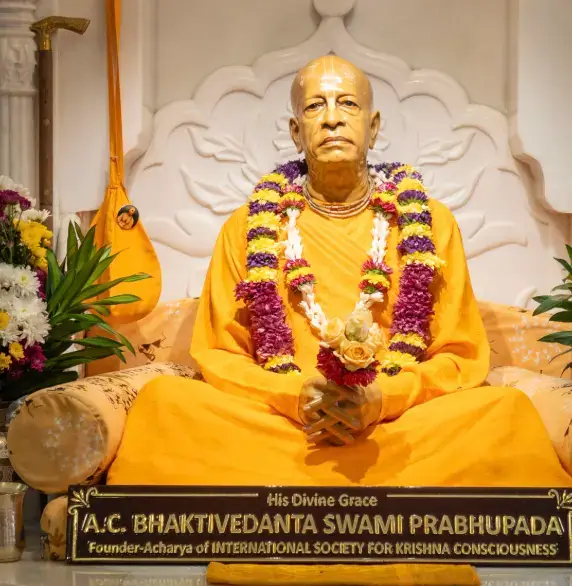
Gratitude to His Divine Grace A.C. Bhaktivedanta Swami Srila Prabhupada
We offer our humble obeisances at the lotus feet of our founder-acharya, His Divine Grace A.C. Bhaktivedanta Swami Srila Prabhupada, without whose causeless mercy the priceless prayers, bhajans and sacred literature of the Gaudiya Vaishnava tradition would have remained inaccessible to most of the world. By his herculean preaching efforts, his unparalleled translations and his founding of the International Society for Krishna Consciousness (ISKCON), the holy names, pastimes and instructions of Sri Sri Radha-Krishna and Sri Chaitanya Mahaprabhu are today chanted in every town and village.
nama om vishnu-padaya krishna-preshthaya bhu-tale
srimate bhaktivedanta-svamin iti namine
namas te sarasvate deve gaura-vani-pracharine
nirvishesha-shunyavadi-pashchatya-desha-tarine
All glories to Srila Prabhupada. All glories to the Vaishnava acharyas in the disciplic succession.