
Bhagavad-gītā
Chapter 15: Puruṣottama-yoga
The Yoga of the Supreme Person
In the fifteenth chapter of the Bhagavad-gītā, Lord Śrī Kṛṣṇa describes the entire cosmic manifestation as an inverted aśvattha (banyan) tree — its roots reaching upward into the spiritual realm and its branches spreading downward into the material world, nourished by the three modes of nature. He instructs Arjuna to cut down this deeply rooted tree of bondage with the sharp weapon of detachment and to take shelter of the Supreme Person, from whom the entire creation has flowed since time immemorial.
The Lord then reveals that every living being is His eternal fragmental part (mamaivāṁśo jīva-loke), struggling under the influence of the mind and senses in material nature. He alone is the brilliance in the sun, the moon and fire; He is the digestive power in every body; and He is seated in everyone's heart as the source of remembrance, knowledge and forgetfulness. Finally, He declares Himself as Puruṣottama — the Supreme Person who is transcendental to both the fallible (kṣara) and the infallible (akṣara). One who knows Him in this way, free from doubt, becomes the knower of everything and engages wholeheartedly in His devotional service.
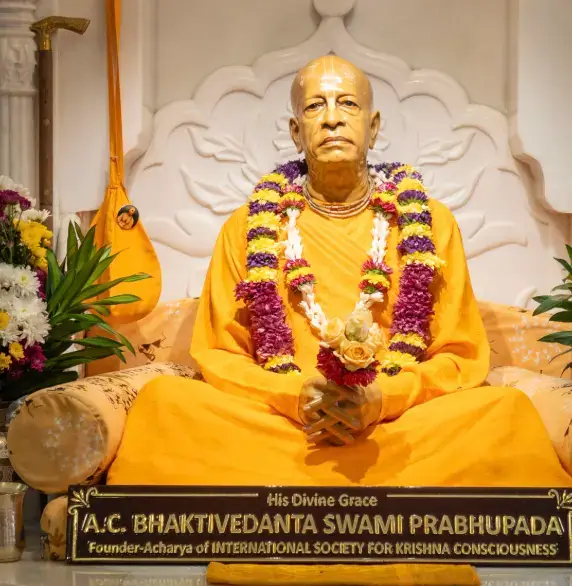
With heartfelt gratitude to His Divine Grace A.C. Bhaktivedanta Swami Śrīla Prabhupāda, the Founder-Ācārya of ISKCON, whose causeless mercy has made Bhagavad-gītā As It Is available to sincere seekers throughout the world.
Read Śrīla Prabhupāda's translation & purport
For the authorised English translation and detailed purport of every verse, please visit the official Bhaktivedanta Book Trust edition on Vedabase.
Sanskrit Verses (Devanāgarī & IAST)
Verse 15.1
ऊर्ध्वमूलमधःशाखमश्वत्थं प्राहुरव्ययम् । छन्दांसि यस्य पर्णानि यस्तं वेद स वेदवित् ॥ १ ॥
ūrdhva-mūlam adhaḥ-śākham aśvatthaṁ prāhur avyayam chandāṁsi yasya parṇāni yas taṁ veda sa veda-vit
śrī-bhagavān uvāca — the Supreme Personality of Godhead said; ūrdhva-mūlam — with roots above; adhaḥ — downwards; śākham — branches; aśvattham — a banyan tree; prāhuḥ — is said; avyayam — eternal; chandāṁsi — the Vedic hymns; yasya — of which; parṇāni — the leaves; yaḥ — anyone who; tam — that; veda — knows; saḥ — he; veda-vit — the knower of the Vedas.
The Supreme Personality of Godhead said: It is said that there is an imperishable banyan tree that has its roots upward and its branches down and whose leaves are the Vedic hymns. One who knows this tree is the knower of the Vedas.
Verse 15.2
अधश्चोर्ध्वं प्रसृतास्तस्य शाखा गुणप्रवृद्धा विषयप्रवालाः । अधश्च मूलान्यनुसन्ततानि कर्मानुबन्धीनि मनुष्यलोके ॥ २ ॥
adhaś cordhvaṁ prasṛtās tasya śākhā guṇa-pravṛddhā viṣaya-pravālāḥ adhaś ca mūlāny anusantatāni karmānubandhīni manuṣya-loke
adhaḥ — downward; ca — and; ūrdhvam — upward; prasṛtāḥ — extended; tasya — its; śākhāḥ — branches; guṇa — by the modes of material nature; pravṛddhāḥ — developed; viṣaya — sense objects; pravālāḥ — twigs; adhaḥ — downward; ca — and; mūlāni — roots; anusantatāni — extended; karma — to work; anubandhīni — bound; manuṣya-loke — in the world of human society.
The branches of this tree extend downward and upward, nourished by the three modes of material nature. The twigs are the objects of the senses. This tree also has roots going down, and these are bound to the fruitive actions of human society.
Verse 15.3, 15.4
न रूपमस्येह तथोपलभ्यते नान्तो न चादिर्न च सम्प्रतिष्ठा । अश्वत्थमेनं सुविरूढमूल- मसङ्गशस्त्रेण दृढेन छित्त्वा ॥ ३ ॥ ततः पदं तत्परिमार्गितव्यं यस्मिन्गता न निवर्तन्ति भूयः । तमेव चाद्यं पुरुषं प्रपद्ये यतः प्रवृत्तिः प्रसृता पुराणी ॥ ४ ॥
na rūpam asyeha tathopalabhyate nānto na cādir na ca sampratiṣṭhā aśvattham enaṁ su-virūḍha-mūlam asaṅga-śastreṇa dṛḍhena chittvā tataḥ padaṁ tat parimārgitavyam yasmin gatā na nivartanti bhūyaḥ tam eva cādyaṁ puruṣaṁ prapadye yataḥ pravṛttiḥ prasṛtā purāṇī
na — not; rūpam — the form; asya — of this tree; iha — in this world; tathā — also; upalabhyate — can be perceived; na — never; antaḥ — end; na — never; ca — also; ādiḥ — beginning; na — never; ca — also; sampratiṣṭhā — the foundation; aśvattham — banyan tree; enam — this; su-virūḍha — strongly; mūlam — rooted; asaṅga-śastreṇa — by the weapon of detachment; dṛḍhena — strong; chittvā — cutting; tataḥ — thereafter; padam — situation; tat — that; parimārgitavyam — has to be searched out; yasmin — where; gatāḥ — going; na — never; nivartanti — they come back; bhūyaḥ — again; tam — to Him; eva — certainly; ca — also; ādyam — original; puruṣam — the Personality of Godhead; prapadye — surrender; yataḥ — from whom; pravṛttiḥ — the beginning; prasṛtā — extended; purāṇi — very old.
The real form of this tree cannot be perceived in this world. No one can understand where it ends, where it begins, or where its foundation is. But with determination one must cut down this strongly rooted tree with the weapon of detachment. Thereafter, one must seek that place from which, having gone, one never returns, and there surrender to that Supreme Personality of Godhead from whom everything began and from whom everything has extended since time immemorial.
Verse 15.5
निर्मानमोहा जितसङ्गदोषा अध्यात्मनित्या विनिवृत्तकामाः । द्वन्द्वैर्विमुक्ताः सुखदुःखसंज्ञै- र्गच्छन्त्यमूढाः पदमव्ययं तत् ॥ ५ ॥
nirmāna-mohā jita-saṅga-doṣā adhyātma-nityā vinivṛtta-kāmāḥ dvandvair vimuktāḥ sukha-duḥkha-saṁjñair gacchanty amūḍhāḥ padam avyayaṁ tat
niḥ — without; māna — false prestige; mohāḥ — and illusion; jita — having conquered; saṅga — of association; doṣāḥ — the faults; adhyātma — in spiritual knowledge; nityāḥ — in eternity; vinivṛtta — disassociated; kāmāḥ — from lust; dvandvaiḥ — from the dualities; vimuktāḥ — liberated; sukha-duḥkha — happiness and distress; saṁjñaiḥ — named; gacchanti — attain; amūḍhāḥ — unbewildered; padam — situation; avyayam — eternal; tat — that.
Those who are free from false prestige, illusion and false association, who understand the eternal, who are done with material lust, who are freed from the dualities of happiness and distress, and who, unbewildered, know how to surrender unto the Supreme Person attain to that eternal kingdom.
Verse 15.6
न तद्भासयते सूर्यो न शशाङ्को न पावकः । यद्गत्वा न निवर्तन्ते तद्धाम परमं मम ॥ ६ ॥
na tad bhāsayate sūryo na śaśāṅko na pāvakaḥ yad gatvā na nivartante tad dhāma paramaṁ mama
na — not; tat — that; bhāsayate — illuminates; sūryaḥ — the sun; na — nor; śaśāṅkaḥ — the moon; na — nor; pāvakaḥ — fire, electricity; yat — where; gatvā — going; na — never; nivartante — they come back; tat dhāma — that abode; paramam — supreme; mama — My.
That supreme abode of Mine is not illumined by the sun or moon, nor by fire or electricity. Those who reach it never return to this material world.
Verse 15.7
ममैवांशो जीवलोके जीवभूतः सनातनः । मनःषष्ठानीन्द्रियाणि प्रकृतिस्थानि कर्षति ॥ ७ ॥
mamaivāṁśo jīva-loke jīva-bhūtaḥ sanātanaḥ manaḥ-ṣaṣṭhānīndriyāṇi prakṛti-sthāni karṣati
mama — My; eva — certainly; aṁśaḥ — fragmental particle; jīva-loke — in the world of conditional life; jīva-bhūtaḥ — the conditioned living entity; sanātanaḥ — eternal; manaḥ — with the mind; ṣaṣṭhāni — the six; indriyāṇi — senses; prakṛti — in material nature; sthāni — situated; karṣati — is struggling hard.
The living entities in this conditioned world are My eternal fragmental parts. Due to conditioned life, they are struggling very hard with the six senses, which include the mind.
Verse 15.8
शरीरं यदवाप्नोति यच्चाप्युत्क्रामतीश्वरः । गृहीत्वैतानि संयाति वायुर्गन्धानिवाशयात् ॥ ८ ॥
śarīraṁ yad avāpnoti yac cāpy utkrāmatīśvaraḥ gṛhītvaitāni saṁyāti vāyur gandhān ivāśayāt
śarīram — the body; yat — as; avāpnoti — gets; yat — as; ca api — also; utkrāmati — gives up; īśvaraḥ — the lord of the body; gṛhītvā — taking; etāni — all these; saṁyāti — goes away; vāyuḥ — the air; gandhān — smells; iva — like; āśayāt — from their source.
The living entity in the material world carries his different conceptions of life from one body to another, as the air carries aromas. Thus he takes one kind of body and again quits it to take another.
Verse 15.9
श्रोत्रं चक्षुः स्पर्शनं च रसनं घ्राणमेव च । अधिष्ठाय मनश्चायं विषयानुपसेवते ॥ ९ ॥
śrotraṁ cakṣuḥ sparśanaṁ ca rasanaṁ ghrāṇam eva ca adhiṣṭhāya manaś cāyaṁ viṣayān upasevate
śrotram — ears; cakṣuḥ — eyes; sparśanam — touch; ca — also; rasanam — tongue; ghrāṇam — smelling power; eva — also; ca — and; adhiṣṭhāya — being situated in; manaḥ — mind; ca — also; ayam — he; viṣayān — sense objects; upasevate — enjoys.
The living entity, thus taking another gross body, obtains a certain type of ear, eye, tongue, nose and sense of touch, which are grouped about the mind. He thus enjoys a particular set of sense objects.
Verse 15.10
उत्क्रामन्तं स्थितं वापि भुञ्जानं वा गुणान्वितम् । विमूढा नानुपश्यन्ति पश्यन्ति ज्ञानचक्षुषः ॥ १० ॥
utkrāmantaṁ sthitaṁ vāpi bhuñjānaṁ vā guṇānvitam vimūḍhā nānupaśyanti paśyanti jñāna-cakṣuṣaḥ
utkrāmantam — quitting the body; sthitam — situated in the body; vā api — either; bhuñjānam — enjoying; vā — or; guṇa-anvitam — under the spell of the modes of material nature; vimūḍhāḥ — foolish persons; na — never; anupaśyanti — can see; paśyanti — can see; jñāna-cakṣuṣaḥ — those who have the eyes of knowledge.
The foolish cannot understand how a living entity can quit his body, nor can they understand what sort of body he enjoys under the spell of the modes of nature. But one whose eyes are trained in knowledge can see all this.
Verse 15.11
यतन्तो योगिनश्चैनं पश्यन्त्यात्मन्यवस्थितम् । यतन्तोऽप्यकृतात्मानो नैनं पश्यन्त्यचेतसः ॥ ११ ॥
yatanto yoginaś cainaṁ paśyanty ātmany avasthitam yatanto 'py akṛtātmāno nainaṁ paśyanty acetasaḥ
yatantaḥ — endeavoring; yoginaḥ — transcendentalists; ca — also; enam — this; paśyanti — can see; ātmani — in the self; avasthitam — situated; yatantaḥ — endeavoring; api — although; akṛta-ātmānaḥ — those without self-realization; na — do not; enam — this; paśyanti — see; acetasaḥ — having undeveloped minds.
The endeavoring transcendentalists who are situated in self-realization can see all this clearly. But those whose minds are not developed and who are not situated in self-realization cannot see what is taking place, though they may try.
Verse 15.12
यदादित्यगतं तेजो जगद्भासयतेऽखिलम् । यच्चन्द्रमसि यच्चाग्नौ तत्तेजो विद्धि मामकम् ॥ १२ ॥
yad āditya-gataṁ tejo jagad bhāsayate 'khilam yac candramasi yac cāgnau tat tejo viddhi māmakam
yat — that which; āditya-gatam — in the sunshine; tejaḥ — splendor; jagat — the whole world; bhāsayate — illuminates; akhilam — entirely; yat — that which; candramasi — in the moon; yat — that which; ca — also; agnau — in fire; tat — that; tejaḥ — splendor; viddhi — understand; māmakam — from Me.
The splendor of the sun, which dissipates the darkness of this whole world, comes from Me. And the splendor of the moon and the splendor of fire are also from Me.
Verse 15.13
गामाविश्य च भूतानि धारयाम्यहमोजसा । पुष्णामि चौषधीः सर्वाः सोमो भूत्वा रसात्मकः ॥ १३ ॥
gām āviśya ca bhūtāni dhārayāmy aham ojasā puṣṇāmi cauṣadhīḥ sarvāḥ somo bhūtvā rasātmakaḥ
gām — the planets; āviśya — entering; ca — also; bhūtāni — the living entities; dhārayāmi — sustain; aham — I; ojasā — by My energy; puṣṇāmi — am nourishing; ca — and; auṣadhīḥ — vegetables; sarvāḥ — all; somaḥ — the moon; bhūtvā — becoming; rasa-ātmakaḥ — supplying the juice.
I enter into each planet, and by My energy they stay in orbit. I become the moon and thereby supply the juice of life to all vegetables.
Verse 15.14
अहं वैश्वानरो भूत्वा प्राणिनां देहमाश्रितः । प्राणापानसमायुक्तः पचाम्यन्नं चतुर्विधम् ॥ १४ ॥
ahaṁ vaiśvānaro bhūtvā prāṇināṁ deham āśritaḥ prāṇāpāna-samāyuktaḥ pacāmy annaṁ catur-vidham
aham — I; vaiśvānaraḥ — My plenary portion as the digesting fire; bhūtvā — becoming; prāṇinām — of all living entities; deham — in the bodies; āśritaḥ — situated; prāṇa — the outgoing air; apāna — the down-going air; samāyuktaḥ — keeping in balance; pacāmi — I digest; annam — foodstuff; catuḥ-vidham — the four kinds.
I am the fire of digestion in the bodies of all living entities, and I join with the air of life, outgoing and incoming, to digest the four kinds of foodstuff.
Verse 15.15
सर्वस्य चाहं हृदि सन्निविष्टो मत्तः स्मृतिर्ज्ञानमपोहनं च । वेदैश्च सर्वैरहमेव वेद्यो वेदान्तकृद्वेदविदेव चाहम् ॥ १५ ॥
sarvasya cāhaṁ hṛdi sanniviṣṭo mattaḥ smṛtir jñānam apohanaṁ ca vedaiś ca sarvair aham eva vedyo vedānta-kṛd veda-vid eva cāham
sarvasya — of all living beings; ca — and; aham — I; hṛdi — in the heart; sanniviṣṭaḥ — situated; mattaḥ — from Me; smṛtiḥ — remembrance; jñānam — knowledge; apohanam — forgetfulness; ca — and; vedaiḥ — by the Vedas; ca — also; sarvaiḥ — all; aham — I am; eva — certainly; vedyaḥ — knowable; vedānta-kṛt — the compiler of the Vedānta; veda-vit — the knower of the Vedas; eva — certainly; ca — and; aham — I.
I am seated in everyone's heart, and from Me come remembrance, knowledge and forgetfulness. By all the Vedas, I am to be known. Indeed, I am the compiler of Vedānta, and I am the knower of the Vedas.
Verse 15.16
द्वाविमौ पुरुषौ लोके क्षरश्चाक्षर एव च । क्षरः सर्वाणि भूतानि कूटस्थोऽक्षर उच्यते ॥ १६ ॥
dvāv imau puruṣau loke kṣaraś cākṣara eva ca kṣaraḥ sarvāṇi bhūtāni kūṭa-stho 'kṣara ucyate
dvau — two; imau — these; puruṣau — living entities; loke — in the world; kṣaraḥ — fallible; ca — and; akṣaraḥ — infallible; eva — certainly; ca — and; kṣaraḥ — fallible; sarvāṇi — all; bhūtāni — living entities; kūṭa-sthaḥ — in oneness; akṣaraḥ — infallible; ucyate — is said.
There are two classes of beings, the fallible and the infallible. In the material world every living entity is fallible, and in the spiritual world every living entity is called infallible.
Verse 15.17
उत्तमः पुरुषस्त्वन्यः परमात्मेत्युदाहृतः । यो लोकत्रयमाविश्य बिभर्त्यव्यय ईश्वरः ॥ १७ ॥
uttamaḥ puruṣas tv anyaḥ paramātmety udāhṛtaḥ yo loka-trayam āviśya bibharty avyaya īśvaraḥ
uttamaḥ — the best; puruṣaḥ — personality; tu — but; anyaḥ — another; parama-ātmā — the Supreme Self; iti — thus; udāhṛtaḥ — is said; yaḥ — who; loka — of the universe; trayam — the three divisions; āviśya — entering; bibharti — is maintaining; avyayaḥ — inexhaustible; īśvaraḥ — the Lord.
Besides these two, there is the greatest living personality, the Supreme Soul, the imperishable Lord Himself, who has entered the three worlds and is maintaining them.
Verse 15.18
यस्मात्क्षरमतीतोऽहमक्षरादपि चोत्तमः । अतोऽस्मि लोके वेदे च प्रथितः पुरुषोत्तमः ॥ १८ ॥
yasmāt kṣaram atīto 'ham akṣarād api cottamaḥ ato 'smi loke vede ca prathitaḥ puruṣottamaḥ
yasmāt — because; kṣaram — to the fallible; atītaḥ — transcendental; aham — I am; akṣarāt — beyond the infallible; api — also; ca — and; uttamaḥ — the best; ataḥ — therefore; asmi — I am; loke — in the world; vede — in the Vedic literature; ca — and; prathitaḥ — celebrated; puruṣa-uttamaḥ — as the Supreme Personality.
Because I am transcendental, beyond both the fallible and the infallible, and because I am the greatest, I am celebrated both in the world and in the Vedas as that Supreme Person.
Verse 15.19
यो मामेवमसम्मूढो जानाति पुरुषोत्तमम् । स सर्वविद्भजति मां सर्वभावेन भारत ॥ १९ ॥
yo mām evam asammūḍho jānāti puruṣottamam sa sarva-vid bhajati māṁ sarva-bhāvena bhārata
yaḥ — anyone who; mām — Me; evam — thus; asammūḍhaḥ — without a doubt; jānāti — knows; puruṣa-uttamam — the Supreme Personality of Godhead; saḥ — he; sarva-vit — the knower of everything; bhajati — renders devotional service; mām — unto Me; sarva-bhāvena — in all respects; bhārata — O son of Bharata.
Whoever knows Me as the Supreme Personality of Godhead, without doubting, is the knower of everything. He therefore engages himself in full devotional service to Me, O son of Bharata.
Verse 15.20
इति गुह्यतमं शास्त्रमिदमुक्तं मयानघ । एतद्बुद्ध्वा बुद्धिमान्स्यात्कृतकृत्यश्च भारत ॥ २० ॥
iti guhya-tamaṁ śāstram idam uktaṁ mayānagha etad buddhvā buddhimān syāt kṛta-kṛtyaś ca bhārata
iti — thus; guhya-tamam — the most confidential; śāstram — revealed scripture; idam — this; uktam — disclosed; mayā — by Me; anagha — O sinless one; etat — this; buddhvā — understanding; buddhi-mān — intelligent; syāt — one becomes; kṛta-kṛtyaḥ — the most perfect in his endeavors; ca — and; bhārata — O son of Bharata.
This is the most confidential part of the Vedic scriptures, O sinless one, and it is disclosed now by Me. Whoever understands this will become wise, and his endeavors will know perfection.
Sanskrit verses presented here are from the timeless original text of Śrīmad Bhagavad-gītā. For the authorised English translation and purport by His Divine Grace A.C. Bhaktivedanta Swami Śrīla Prabhupāda (© Bhaktivedanta Book Trust), please visit vedabase.io/en/library/bg/15.
Spiritual Significance
Scriptural Source & Tradition
Commentary from the Acharyas
When to Sing / Chant
Benefits for the Devotee
Gratitude to His Divine Grace A.C. Bhaktivedanta Swami Srila Prabhupada
We offer our humble obeisances at the lotus feet of our founder-acharya, His Divine Grace A.C. Bhaktivedanta Swami Srila Prabhupada, without whose causeless mercy the priceless prayers, bhajans and sacred literature of the Gaudiya Vaishnava tradition would have remained inaccessible to most of the world. By his herculean preaching efforts, his unparalleled translations and his founding of the International Society for Krishna Consciousness (ISKCON), the holy names, pastimes and instructions of Sri Sri Radha-Krishna and Sri Chaitanya Mahaprabhu are today chanted in every town and village.
nama om vishnu-padaya krishna-preshthaya bhu-tale
srimate bhaktivedanta-svamin iti namine
namas te sarasvate deve gaura-vani-pracharine
nirvishesha-shunyavadi-pashchatya-desha-tarine
All glories to Srila Prabhupada. All glories to the Vaishnava acharyas in the disciplic succession.